QUESTION IMAGE
Question
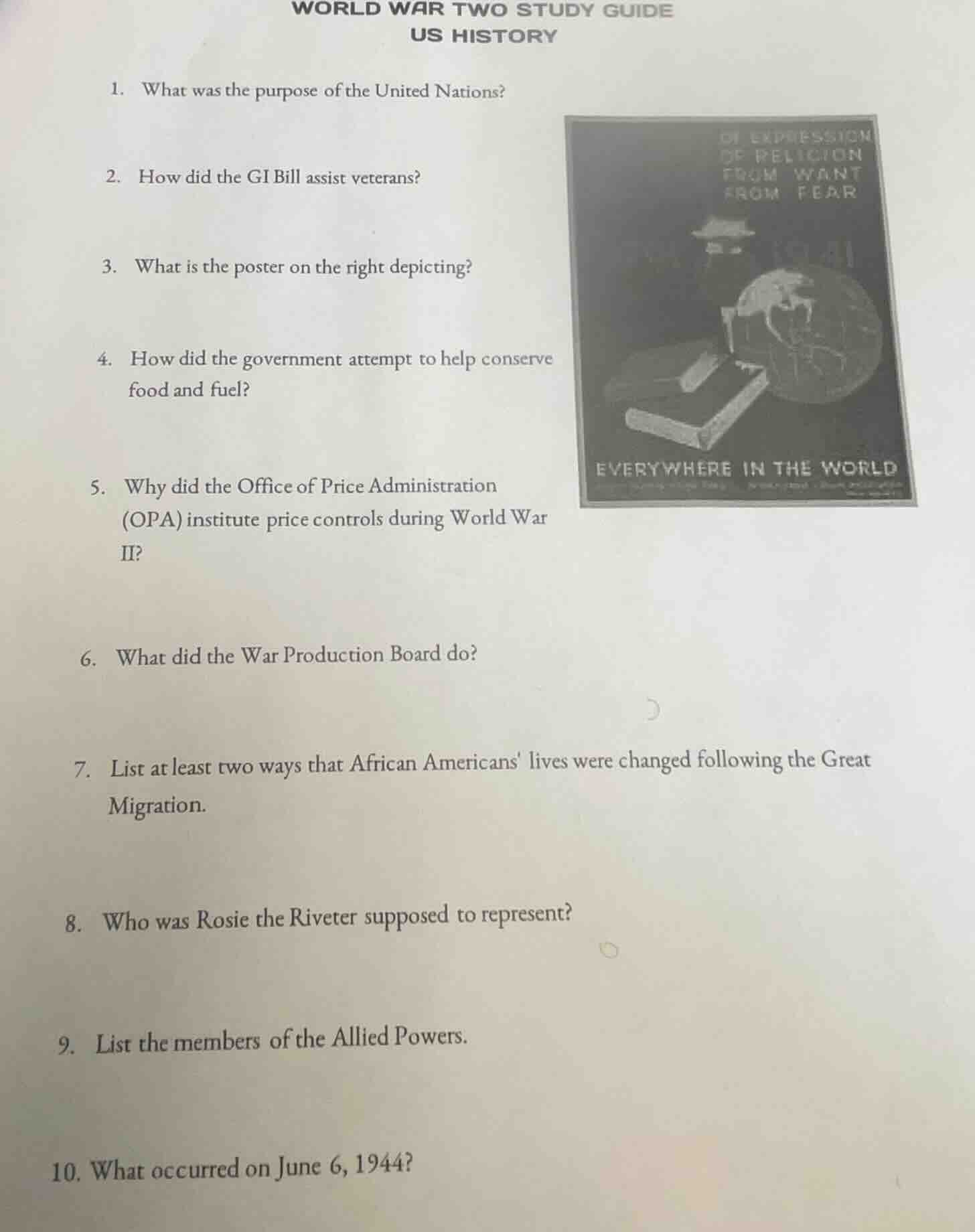
world war two study guideus history1. what was the purpose of the united nations?2. how did the gi bill assist veterans?3. what is the poster on the right depicting?4. how did the government attempt to help conserve food and fuel?5. why did the office of price administration (opa) institute price controls during world war ii?6. what did the war production board do?7. list at least two ways that african americans lives were changed following the great migration.8. who was rosie the riveter supposed to represent?9. list the members of the allied powers.10. what occurred on june 6, 1944?
Brief Explanations
- The UN was founded to foster global cooperation, prevent future wars, and address international issues like human rights, poverty, and conflict.
- The GI Bill provided financial support for education, home loans, and unemployment benefits to WWII veterans.
- The 1941 poster depicts the Atlantic Charter's principles (freedom of expression/religion, freedom from want/fear) as a universal vision for the world.
- The government promoted rationing (via coupons for food/fuel), victory gardens, and fuel-saving measures like carpooling.
- The OPA imposed price controls to prevent inflation, keep essential goods affordable, and avoid shortages during wartime demand.
- The War Production Board converted civilian industry to war production, allocated resources, and set production goals for military goods.
- The Great Migration brought African Americans new industrial jobs in Northern cities and laid groundwork for later civil rights organizing.
- Rosie the Riveter represented women entering the wartime workforce to fill jobs left by deployed men, symbolizing female industrial labor and patriotism.
- The core Allied Powers were the United States, United Kingdom, Soviet Union, and China; other members included France (Free French forces), Canada, and Australia.
- June 6, 1944, was D-Day: the Allied amphibious invasion of Normandy, France, opening a Western front against Nazi Germany.

Snap & solve any problem in the app
Get step-by-step solutions on Sovi AI
Photo-based solutions with guided steps
Explore more problems and detailed explanations
- To prevent future global wars, promote international cooperation, and address global issues like human rights and conflict resolution.
- It provided funding for veterans' college education, low-interest home loans, and unemployment compensation.
- It depicts the universal goals of the Atlantic Charter (freedom of expression, freedom of religion, freedom from want, freedom from fear) as a vision for all the world in 1941.
- It implemented rationing systems (using coupons for limited goods), encouraged victory gardens for home food production, and promoted fuel conservation like carpooling and speed limits.
- To combat wartime inflation, keep essential goods affordable for civilians, and prevent shortages of critical supplies caused by high military demand.
- It converted U.S. civilian manufacturing to war production, allocated raw materials to military projects, and set production targets for weapons, vehicles, and other war goods.
- - Gained access to industrial jobs in Northern[LLM SSE On Failure]