QUESTION IMAGE
Question
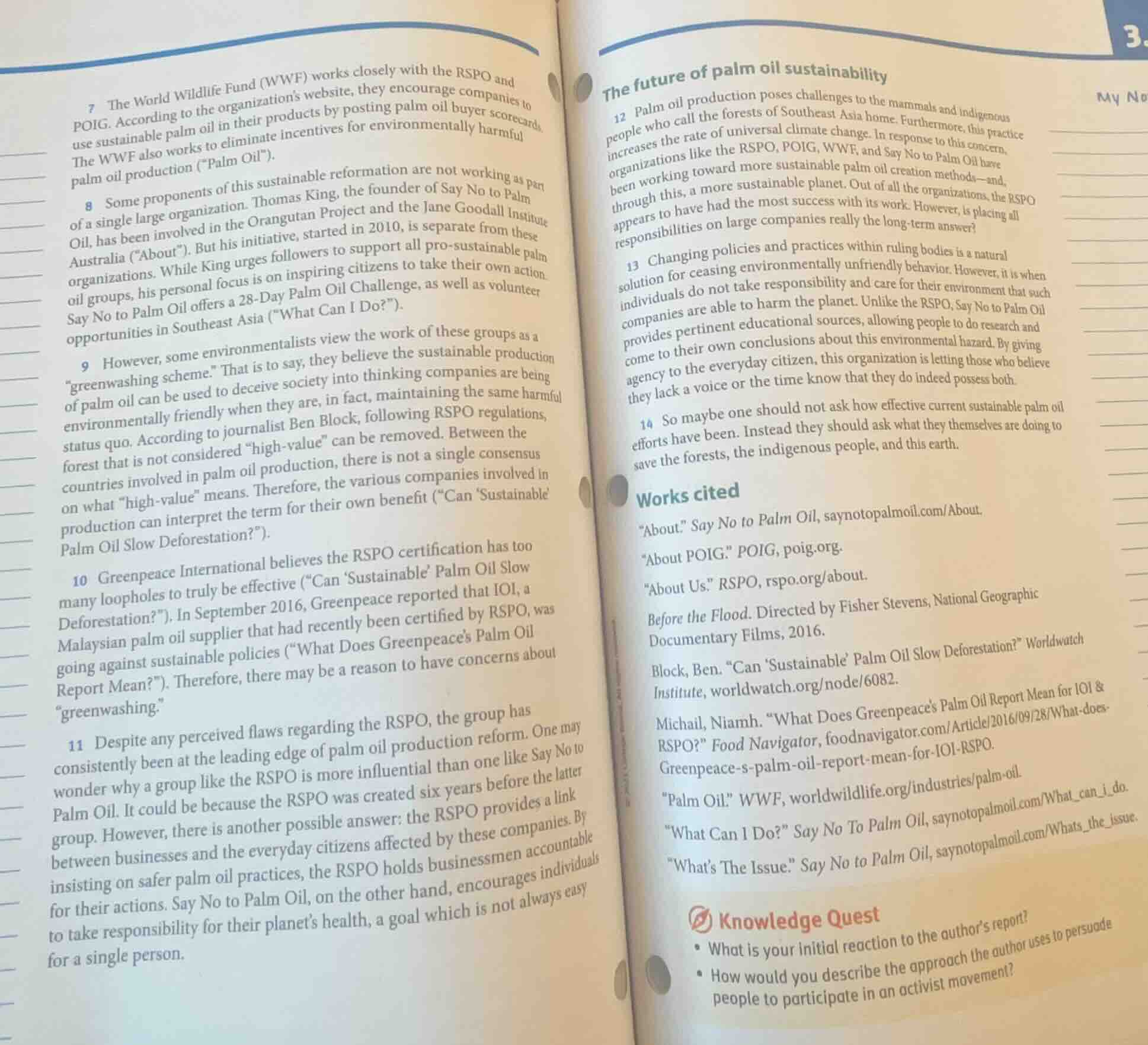
7 the world wildlife fund (wwf) works closely with the rspo and poig. according to the organization’s website, they encourage companies to use sustainable palm oil in their products by posting palm oil buyer scorecards. the wwf also works to eliminate incentives for environmentally harmful palm oil production (“palm oil”).
8 some proponents of this sustainable reformation are not working as part of a single large organization. thomas king, the founder of say no to palm oil, has been involved in the orangutan project and the jane goodall institute australia (“about”). but his initiative, started in 2010, is separate from these organizations. while king urges followers to support all pro - sustainable palm oil groups, his personal focus is on inspiring citizens to take their own action. say no to palm oil offers a 28 - day palm oil challenge, as well as volunteer opportunities in southeast asia (“what can i do?”).
9 however, some environmentalists view the work of these groups as a “greenwashing scheme.” that is to say, they believe the sustainable production of palm oil can be used to deceive society into thinking companies are being environmentally friendly when they are, in fact, maintaining the same harmful status quo. according to journalist ben block, following rspo regulations, forest that is not considered “high - value” can be removed. between the countries involved in palm oil production, there is not a single consensus on what “high - value” means. therefore, the various companies involved in production can interpret the term for their own benefit (“can ‘sustainable’ palm oil slow deforestation?”).
10 greenpeace international believes the rspo certification has too many loopholes to truly be effective (“can ‘sustainable’ palm oil slow deforestation?”). in september 2016, greenpeace reported that ioi, a malaysian palm oil supplier that had recently been certified by rspo, was going against sustainable policies (“what does greenpeace’s palm oil report mean?”). therefore, there may be a reason to have concerns about “greenwashing.”
11 despite any perceived flaws regarding the rspo, the group has consistently been at the leading edge of palm oil production reform. one may wonder why a group like the rspo is more influential than one like say no to palm oil. it could be because the rspo was created six years before the latter group. however, there is another possible answer: the rspo provides a link between businesses and the everyday citizens affected by these companies. by insisting on safer palm oil practices, the rspo holds businessmen accountable for their actions. say no to palm oil, on the other hand, encourages individuals to take responsibility for their planet’s health, a goal which is not always easy for a single person.
the future of palm oil sustainability
12 palm oil production poses challenges to the mammals and indigenous people who call the forests of southeast asia home. furthermore, this practice increases the rate of universal climate change. in response to this concern, organizations like the rspo, poig, wwf, and say no to palm oil have been working toward more sustainable palm oil creation methods—and, through this, a more sustainable planet. out of all the organizations, the rspo appears to have had the most success with its work. however, is placing all responsibilities on large companies really the long - term answer?
13 changing policies and practices within ruling bodies is a natural solution for ceasing environmentally unfriendly behavior. however, it is when individuals do not take responsibility and care for their environment that such companies are able to harm the planet. unlike the rspo, say no to palm oil provides pertinent educational sources, allowing people to do research and come to their own conclusions about this environmental hazard. by giving agency to the everyday citizen, this organization is letting those who believe they lack a voice or the time know that they do indeed possess both.
14 so maybe one should not ask how effective current sustainable palm oil efforts have been. instead they should ask what they themselves are doing to save the forests, the indigenous people, and this earth.
works cited
“about.” say no to palm oil, saynotopalmoil.com/about.
“about poig.” poig, poig.org.
“about us.” rspo, rspo.org/about.
before the flood. directed by fisher stevens, national geographic documentary films, 2016.
block, ben. “can ‘sustainable’ palm oil slow deforestation?” worldwatch institute, worldwatch.org/node/6082.
michail, niamh. “what does greenpeace’s palm oil report mean for ioi & rspo?” food navigator, foodnavigator.com/article/2016/09/28/what - does - greenpeace - s - palm - oil - report - mean - for - ioi - rspo.
“palm oil.” wwf, worldwildlife.org/industries/palm - oil.
“what can i do?” say no to palm oil, saynotopalmoil.com/what_can_i_do.
“what’s the issue.” say no to palm oil, saynotopalmoil.com/whats_the_issue.
knowledge quest
- what is your initial reaction to the author’s report?
- how would you describe the approach the author uses to persuade people to participate in an activist movement?
- For the first question: The report presents a balanced view of sustainable palm oil efforts, highlighting both progress (like RSPO's industry linkages, Say No to Palm Oil's citizen empowerment) and critical flaws (greenwashing concerns, RSPO loopholes). A reasonable initial reaction is recognition that systemic change requires both corporate accountability and individual action, and that current initiatives have room for improvement to avoid greenwashing.
- For the second question: The author uses a balanced, evidence-based persuasive approach. They cite multiple organizations (WWF, RSPO, Say No to Palm Oil, Greenpeace) and their diverse strategies, present critical counterpoints (greenwashing claims), and frame the issue to show that both top-down (corporate/policy) and bottom-up (citizen action) approaches are necessary, encouraging readers to reflect on their own role rather than pushing a single agenda.

Snap & solve any problem in the app
Get step-by-step solutions on Sovi AI
Photo-based solutions with guided steps
Explore more problems and detailed explanations
- My initial reaction is that sustainable palm oil efforts are a mixed bag: there are meaningful attempts to drive change from both industry-focused groups and citizen-led initiatives, but the risk of greenwashing and gaps in accountability mean current solutions are not yet sufficient for long-term, real sustainability.
- The author uses a balanced, reflective, evidence-based approach. They outline multiple organizational strategies, include critical perspectives (like greenwashing concerns), and reframe the conversation from judging existing efforts to encouraging personal action, persuading by presenting a holistic view of the issue rather than advocating for one single solution.