QUESTION IMAGE
Question
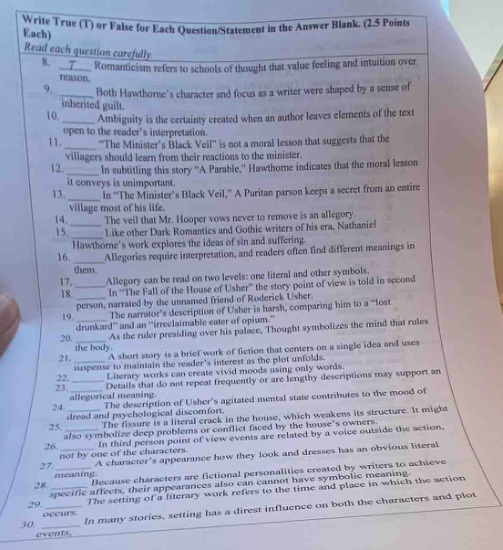
write true (t) or false for each question/statement in the answer blank. (2.5 points each)
read each question carefully.
- romanticism refers to schools of thought that value feeling and intuition over reason.
- both hawthorne’s character and focus as a writer were shaped by a sense of inherited guilt.
- ambiguity is the certainty created when an author leaves elements of the text open to the reader’s interpretation.
- “the minister’s black veil” is not a moral lesson that suggests that the villagers should learn from their reactions to the minister.
- in submitting this story “a parable,” hawthorne indicates that the moral lesson it conveys is unimportant.
- in “the minister’s black veil,” a puritan pastor keeps a secret from the entire village most of his life.
- “the fall of the house of usher” never to return is an allegory.
- the veil that hooper wears and gothic writers of his era, nathaniel hawthorne’s work explores the idea of sin and suffering.
- allegories require interpretation, and readers often find different meanings in them.
- “the fall of the house of usher” the story point of view is told in second person, narrated by a friend of roderick usher.
- in “the fall of the house of usher,” the description of usher’s “wildly importunate nature” and his “excessive and morbid” thoughts symbolize him to a “mad drunkard” and an “irrepressible eater of opium,” symbolizing the mind that rules the body, as the body is pressing over his brain.
- a short story is a brief work of fiction that centers on a single idea and uses suspense to keep the reader’s interest in the plot lengthy.
- literary works can create imagery or lengthy descriptions may support an allegorical meaning or to represent frequently are not faulty words.
- the description of usher’s agitated mental state contributes to the mood of dread and psychological horror in the house, which weakens its structure. it might also symbolize deep internal crack or conflict has related by a voice.
- in a third - person point of view house which by a voice outside the action, not by one of the characters’ appointment how they look and dresses has obvious literal meaning.
- in a direct person point of view house which by a voice outside the action, not by one of the characters’ appointment how they look and dresses has obvious literal meaning.
- characters in literature, their appearances are fictional personalities created by writers to achieve specific effects; their appearances also carry symbolic meaning.
- the setting of a literary work refers to the time and place in which the action occurs.
- in many stories, setting has a direct influence on both the characters and plot events.
(note: some line numbers and minor formatting issues in the original are retained as is for accuracy.)
Response
drives the story's conflict.
- Mr. Hooper's veil is a clear symbolic allegory.
- Hawthorne is a Dark Romantic, not Gothic writer.
- Dark Romantics focus on human sin/darkness.
- Allegories have layered, interpretable meanings.
- Allegories function on literal and symbolic levels.
- The Fall of the House of Usher has a frame narrative.
- The narrator compares Roderick to a lost drunkard.
- The house's collapse mirrors Usher's mental breakdown.
- Short stories focus on a single idea/character.
- Literary works use multiple symbols for themes.
- Relevant, repeated details support allegorical meaning.
- Usher's fear creates the story's dark mood.
- The house's decay mirrors Usher's mental state.
- Third-person limited shows only one character's view.
- Hester's scarlet letter's meaning evolves, not fixed.
- Character appearance reveals personality traits.
- Setting defines a story's time, place, and action space.
- Setting directly impacts plot and character behavior.

Snap & solve any problem in the app
Get step-by-step solutions on Sovi AI
Photo-based solutions with guided steps
Explore more problems and detailed explanations
drives the story's conflict.
- Mr. Hooper's veil is a clear symbolic allegory.
- Hawthorne is a Dark Romantic, not Gothic writer.
- Dark Romantics focus on human sin/darkness.
- Allegories have layered, interpretable meanings.
- Allegories function on literal and symbolic levels.
- The Fall of the House of Usher has a frame narrative.
- The narrator compares Roderick to a lost drunkard.
- The house's collapse mirrors Usher's mental breakdown.
- Short stories focus on a single idea/character.
- Literary works use multiple symbols for themes.
- Relevant, repeated details support allegorical meaning.
- Usher's fear creates the story's dark mood.
- The house's decay mirrors Usher's mental state.
- Third-person limited shows only one character's view.
- Hester's scarlet letter's meaning evolves, not fixed.
- Character appearance reveals personality traits.
- Setting defines a story's time, place, and action space.
- Setting directly impacts plot and character behavior.