QUESTION IMAGE
Question
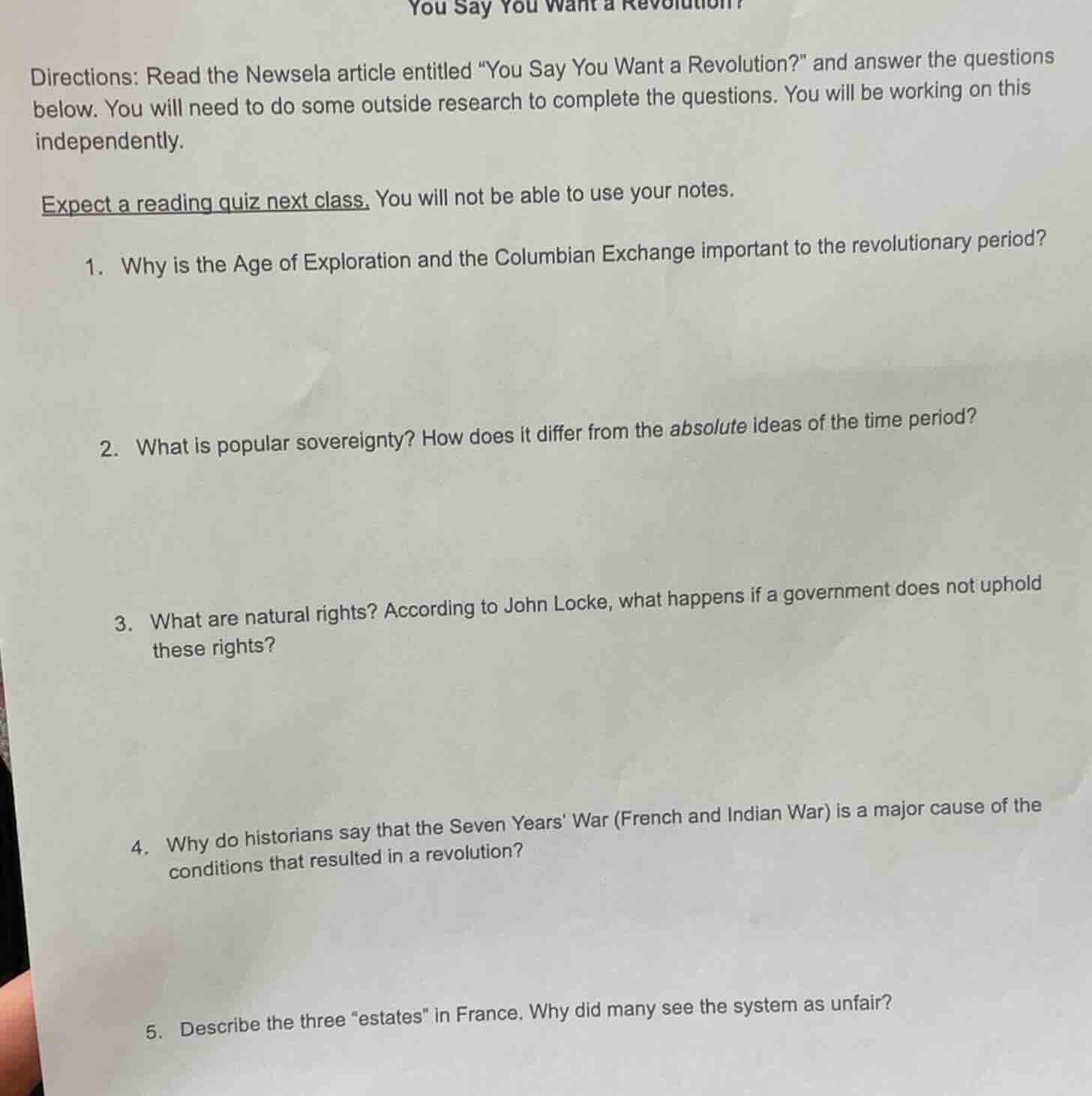
you say you want a revolution?directions: read the newsela article entitled \you say you want a revolution?\ and answer the questions below. you will need to do some outside research to complete the questions. you will be working on this independently.expect a reading quiz next class. you will not be able to use your notes.1. why is the age of exploration and the columbian exchange important to the revolutionary period?2. what is popular sovereignty? how does it differ from the absolute ideas of the time period?3. what are natural rights? according to john locke, what happens if a government does not uphold these rights?4. why do historians say that the seven years war (french and indian war) is a major cause of the conditions that resulted in a revolution?5. describe the three \estates\ in france. why did many see the system as unfair?
- The Age of Exploration and Columbian Exchange created global trade networks that enriched European powers but also sparked economic competition and inequality; the flow of goods, resources, and ideas (like Enlightenment thought spread via global contact) laid the groundwork for revolutionary tensions over wealth distribution and self-governance.
- Popular sovereignty is the principle that a government's authority comes from the consent of the governed. It differs from absolute rule (where power is held by a single ruler with unlimited, divine or inherent authority) by placing ultimate power in the people instead of a monarch or elite.
- Natural rights are inherent, universal rights (like life, liberty, property) that people possess regardless of government. John Locke argued that if a government fails to protect these rights, the people have the right to overthrow it and establish a new government.
- The Seven Years' War left Britain with massive war debt. To pay this debt, Britain imposed heavy taxes and restrictive trade policies on its North American colonies, which fueled colonial anger and resistance, directly contributing to the conditions that led to the American Revolution.
- France's three estates were: 1) The First Estate (clergy, ~1% of population, exempt from most taxes), 2) The Second Estate (nobility, ~2% of population, exempt from most taxes), 3) The Third Estate (commoners, ~97% of population, bearing nearly all tax burden). The system was seen as unfair because the small, wealthy upper estates had political power and tax immunity, while the vast majority of the population faced poverty, high taxes, and no meaningful political representation.

Snap & solve any problem in the app
Get step-by-step solutions on Sovi AI
Photo-based solutions with guided steps
Explore more problems and detailed explanations
- They established global trade and ideological flows that created economic inequalities and spread ideas that fueled revolutionary sentiment.
- Popular sovereignty is rule by the people's consent; it differs from absolute rule by placing power in the people, not a single ruler with unlimited authority.
- Natural rights are inherent, universal rights (life, liberty, property). Locke stated people may overthrow a government that fails to protect them.
- The war left Britain in debt, leading to punitive taxes and policies on colonies that sparked revolutionary resistance.
- First Estate: Clergy; Second Estate: Nobility; Third Estate: All commoners. It was unfair because the tiny upper estates had tax immunity and political power, while the vast Third Estate carried the tax burden and had no representation.