QUESTION IMAGE
Question
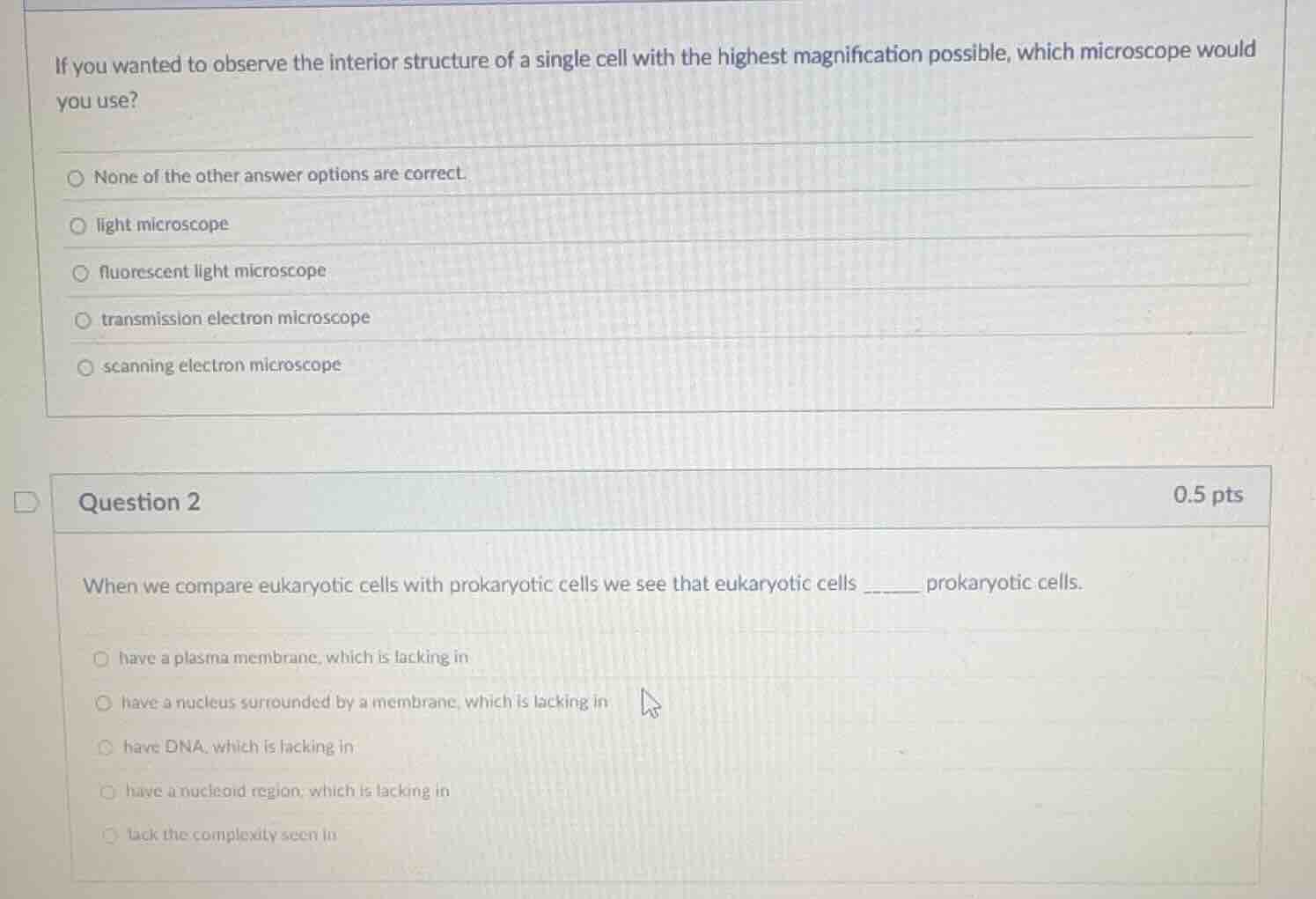
if you wanted to observe the interior structure of a single cell with the highest magnification possible, which microscope would you use?
none of the other answer options are correct.
light microscope
fluorescent light microscope
transmission electron microscope
scanning electron microscope
question 2
0.5 pts
when we compare eukaryotic cells with prokaryotic cells we see that eukaryotic cells ______ prokaryotic cells.
have a plasma membrane, which is lacking in
have a nucleus surrounded by a membrane, which is lacking in
have dna, which is lacking in
have a nucleoid region, which is lacking in
lack the complexity seen in
Question 1
To observe the interior structure of a single cell with the highest magnification, we analyze each microscope: Light microscopes (including fluorescent) have lower magnification. Scanning electron microscopes (SEM) are for surface structures. Transmission electron microscopes (TEM) use electrons to view internal cell structures at very high magnifications, suitable for seeing interior details.
Eukaryotic and prokaryotic cells: Both have plasma membranes and DNA. Prokaryotes have a nucleoid (no membrane - bound nucleus), eukaryotes have a membrane - bound nucleus. So eukaryotic cells have a nucleus surrounded by a membrane (nuclear envelope), which prokaryotes lack.

Snap & solve any problem in the app
Get step-by-step solutions on Sovi AI
Photo-based solutions with guided steps
Explore more problems and detailed explanations
D. transmission electron microscope