QUESTION IMAGE
Question
(02.06 mc)
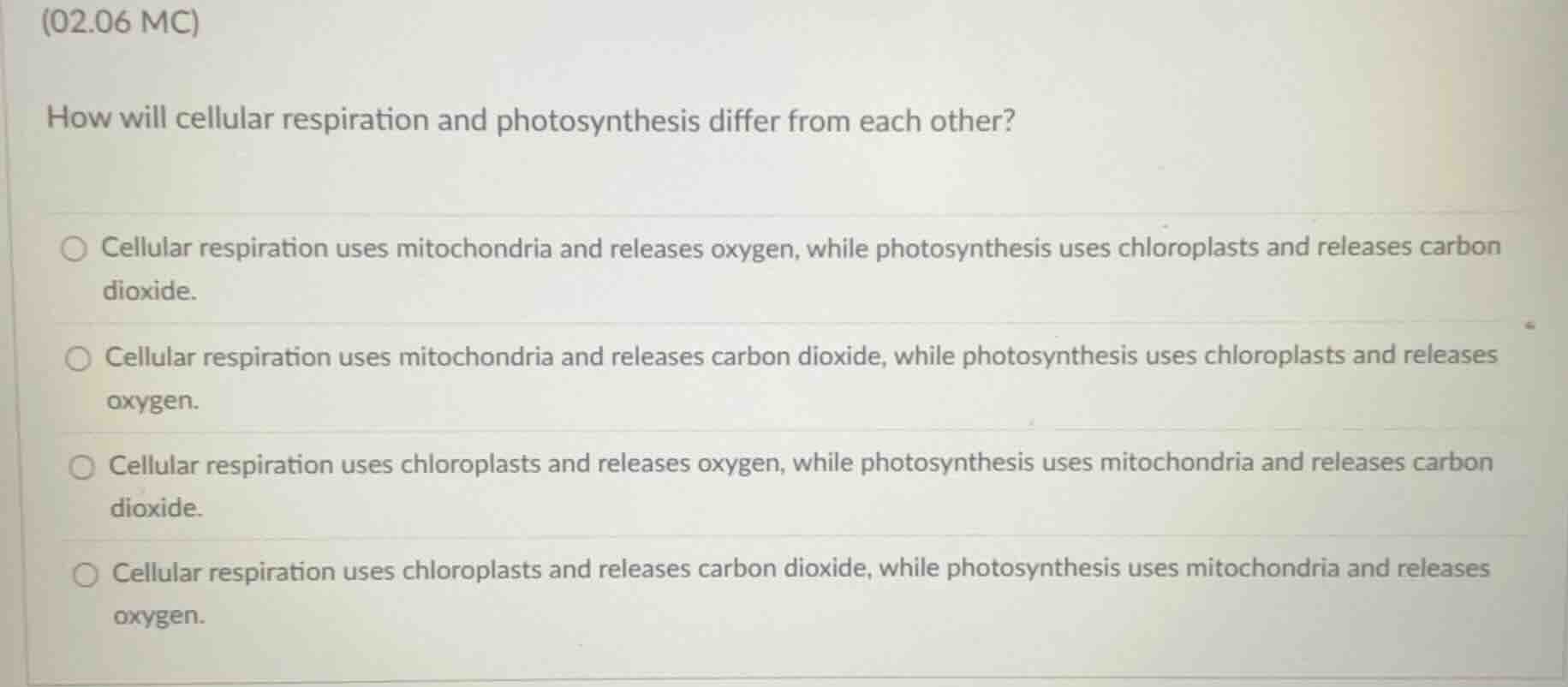
how will cellular respiration and photosynthesis differ from each other?
○ cellular respiration uses mitochondria and releases oxygen, while photosynthesis uses chloroplasts and releases carbon dioxide.
○ cellular respiration uses mitochondria and releases carbon dioxide, while photosynthesis uses chloroplasts and releases oxygen.
○ cellular respiration uses chloroplasts and releases oxygen, while photosynthesis uses mitochondria and releases carbon dioxide.
○ cellular respiration uses chloroplasts and releases carbon dioxide, while photosynthesis uses mitochondria and releases oxygen.
To solve this, we recall the key differences between cellular respiration and photosynthesis:
- Cellular Respiration: Occurs in mitochondria. The process breaks down glucose, using oxygen and producing carbon dioxide, water, and ATP (energy). So it releases carbon dioxide.
- Photosynthesis: Occurs in chloroplasts (in plants/algae). It uses carbon dioxide and water, with light energy, to produce glucose and oxygen. So it releases oxygen.
Now let's analyze each option:
- First option: Wrong. Cellular respiration releases CO₂ (not O₂), photosynthesis releases O₂ (not CO₂).
- Second option: Correct. Matches the above descriptions (mitochondria for respiration, releases CO₂; chloroplasts for photosynthesis, releases O₂).
- Third option: Wrong. Cellular respiration uses mitochondria (not chloroplasts), photosynthesis uses chloroplasts (not mitochondria). Also, their gas releases are reversed.
- Fourth option: Wrong. Cellular respiration uses mitochondria (not chloroplasts), photosynthesis uses chloroplasts (not mitochondria).

Snap & solve any problem in the app
Get step-by-step solutions on Sovi AI
Photo-based solutions with guided steps
Explore more problems and detailed explanations
B. Cellular respiration uses mitochondria and releases carbon dioxide, while photosynthesis uses chloroplasts and releases oxygen.