QUESTION IMAGE
Question
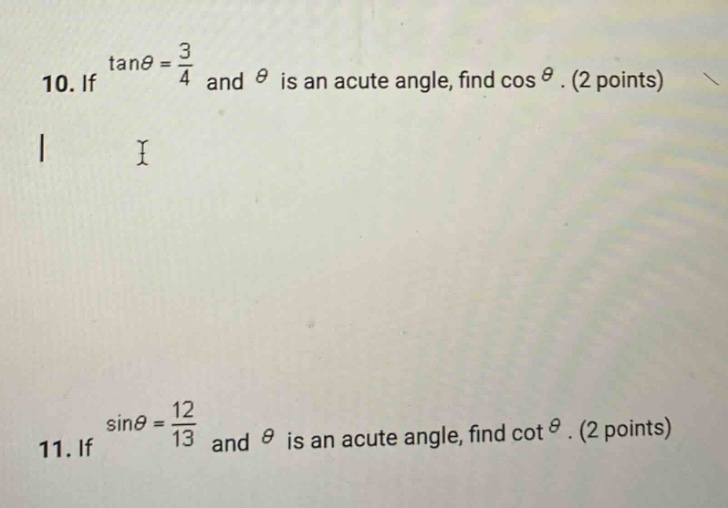
- if \\(\tan\theta = \frac{3}{4}\\) and \\(\theta\\) is an acute angle, find \\(\cos\theta\\). (2 points)
- if \\(\sin\theta = \frac{12}{13}\\) and \\(\theta\\) is an acute angle, find \\(\cot\theta\\). (2 points)
Question 10:
Step1: Recall the definition of tangent
We know that \(\tan\theta=\frac{\text{opposite}}{\text{adjacent}}=\frac{3}{4}\) for a right triangle with acute angle \(\theta\). Let the opposite side be \(3k\) and the adjacent side be \(4k\) (\(k>0\)).
Step2: Find the hypotenuse
Using the Pythagorean theorem \(c^2 = a^2 + b^2\), where \(c\) is the hypotenuse, \(a = 3k\), and \(b = 4k\). So, \(c=\sqrt{(3k)^2+(4k)^2}=\sqrt{9k^2 + 16k^2}=\sqrt{25k^2}=5k\).
Step3: Find \(\cos\theta\)
We know that \(\cos\theta=\frac{\text{adjacent}}{\text{hypotenuse}}\). Substituting the values, we get \(\cos\theta=\frac{4k}{5k}=\frac{4}{5}\) (since \(k
eq0\), we can cancel \(k\)).
Step1: Recall the definition of sine and Pythagorean identity
We know that \(\sin\theta=\frac{\text{opposite}}{\text{hypotenuse}}=\frac{12}{13}\). Let the opposite side be \(12k\) and the hypotenuse be \(13k\) (\(k > 0\)). Using the Pythagorean theorem \(a^2+b^2=c^2\), where \(c = 13k\) and \(a=12k\), we can find the adjacent side \(b\). So, \(b=\sqrt{(13k)^2-(12k)^2}=\sqrt{169k^2 - 144k^2}=\sqrt{25k^2}=5k\).
Step2: Recall the definition of cotangent
We know that \(\cot\theta=\frac{\text{adjacent}}{\text{opposite}}\). Substituting the values of adjacent (\(5k\)) and opposite (\(12k\)), we get \(\cot\theta=\frac{5k}{12k}=\frac{5}{12}\) (since \(k
eq0\), we can cancel \(k\)).

Snap & solve any problem in the app
Get step-by-step solutions on Sovi AI
Photo-based solutions with guided steps
Explore more problems and detailed explanations
\(\frac{4}{5}\)