QUESTION IMAGE
Question
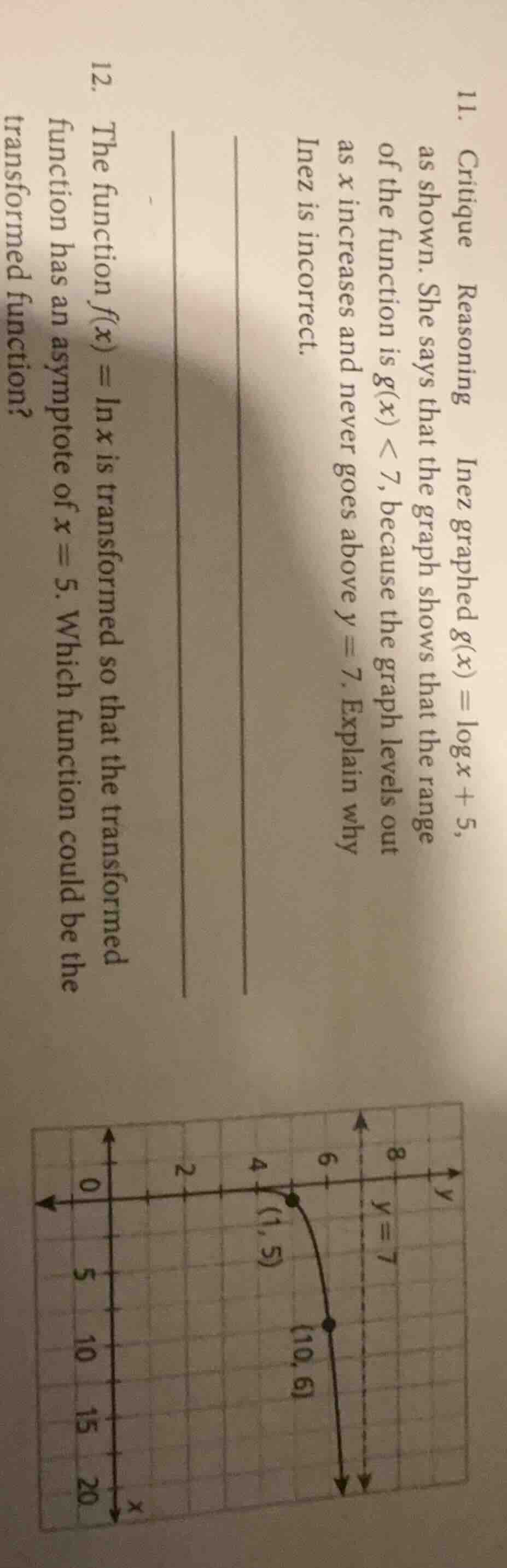
- critique reasoning inez graphed ( g(x)=log x + 5 ), as shown. she says that the graph shows that the range of the function is ( g(x) < 7 ), because the graph levels out as ( x ) increases and never goes above ( y = 7 ). explain why inez is incorrect.
- the function ( f(x)=ln x ) is transformed so that the transformed function has an asymptote of ( x = 5 ). which function could be the transformed function?
Question 11
Step1: Recall the range of logarithmic functions
The parent function \( y = \log x \) (assuming base 10 or natural log, the range is all real numbers, i.e., \( (-\infty, \infty) \). When we have \( g(x)=\log x + 5 \), the vertical shift up by 5 units does not change the fact that the range of a logarithmic function is still all real numbers.
Step2: Analyze Inez's claim
Inez says the range is \( g(x)<7 \), but as \( x \) approaches \( \infty \), \( \log x \) approaches \( \infty \) (for base \( > 1 \)), so \( g(x)=\log x + 5 \) will also approach \( \infty \). Even though the graph seems to "level out" near \( y = 7 \) in the visible part, the logarithmic function will continue to increase (slowly) without bound as \( x \) increases. So the range of \( g(x) \) is actually \( (-\infty, \infty) \), not restricted to \( g(x)<7 \).
Step1: Recall asymptotes of \( \ln x \)
The parent function \( f(x)=\ln x \) has a vertical asymptote at \( x = 0 \) (since \( \ln x \) is defined for \( x>0 \) and \( \lim_{x
ightarrow 0^+} \ln x=-\infty \)).
Step2: Determine transformation for asymptote \( x = 5 \)
To shift the vertical asymptote from \( x = 0 \) to \( x = 5 \), we need a horizontal shift of the function. A horizontal shift of \( h \) units (right if \( h>0 \)) for a function \( f(x) \) is given by \( f(x - h) \). So if we shift \( \ln x \) 5 units to the right, the function becomes \( \ln(x - 5) \). We can also have vertical shifts or stretches/compressions, but the key transformation for the vertical asymptote is the horizontal shift. For example, the function could be \( y=\ln(x - 5)+k \) where \( k \) is any real number (vertical shift), or with other transformations, but the essential part is the horizontal shift to get the asymptote at \( x = 5 \).

Snap & solve any problem in the app
Get step-by-step solutions on Sovi AI
Photo-based solutions with guided steps
Explore more problems and detailed explanations
Inez is incorrect because the function \( g(x)=\log x + 5 \) (for base \( > 1 \)) has a range of all real numbers. As \( x \) increases, \( \log x \) increases without bound (albeit slowly), so \( g(x)=\log x + 5 \) also increases without bound. The graph only appears to level out near \( y = 7 \) in the visible domain, but mathematically, the range is \( (-\infty, \infty) \), not \( g(x)<7 \).