QUESTION IMAGE
Question
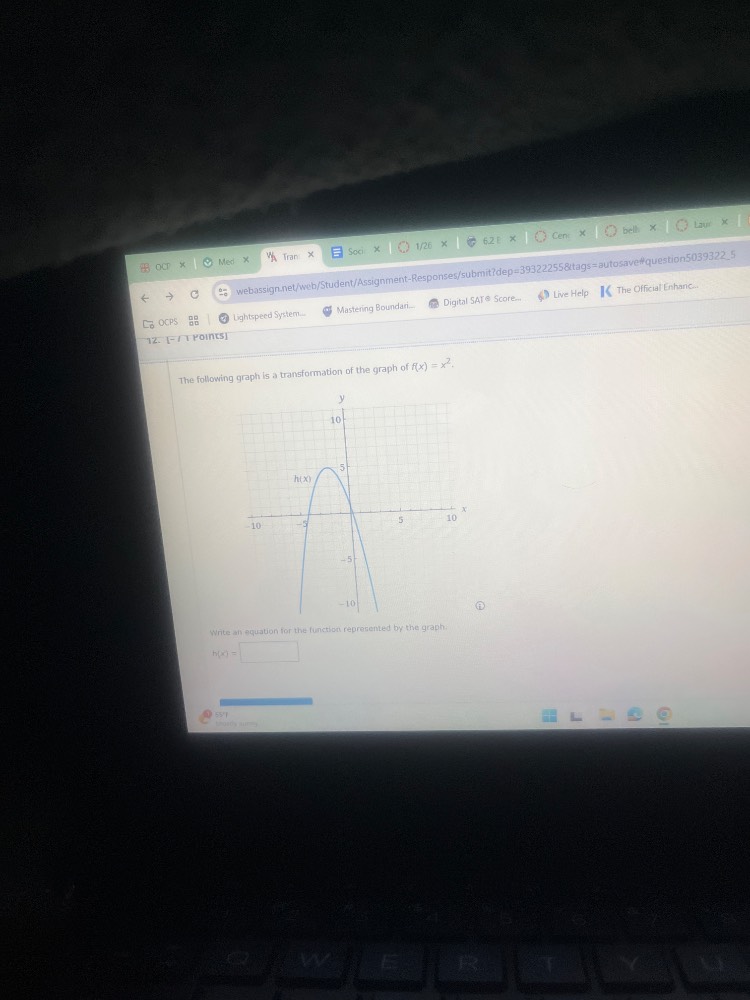
- -/1 points the following graph is a transformation of the graph of ( f(x) = x^2 ). write an equation for the function represented by the graph. ( h(x) = square )
Step1: Identify the vertex form of a parabola
The vertex form of a parabola is \( h(x) = a(x - h)^2 + k \), where \((h, k)\) is the vertex. From the graph, the vertex seems to be at \((-1, 6)\)? Wait, no, looking again, the graph is a downward - opening parabola. Wait, the original function is \( f(x)=x^{2} \), which is upward - opening. The transformed graph is downward - opening, so \( a\) will be negative. Let's find the vertex. From the graph, the vertex is at \((-1, 6)\)? Wait, no, maybe I misread. Wait, the graph crosses the y - axis at (0, 4)? Wait, no, let's check the grid. The graph has a vertex, let's see the x - coordinate of the vertex. The graph is symmetric about \( x=-1\) (since it's a parabola). Let's assume the vertex is \((h, k)=(-1, 6)\)? Wait, no, maybe the vertex is at \((-1, 6)\)? Wait, no, let's think again. The general form of a transformed quadratic function (from \( f(x)=x^{2} \)) is \( h(x)=a(x - h)^2 + k \), where \((h, k)\) is the vertex. Also, if the parabola opens downward, \( a<0 \).
Wait, maybe the vertex is at \((-1, 6)\)? No, let's check the y - intercept. When \( x = 0 \), let's see the value of \( h(x) \). From the graph, when \( x = 0 \), \( h(0)=4 \)? Wait, no, maybe the vertex is at \((-1, 5)\)? Wait, the graph is a downward - opening parabola. Let's suppose the vertex is \((h, k)=(-1, 5)\). Then the equation is \( h(x)=a(x + 1)^2+5 \). Now, we need to find \( a \). Let's use a point on the graph. Let's take the x - intercept? Wait, the graph crosses the x - axis? Wait, no, the graph seems to cross the x - axis? Wait, the original function is \( f(x)=x^{2} \), the transformed function is a downward - opening parabola. Let's assume that when \( x = 0 \), \( h(0)=4 \)? Wait, no, maybe the vertex is at \((-1, 5)\) and when \( x = 0 \), \( h(0)=4 \). Let's plug \( x = 0 \), \( h(0)=a(0 + 1)^2+5=a + 5 \). If \( h(0)=4 \), then \( a+5 = 4\), so \( a=-1 \). Wait, but maybe the vertex is at \((-1, 6)\)? No, let's re - examine. Wait, the graph is a transformation of \( f(x)=x^{2} \), which is a parabola. The transformed graph is a downward - opening parabola, so \( a<0 \). Let's find two points. Let's say the vertex is at \((-1, 5)\). Then the equation is \( h(x)=a(x + 1)^2+5 \). Now, let's use the y - intercept. When \( x = 0 \), \( h(0)=a(0 + 1)^2+5=a + 5 \). From the graph, when \( x = 0 \), \( h(0)=4 \)? Wait, no, maybe the y - intercept is 4? Wait, the graph is drawn on a grid. Let's count the units. The vertex is at \( x=-1 \), \( y = 5 \) (since it's 5 units up from the x - axis). Then, when \( x = 0 \), the value of \( h(x) \) is 4? No, maybe the vertex is at \( (-1, 5) \) and the parabola passes through \( (0, 4) \). Then:
Substitute \( x = 0 \), \( h(0)=4 \) into \( h(x)=a(x + 1)^2+5 \):
\( 4=a(0 + 1)^2+5 \)
\( 4=a + 5 \)
Subtract 5 from both sides: \( a=4 - 5=-1 \)
So the equation is \( h(x)=-1(x + 1)^2+5 \)
Expand this: \( h(x)=-(x^{2}+2x + 1)+5=-x^{2}-2x - 1 + 5=-x^{2}-2x + 4 \)
Wait, let's check another point. Let's take \( x=-2 \). Then \( h(-2)=-(-2)^{2}-2(-2)+4=-4 + 4 + 4 = 4 \). Wait, but from the graph, at \( x=-2 \), what's the value? The vertex is at \( x=-1 \), so at \( x=-2 \), it should be symmetric to \( x = 0 \). Wait, maybe my vertex is wrong. Wait, maybe the vertex is at \( (-1, 5) \) and the parabola passes through \( (0, 4) \), so \( a=-1 \). So the equation is \( h(x)=- (x + 1)^2+5=-x^{2}-2x - 1 + 5=-x^{2}-2x + 4 \). Wait, but let's check the y - intercept again. If \( x = 0 \), \( h(0)=-0 - 0 + 4 = 4 \), which matches.
Alternatively, maybe the vertex is at \((…

Snap & solve any problem in the app
Get step-by-step solutions on Sovi AI
Photo-based solutions with guided steps
Explore more problems and detailed explanations
\( h(x)=- (x + 1)^2+5 \) (or \( h(x)=-x^{2}-2x + 4 \))