QUESTION IMAGE
Question
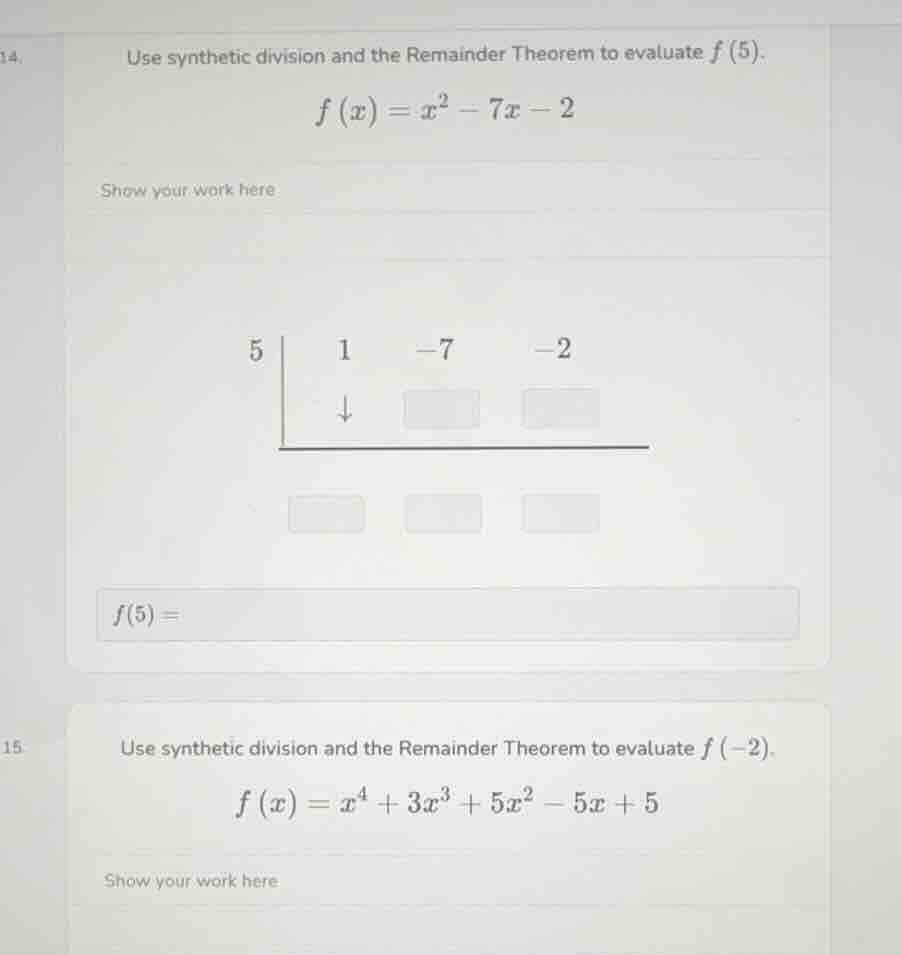
- use synthetic division and the remainder theorem to evaluate $f(5)$.
$f(x)=x^2 - 7x - 2$
show your work here
5 | 1 -7 -2
↓
$f(5)=$
- use synthetic division and the remainder theorem to evaluate $f(-2)$.
$f(x)=x^4 + 3x^3 + 5x^2 - 5x + 5$
show your work here
Problem 14: Evaluate \( f(5) \) for \( f(x) = x^2 - 7x - 2 \) using Synthetic Division and Remainder Theorem
Step 1: Set up Synthetic Division
For \( f(x) = x^2 - 7x - 2 \), the coefficients are \( 1 \) (for \( x^2 \)), \( -7 \) (for \( x \)), and \( -2 \) (constant term). We use \( x = 5 \) for synthetic division.
The setup is:
\[
\]
Step 2: Bring down the leading coefficient
Bring down the \( 1 \) (the coefficient of \( x^2 \)):
\[
\]
Step 3: Multiply and add
Multiply the number we just brought down (\( 1 \)) by \( 5 \): \( 1 \times 5 = 5 \). Add this to the next coefficient (\( -7 \)): \( -7 + 5 = -2 \).
\[
\]
Step 4: Multiply and add again
Multiply the new number (\( -2 \)) by \( 5 \): \( -2 \times 5 = -10 \). Add this to the last coefficient (\( -2 \)): \( -2 + (-10) = -12 \).
\[
\]
By the Remainder Theorem, the remainder when \( f(x) \) is divided by \( x - 5 \) is \( f(5) \). The remainder from synthetic division is \( -12 \), so \( f(5) = -12 \).
Step 1: Set up Synthetic Division
For \( f(x) = x^4 + 3x^3 + 5x^2 - 5x + 5 \), the coefficients are \( 1 \) (for \( x^4 \)), \( 3 \) (for \( x^3 \)), \( 5 \) (for \( x^2 \)), \( -5 \) (for \( x \)), and \( 5 \) (constant term). We use \( x = -2 \) for synthetic division.
The setup is:
\[
\]
Step 2: Bring down the leading coefficient
Bring down the \( 1 \) (the coefficient of \( x^4 \)):
\[
\]
Step 3: Multiply and add (first time)
Multiply the number we just brought down (\( 1 \)) by \( -2 \): \( 1 \times (-2) = -2 \). Add this to the next coefficient (\( 3 \)): \( 3 + (-2) = 1 \).
\[
\]
Step 4: Multiply and add (second time)
Multiply the new number (\( 1 \)) by \( -2 \): \( 1 \times (-2) = -2 \). Add this to the next coefficient (\( 5 \)): \( 5 + (-2) = 3 \).
\[
\]
Step 5: Multiply and add (third time)
Multiply the new number (\( 3 \)) by \( -2 \): \( 3 \times (-2) = -6 \). Add this to the next coefficient (\( -5 \)): \( -5 + (-6) = -11 \).
\[
\]
Step 6: Multiply and add (fourth time)
Multiply the new number (\( -11 \)) by \( -2 \): \( -11 \times (-2) = 22 \). Add this to the last coefficient (\( 5 \)): \( 5 + 22 = 27 \).
\[
\]
By the Remainder Theorem, the remainder when \( f(x) \) is divided by \( x + 2 \) (since \( x - (-2) = x + 2 \)) is \( f(-2) \). The remainder from synthetic division is \( 27 \), so \( f(-2) = 27 \).

Snap & solve any problem in the app
Get step-by-step solutions on Sovi AI
Photo-based solutions with guided steps
Explore more problems and detailed explanations
For the synthetic division table:
- The first empty box (under -7) is \( 5 \)
- The second empty box (under -2) is \( -10 \)
- The bottom row boxes are \( 1 \), \( -2 \), \( -12 \)
\( f(5) = \boldsymbol{-12} \)