QUESTION IMAGE
Question
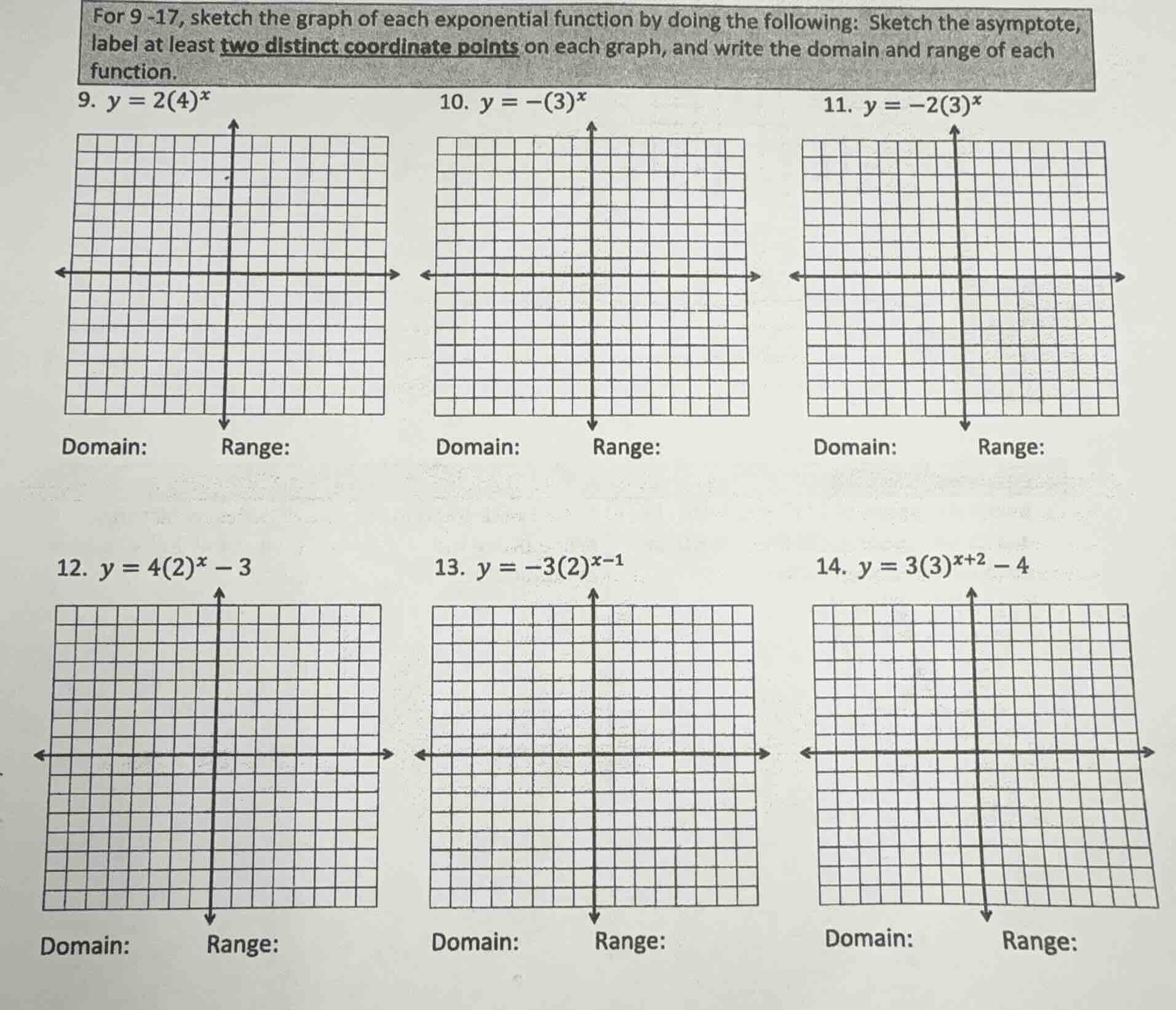
for 9 -17, sketch the graph of each exponential function by doing the following: sketch the asymptote, label at least two distinct coordinate points on each graph, and write the domain and range of each function. 9. $y = 2(4)^x$ domain: range: 10. $y = -(3)^x$ domain: range: 11. $y = -2(3)^x$ domain: range: 12. $y = 4(2)^x - 3$ domain: range: 13. $y = -3(2)^{x - 1}$ domain: range: 14. $y = 3(3)^{x + 2} - 4$ domain: range:
Problem 9: \( y = 2(4)^x \)
Step 1: Find the Asymptote
For exponential functions of the form \( y = ab^x + k \), the horizontal asymptote is \( y = k \). Here, \( k = 0 \), so the asymptote is \( y = 0 \) (the x - axis).
Step 2: Find Coordinate Points
- When \( x = 0 \):
\( y=2(4)^0 = 2\times1 = 2 \), so the point is \( (0, 2) \).
- When \( x = 1 \):
\( y = 2(4)^1=2\times4 = 8 \), so the point is \( (1, 8) \).
Step 3: Determine Domain and Range
- Domain: For any exponential function \( y = ab^x \), the domain is all real numbers, so Domain: \( (-\infty, \infty) \)
- Range: Since \( 4^x>0 \) for all real \( x \), and we multiply by 2 (a positive number), \( 2(4)^x>0 \). So the range is \( (0, \infty) \)
Problem 10: \( y=-(3)^x \)
Step 1: Find the Asymptote
The function is of the form \( y = ab^x + k \) with \( k = 0 \). So the horizontal asymptote is \( y = 0 \) (the x - axis).
Step 2: Find Coordinate Points
- When \( x = 0 \):
\( y=-(3)^0=- 1\times1=-1 \), so the point is \( (0, - 1) \).
- When \( x = 1 \):
\( y=-(3)^1=-3 \), so the point is \( (1, - 3) \).
Step 3: Determine Domain and Range
- Domain: All real numbers, so Domain: \( (-\infty, \infty) \)
- Range: Since \( 3^x>0 \) for all real \( x \), then \( - 3^x<0 \). So the range is \( (-\infty, 0) \)
Problem 11: \( y=-2(3)^x \)
Step 1: Find the Asymptote
The function is of the form \( y = ab^x + k \) with \( k = 0 \). So the horizontal asymptote is \( y = 0 \) (the x - axis).
Step 2: Find Coordinate Points
- When \( x = 0 \):
\( y=-2(3)^0=-2\times1=-2 \), so the point is \( (0, - 2) \).
- When \( x = 1 \):
\( y=-2(3)^1=-2\times3=-6 \), so the point is \( (1, - 6) \).
Step 3: Determine Domain and Range
- Domain: All real numbers, so Domain: \( (-\infty, \infty) \)
- Range: Since \( 3^x>0 \) for all real \( x \), and we multiply by - 2 (a negative number), \( - 2(3)^x<0 \). So the range is \( (-\infty, 0) \)
Problem 12: \( y = 4(2)^x-3 \)

Snap & solve any problem in the app
Get step-by-step solutions on Sovi AI
Photo-based solutions with guided steps
Explore more problems and detailed explanations
s:
Problem 9:
- Asymptote: \( y = 0 \)
- Points: \( (0, 2) \), \( (1, 8) \)
- Domain: \( (-\infty, \infty) \)
- Range: \( (0, \infty) \)
Problem 10:
- Asymptote: \( y = 0 \)
- Points: \( (0, - 1) \), \( (1, - 3) \)
- Domain: \( (-\infty, \infty) \)
- Range: \( (-\infty, 0) \)
Problem 11:
- Asymptote: \( y = 0 \)
- Points: \( (0, - 2) \), \( (1, - 6) \)
- Domain: \( (-\infty, \infty) \)
- Range: \( (-\infty, 0) \)
Problem 12:
- Asymptote: \( y=-3 \)
- Points: \( (0, 1) \), \( (1, 5) \)
- Domain: \( (-\infty, \infty) \)
- Range: \( (-3, \infty) \)
Problem 13:
- Asymptote: \( y = 0 \)
- Points: \( (1, - 3) \), \( (2, - 6) \)
- Domain: \( (-\infty, \infty) \)
- Range: \( (-\infty, 0) \)
Problem 14:
- Asymptote: \( y=-4 \)
- Points: \( (-2, - 1) \), \( (-1, 5) \)
- Domain: \( (-\infty, \infty) \)
- Range: \( (-4, \infty) \)
(Note: For sketching the graphs, plot the asymptote as a dashed line, then plot the coordinate points and draw the curve of the exponential function passing through those points, approaching the asymptote as \( x\to\pm\infty \) depending on the direction of the function's growth/decay)