QUESTION IMAGE
Question
1710_roller coaster
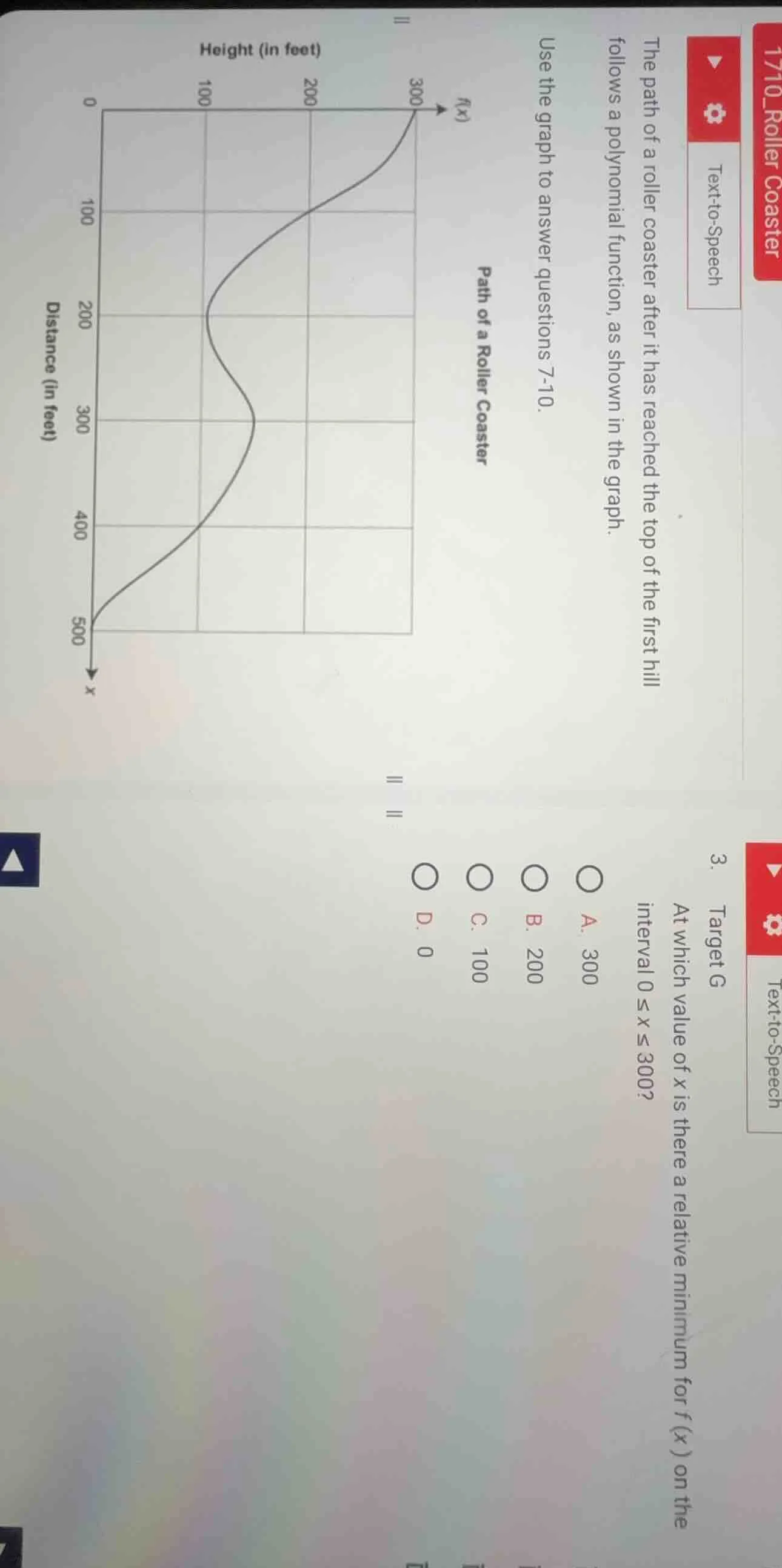
the path of a roller coaster after it has reached the top of the first hill follows a polynomial function, as shown in the graph.
use the graph to answer questions 7 - 10.
path of a roller coaster
- target g
at which value of x is there a relative minimum for f(x) on the interval 0 ≤ x ≤ 300?
a. 300
b. 200
c. 100
d. 0
Step1: Understand relative minimum
A relative minimum on a graph is a point where the function changes from decreasing to increasing (the graph dips to a low point and then rises).
Step2: Analyze the graph
Looking at the graph of the roller coaster path (the polynomial function \( f(x) \)):
- At \( x = 0 \), the graph starts at a point (it's a starting point, not a minimum in the interval's context as we check the behavior around it).
- At \( x = 100 \), we check the behavior: before \( x = 100 \), the graph is decreasing, and after \( x = 100 \), does it increase? Wait, no, let's re - examine. Wait, actually, looking at the graph's shape (from the given grid), the relative minimum occurs where the graph has a "valley" - a point where the function is lower than its neighbors. Wait, maybe I misread earlier. Wait, the x - axis is distance (in feet) from 0 to 500, and y - axis is height (in feet) from 0 to 300? Wait, no, the axes: the horizontal axis (x) is distance (in feet) with labels 0, 100, 200, 300, 400, 500. The vertical axis (f(x)) is height (in feet) with labels 0, 100, 200, 300. Wait, the graph starts at (0, 500)? No, wait the bottom - left corner is (0, 500) on the x - y? Wait, no, the axes: the x - axis is labeled "Distance (in feet)" with arrow at 500, and the y - axis is labeled "Height (in feet)" with arrow at 300. Wait, the graph starts at (0, 300) on the y - axis (f(x)) and (500, 0) on the x - axis? Wait, no, the coordinates: the top - right corner of the graph is at (x = 0, f(x)=300), and the bottom - left is at (x = 500, f(x)=0). Wait, maybe the graph is plotted with x as distance (increasing to the right - no, the x - arrow is to the right, but the labels are 0, 100, 200, 300, 400, 500 from left to right, and f(x) (height) is from bottom (0) to top (300). Wait, the graph starts at (x = 0, f(x)=300) and goes down, then has a curve. Wait, maybe the relative minimum: a relative minimum is a point where the function value is less than the values around it. Looking at the options: 0, 100, 200, 300. Wait, when x = 300? No, wait, let's think again. Wait, the question is "At which value of x is there a relative minimum for \( f(x) \) on the interval \( 0\leq x\leq300 \)?" Wait, maybe I had the axes reversed. Let's assume that the x - axis is the independent variable (distance) and f(x) is the height. A relative minimum in height would be a point where the height is lower than the surrounding points. Looking at the graph, when x = 300? No, wait, the options are A. 300, B. 200, C. 100, D. 0. Wait, maybe the correct approach: a relative minimum occurs where the function changes from decreasing to increasing. Looking at the graph, at x = 300? No, wait, maybe the graph has a relative minimum at x = 300? No, wait, let's check the graph's shape. If we look at the curve, the point where the function has a local minimum (relative minimum) is at x = 300? No, wait, maybe I made a mistake. Wait, the answer options: let's re - evaluate. Wait, the key is that a relative minimum is a point where the function is lower than its immediate neighbors. If we look at the graph, when x = 300, is that a minimum? Wait, no, maybe the correct answer is C? Wait, no, wait the original problem's graph: maybe the relative minimum is at x = 300? No, I think I messed up the axes. Wait, the x - axis is distance (in feet) from 0 to 500, and the y - axis is height (in feet) from 0 to 300. The graph starts at (x = 0, y = 300) and goes down, then has a curve. Wait, the relative minimum (the lowest point in the interval \( 0\leq x\leq300 \)): looking at th…

Snap & solve any problem in the app
Get step-by-step solutions on Sovi AI
Photo-based solutions with guided steps
Explore more problems and detailed explanations
C. 100