QUESTION IMAGE
Question
18 mark for review
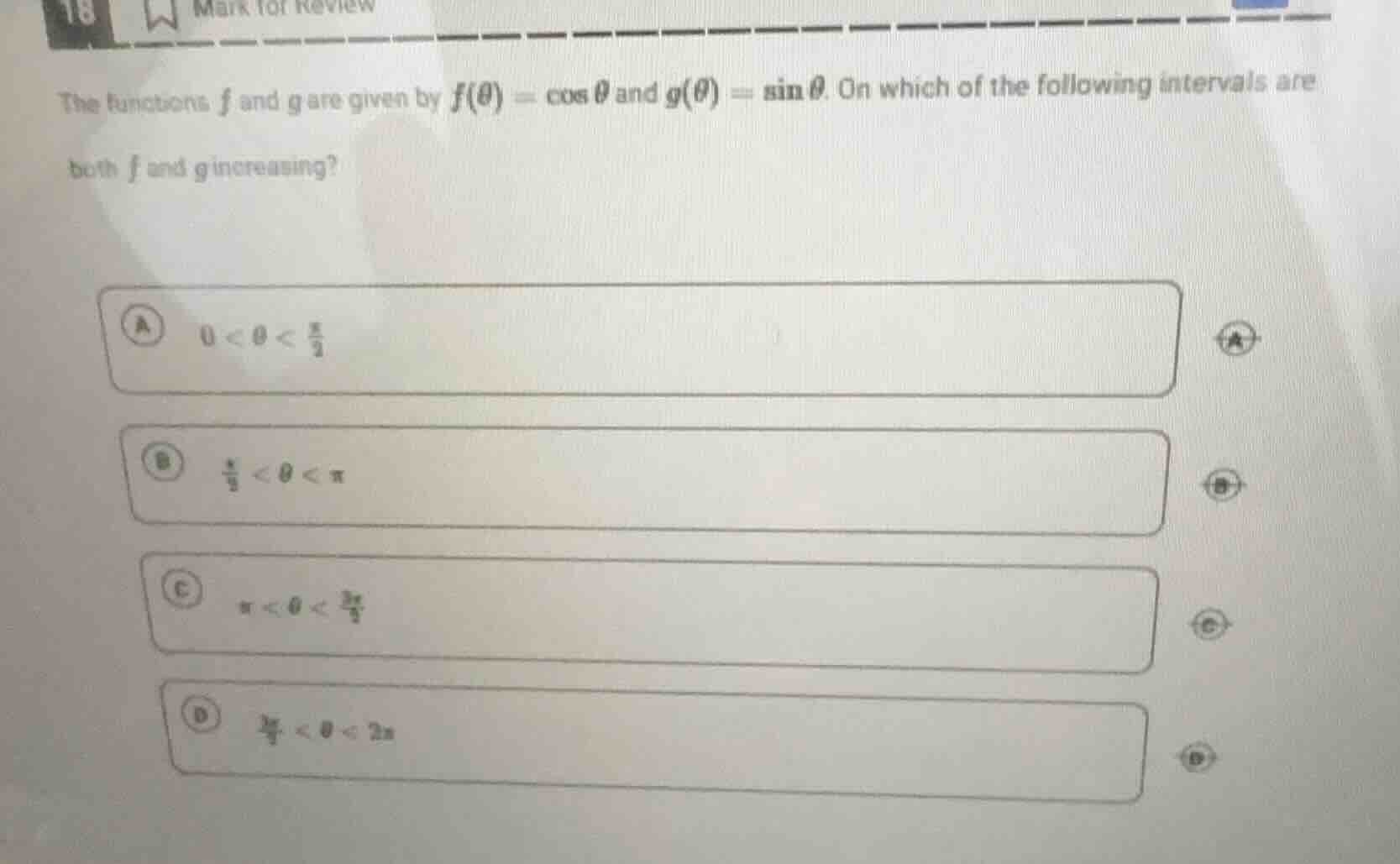
the functions $f$ and $g$ are given by $f(\theta)=\cos\theta$ and $g(\theta)=\sin\theta$. on which of the following intervals are both $f$ and $g$ increasing?
a $0<\theta<\frac{\pi}{2}$
b $\frac{\pi}{2}<\theta<\pi$
c $\pi<\theta<\frac{3\pi}{2}$
d $\frac{3\pi}{2}<\theta<2\pi$
Step1: Find derivative of $f(\theta)$
$f'(\theta) = \frac{d}{d\theta}\cos\theta = -\sin\theta$
Step2: Find derivative of $g(\theta)$
$g'(\theta) = \frac{d}{d\theta}\sin\theta = \cos\theta$
Step3: Analyze interval A ($0<\theta<\frac{\pi}{2}$)
$f'(\theta)=-\sin\theta <0$ ($f$ decreasing), $g'(\theta)=\cos\theta>0$ ($g$ increasing)
Step4: Analyze interval B ($\frac{\pi}{2}<\theta<\pi$)
$f'(\theta)=-\sin\theta <0$ ($f$ decreasing), $g'(\theta)=\cos\theta<0$ ($g$ decreasing)
Step5: Analyze interval C ($\pi<\theta<\frac{3\pi}{2}$)
$f'(\theta)=-\sin\theta >0$ ($f$ increasing), $g'(\theta)=\cos\theta<0$ ($g$ decreasing)
Step6: Analyze interval D ($\frac{3\pi}{2}<\theta<2\pi$)
$f'(\theta)=-\sin\theta >0$ ($f$ increasing), $g'(\theta)=\cos\theta>0$ ($g$ increasing)

Snap & solve any problem in the app
Get step-by-step solutions on Sovi AI
Photo-based solutions with guided steps
Explore more problems and detailed explanations
D. $\frac{3\pi}{2} < \theta < 2\pi$