QUESTION IMAGE
Question
19.
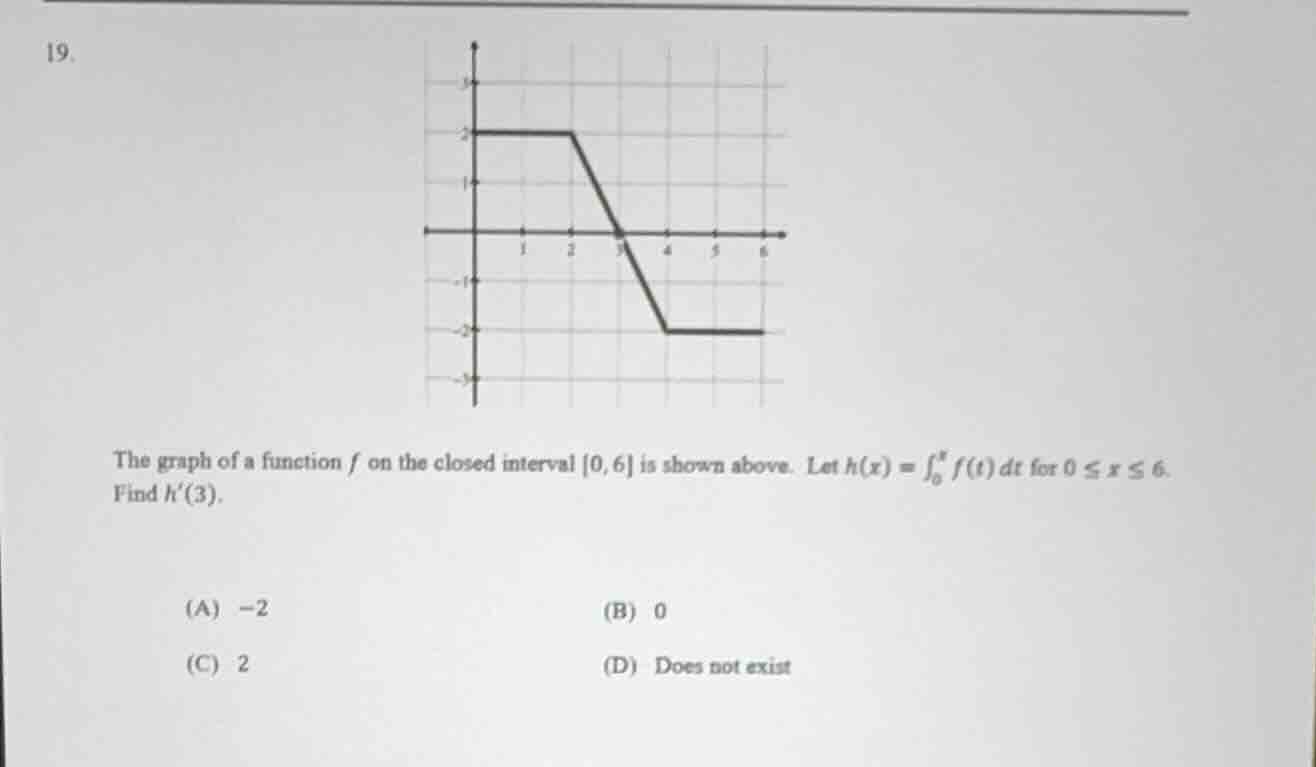
the graph of a function ( f ) on the closed interval ( 0, 6 ) is shown above. let ( h(x)=int_{0}^{x}f(t)dt ) for ( 0leq xleq6 ). find ( h(3) ).
(a) ( -2 )
(b) ( 0 )
(c) ( 2 )
(d) does not exist
Step1: Recall the Fundamental Theorem of Calculus
The Fundamental Theorem of Calculus, Part 1 states that if \( h(x)=\int_{a}^{x}f(t)dt \), then \( h'(x) = f(x) \) for \( x \) in the domain of \( f \).
Step2: Apply the theorem to find \( h'(3) \)
We need to find \( h'(3) \). By the Fundamental Theorem of Calculus, \( h'(x)=f(x) \), so \( h'(3)=f(3) \).
Now, we look at the graph of \( f \) at \( x = 3 \). From the graph, at \( x = 3 \), the function \( f \) passes through the origin, so \( f(3)=0 \)? Wait, no, wait. Wait, let's check the graph again. Wait, the graph: from \( x = 2 \) to \( x = 4 \), the line goes from \( (2, 2) \) to \( (4, - 2) \)? Wait, no, wait the graph: at \( x = 2 \), the value is 2, then it goes down to \( x = 3 \), where is it? Wait, the graph: the point at \( x = 3 \) is on the x - axis? Wait, no, the graph: let's see, the first segment is from \( x = 0 \) to \( x = 2 \), horizontal at \( y = 2 \). Then from \( x = 2 \) to \( x = 4 \), it's a line. Let's find the slope of the line from \( (2, 2) \) to \( (4, - 2) \). The slope \( m=\frac{-2 - 2}{4 - 2}=\frac{-4}{2}=-2 \). The equation of the line is \( y - 2=-2(x - 2) \), which simplifies to \( y=-2x + 4 + 2=-2x+6 \). Now, when \( x = 3 \), \( y=-2(3)+6=-6 + 6 = 0 \). Wait, but wait, the problem is to find \( h'(3) \). Wait, no, the Fundamental Theorem of Calculus says \( h'(x)=f(x) \), so \( h'(3)=f(3) \). But wait, maybe I made a mistake. Wait, no, let's re - examine. Wait, the graph: at \( x = 3 \), the function \( f \) is at 0? Wait, no, wait the graph: when \( x = 3 \), the point is on the x - axis, so \( f(3)=0 \)? But that's not one of the options? Wait, no, wait the options are (A) - 2, (B) 0, (C) 2, (D) Does not exist. Wait, maybe I misread the graph. Wait, let's look again. The graph: from \( x = 2 \) to \( x = 4 \), the line goes from \( (2, 2) \) to \( (4, - 2) \)? Wait, no, maybe the point at \( x = 3 \) is on the line. Wait, the slope between \( x = 2 \) (where \( f(2)=2 \)) and \( x = 4 \) (where \( f(4)=-2 \)) is \( \frac{-2 - 2}{4 - 2}=-2 \). But when \( x = 3 \), \( f(3) \): using the slope, from \( x = 2 \) to \( x = 3 \), the change in x is 1, so the change in y is \( - 2\times1=-2 \), so \( f(3)=f(2)-2=2 - 2 = 0 \)? Wait, but that would mean \( h'(3)=0 \), but let's check again. Wait, no, maybe I messed up the Fundamental Theorem. Wait, no, the Fundamental Theorem of Calculus Part 1: if \( h(x)=\int_{a}^{x}f(t)dt \), then \( h'(x)=f(x) \), provided \( f \) is continuous at \( x \). Is \( f \) continuous at \( x = 3 \)? The graph shows a line segment from \( x = 2 \) to \( x = 4 \), so \( f \) is continuous at \( x = 3 \). So \( h'(3)=f(3) \). But from the graph, at \( x = 3 \), the function \( f \) is 0? But wait, the options have 0 as option B. Wait, but let's check again. Wait, maybe the graph: when \( x = 3 \), the value of \( f(3) \) is 0? Wait, but let's re - evaluate. Wait, the line from \( (2, 2) \) to \( (4, - 2) \): when \( x = 3 \), \( y = 0 \), so \( f(3)=0 \), so \( h'(3)=f(3)=0 \)? But that seems wrong. Wait, no, wait maybe I made a mistake in the graph interpretation. Wait, the first segment: from \( x = 0 \) to \( x = 2 \), \( f(x)=2 \). Then from \( x = 2 \) to \( x = 4 \), it's a line. Let's check the coordinates: at \( x = 2 \), \( y = 2 \); at \( x = 3 \), \( y = 0 \); at \( x = 4 \), \( y=-2 \). Then from \( x = 4 \) to \( x = 6 \), \( f(x)=-2 \). So according to the Fundamental Theorem, \( h'(x)=f(x) \), so \( h'(3)=f(3)=0 \). So the answer should be B.
Wait, no, wait a second. Wait, the Fundamental Theorem o…

Snap & solve any problem in the app
Get step-by-step solutions on Sovi AI
Photo-based solutions with guided steps
Explore more problems and detailed explanations
B. 0