QUESTION IMAGE
Question
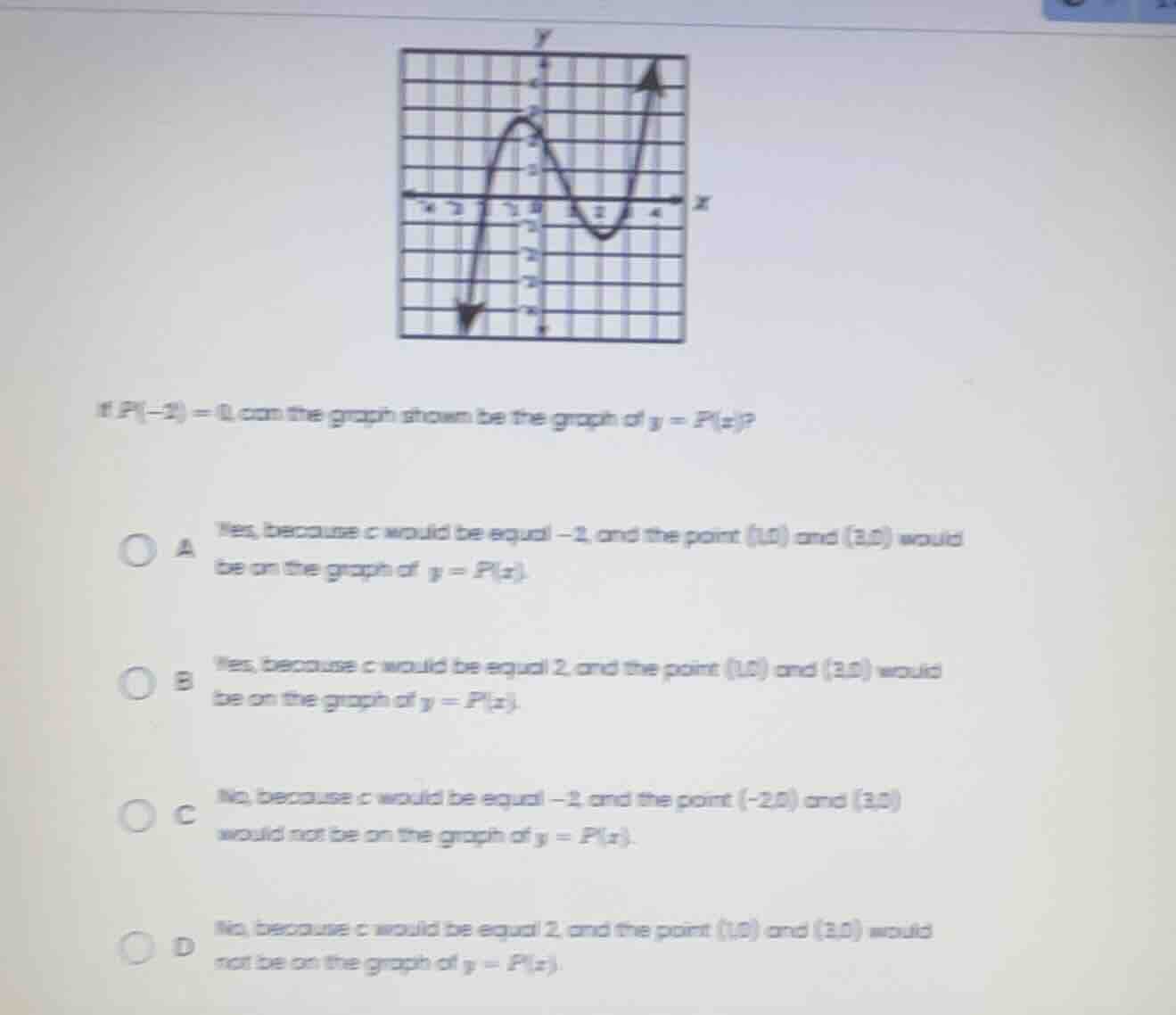
if ( p(-2) = 0 ), can the graph shown be the graph of ( y = p(x) )?
a yes, because ( c ) would be equal ( -2 ), and the point ( (1,0) ) and ( (3,0) ) would be on the graph of ( y = p(x) ).
b yes, because ( c ) would be equal ( 2 ), and the point ( (1,0) ) and ( (3,0) ) would be on the graph of ( y = p(x) ).
c no, because ( c ) would be equal ( -2 ), and the point ( (-2,0) ) and ( (3,0) ) would not be on the graph of ( y = p(x) ).
d no, because ( c ) would be equal ( 2 ), and the point ( (1,0) ) and ( (3,0) ) would not be on the graph of ( y = p(x) ).
Recall that if \( P(c) = 0 \), then \( (c, 0) \) is an \( x \)-intercept (root) of the polynomial \( P(x) \). Here, \( P(-2)=0 \), so \( (-2, 0) \) should be an \( x \)-intercept. Looking at the graph, the \( x \)-intercepts shown are \( (1, 0) \) and \( (3, 0) \), and \( (-2, 0) \) is not on the graph. So we check the options:
- Option A: Says yes, but \( (-2,0) \) is not on the graph, so A is wrong.
- Option B: Incorrectly states \( c = 2 \) (should be \( c=-2 \)) and claims \( (1,0),(3,0) \) are on the graph, but the issue is \( (-2,0) \) not being there, so B is wrong.
- Option C: Correctly states \( c=-2 \) and that \( (-2,0) \) (and also notes \( (3,0) \) is on the graph? Wait, no, the graph has \( (1,0) \) and \( (3,0) \)? Wait, looking at the graph, the roots are at \( x = 1 \) and \( x = 3 \)? Wait, no, the graph: let's re - examine. The graph crosses the \( x \)-axis at \( x = 1 \) and \( x = 3 \)? Wait, no, the original problem: if \( P(-2)=0 \), then \( x=-2 \) should be a root. But the graph shown does not have a root at \( x=-2 \). So option C says "No, because \( c=-2 \), and the point \( (-2,0) \) and \( (3,0) \) would not be on the graph of \( y = P(x) \)". Wait, actually, \( (3,0) \) is on the graph? Wait, maybe I misread. Wait, the graph: looking at the grid, the \( x \)-intercepts are at \( x = 1 \) and \( x = 3 \)? No, wait, the graph: let's see the \( x \)-axis. The graph comes from the bottom left, rises, has a peak, then falls, crosses the \( x \)-axis at \( x = 1 \), then has a valley, then rises, crosses the \( x \)-axis at \( x = 3 \), then goes up. And at \( x=-2 \), the graph is not on the \( x \)-axis. So \( P(-2)=0 \) implies \( (-2,0) \) should be a root, but it's not on the graph. So option C says "No, because \( c=-2 \), and the point \( (-2,0) \) and \( (3,0) \) would not be on the graph of \( y = P(x) \)". Wait, \( (3,0) \) is on the graph, but \( (-2,0) \) is not. So the reasoning is that since \( P(-2)=0 \) requires \( (-2,0) \) to be on the graph, and it's not, so the answer is no, and option C correctly identifies that \( c=-2 \) and \( (-2,0) \) is not on the graph (and maybe a typo about \( (3,0) \), but among the options, C is the only one that correctly says no and identifies the issue with \( c=-2 \) and the absence of \( (-2,0) \) on the graph.
- Option D: Incorrectly states \( c = 2 \) and misidentifies the roots, so D is wrong.

Snap & solve any problem in the app
Get step-by-step solutions on Sovi AI
Photo-based solutions with guided steps
Explore more problems and detailed explanations
C. No, because c would be equal -2, and the point (-2,0) and (3,0) would not be on the graph of \( y = P(x) \)