QUESTION IMAGE
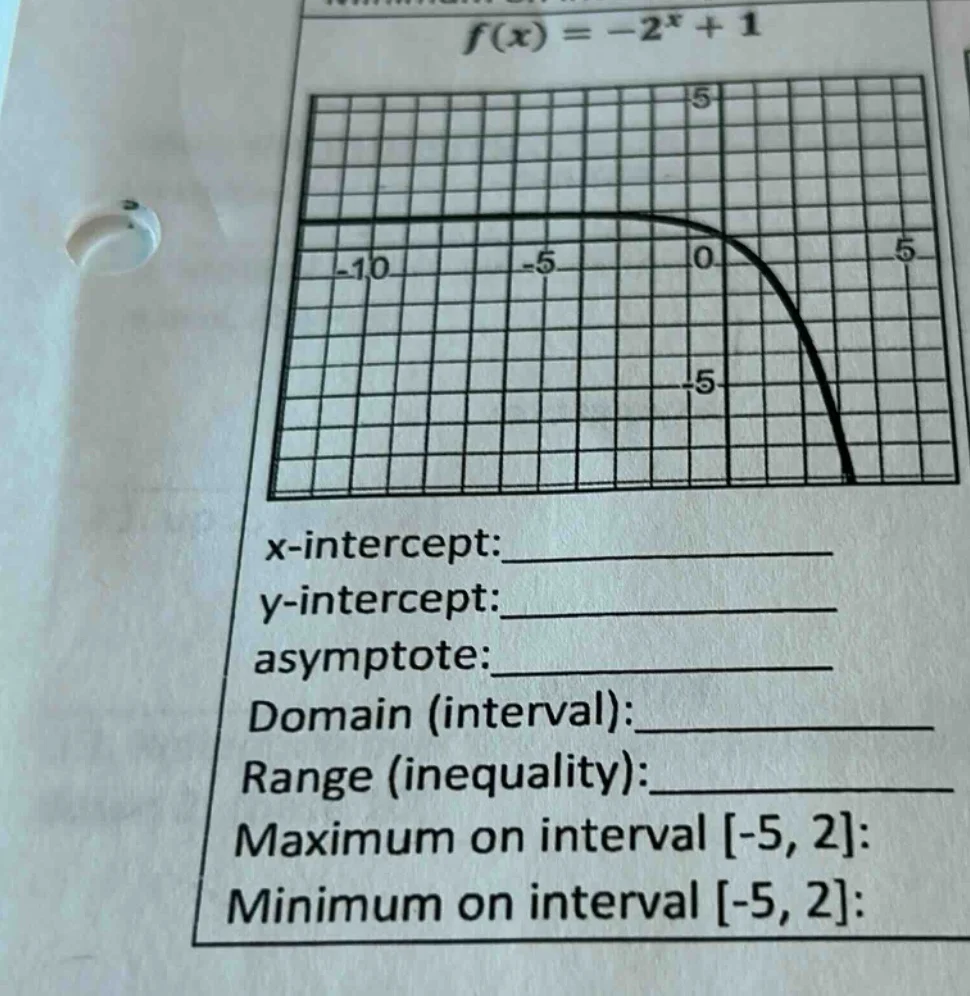
Question
f(x) = -2^x + 1
x-intercept:
y-intercept:
asymptote:
domain (interval):
range (inequality):
maximum on interval -5, 2:
minimum on interval -5, 2:
Step1: Find x-intercept (set \( y = 0 \))
Set \( f(x)=0 \), so \( -2^{x}+1 = 0 \). Then \( 2^{x}=1 \), and \( x = 0 \) (since \( 2^{0}=1 \)).
Step2: Find y-intercept (set \( x = 0 \))
Substitute \( x = 0 \) into \( f(x) \): \( f(0)=-2^{0}+1=-1 + 1 = 0 \).
Step3: Analyze asymptote of exponential function
The parent function \( 2^{x} \) has a horizontal asymptote \( y = 0 \). For \( f(x)=-2^{x}+1 \), the horizontal asymptote is \( y = 1 \) (vertical shift up 1, reflection over x - axis doesn't change horizontal asymptote direction).
Step4: Determine domain of exponential function
Exponential functions \( a^{x} \) ( \( a>0,a
eq1 \)) have domain \( (-\infty,\infty) \), so \( f(x)=-2^{x}+1 \) has domain \( (-\infty,\infty) \).
Step5: Determine range of \( f(x)=-2^{x}+1 \)
Since \( 2^{x}>0 \), then \( -2^{x}<0 \), and \( -2^{x}+1<1 \). Also, as \( x
ightarrow-\infty \), \( 2^{x}
ightarrow0 \), so \( f(x)
ightarrow1 \); as \( x
ightarrow\infty \), \( 2^{x}
ightarrow\infty \), so \( f(x)
ightarrow-\infty \). Thus, range is \( (-\infty,1) \).
Step6: Find maximum on \([-5,2]\)
The function \( f(x)=-2^{x}+1 \) is a decreasing function (since the coefficient of \( 2^{x} \) is negative, so it's a reflection of an increasing exponential function, hence decreasing). So on the interval \([-5,2]\), the maximum occurs at the left - most point \( x=-5 \). Calculate \( f(-5)=-2^{-5}+1=-\frac{1}{32}+1=\frac{31}{32}\approx0.96875 \)? Wait, no, wait: Wait, \( 2^{-5}=\frac{1}{32} \), so \( -2^{-5}+1 = 1-\frac{1}{32}=\frac{31}{32} \)? Wait, no, earlier when we did x - intercept, we saw at \( x = 0 \), \( f(x)=0 \), but wait, the graph in the picture: Wait, maybe I made a mistake in the direction of decrease. Wait, \( y = 2^{x} \) is increasing, \( y=-2^{x} \) is decreasing, so \( y=-2^{x}+1 \) is decreasing. So as \( x \) increases, \( f(x) \) decreases. So on \([-5,2]\), the maximum is at \( x=-5 \), minimum at \( x = 2 \). Wait, but when \( x = 0 \), \( f(x)=0 \), when \( x = 2 \), \( f(2)=-4 + 1=-3 \), when \( x=-5 \), \( f(-5)=-2^{-5}+1=-\frac{1}{32}+1=\frac{31}{32}\approx0.96875 \), and the horizontal asymptote is \( y = 1 \), but the function approaches \( y = 1 \) as \( x
ightarrow-\infty \), so on the interval \([-5,2]\), the maximum value is approaching 1, but the closest point is at \( x=-5 \), but wait, the graph in the picture: Let's re - check. The graph shows that at \( x = 0 \), it's at (0,0), and as \( x \) increases (to the right), it goes down, and as \( x \) decreases (to the left), it approaches the horizontal line \( y = 1 \). So on the interval \([-5,2]\), the maximum occurs at \( x=-5 \), and the value is \( f(-5)=-2^{-5}+1=1-\frac{1}{32}=\frac{31}{32}\), but wait, maybe the graph is a bit different. Wait, actually, when \( x = 0 \), \( f(x)=0 \), and the horizontal asymptote is \( y = 1 \). So as \( x
ightarrow-\infty \), \( f(x)
ightarrow1 \), so on the interval \([-5,2]\), the maximum value is less than 1, and the minimum is at \( x = 2 \), \( f(2)=-2^{2}+1=-4 + 1=-3 \). Wait, but let's confirm the x - intercept: when \( y = 0 \), \( -2^{x}+1 = 0\Rightarrow2^{x}=1\Rightarrow x = 0 \), so x - intercept is (0,0), y - intercept is also (0,0). The horizontal asymptote is \( y = 1 \). Domain is all real numbers, range is \( (-\infty,1) \). For the maximum on \([-5,2]\): since the function is decreasing, maximum at \( x=-5 \), \( f(-5)=-2^{-5}+1=1-\frac{1}{32}=\frac{31}{32}\approx0.96875 \), and minimum at \( x = 2 \), \( f(2)=-4 + 1=-3 \).

Snap & solve any problem in the app
Get step-by-step solutions on Sovi AI
Photo-based solutions with guided steps
Explore more problems and detailed explanations
s:
x - intercept: \(\boldsymbol{(0,0)}\)
y - intercept: \(\boldsymbol{(0,0)}\)
asymptote: \(\boldsymbol{y = 1}\)
Domain (interval): \(\boldsymbol{(-\infty,\infty)}\)
Range (inequality): \(\boldsymbol{y<1}\)
Maximum on interval \([-5,2]\): \(\boldsymbol{\frac{31}{32}}\) (or approximately \(0.97\), but exact value is \(\frac{31}{32}\))
Minimum on interval \([-5,2]\): \(\boldsymbol{-3}\)