QUESTION IMAGE
Question
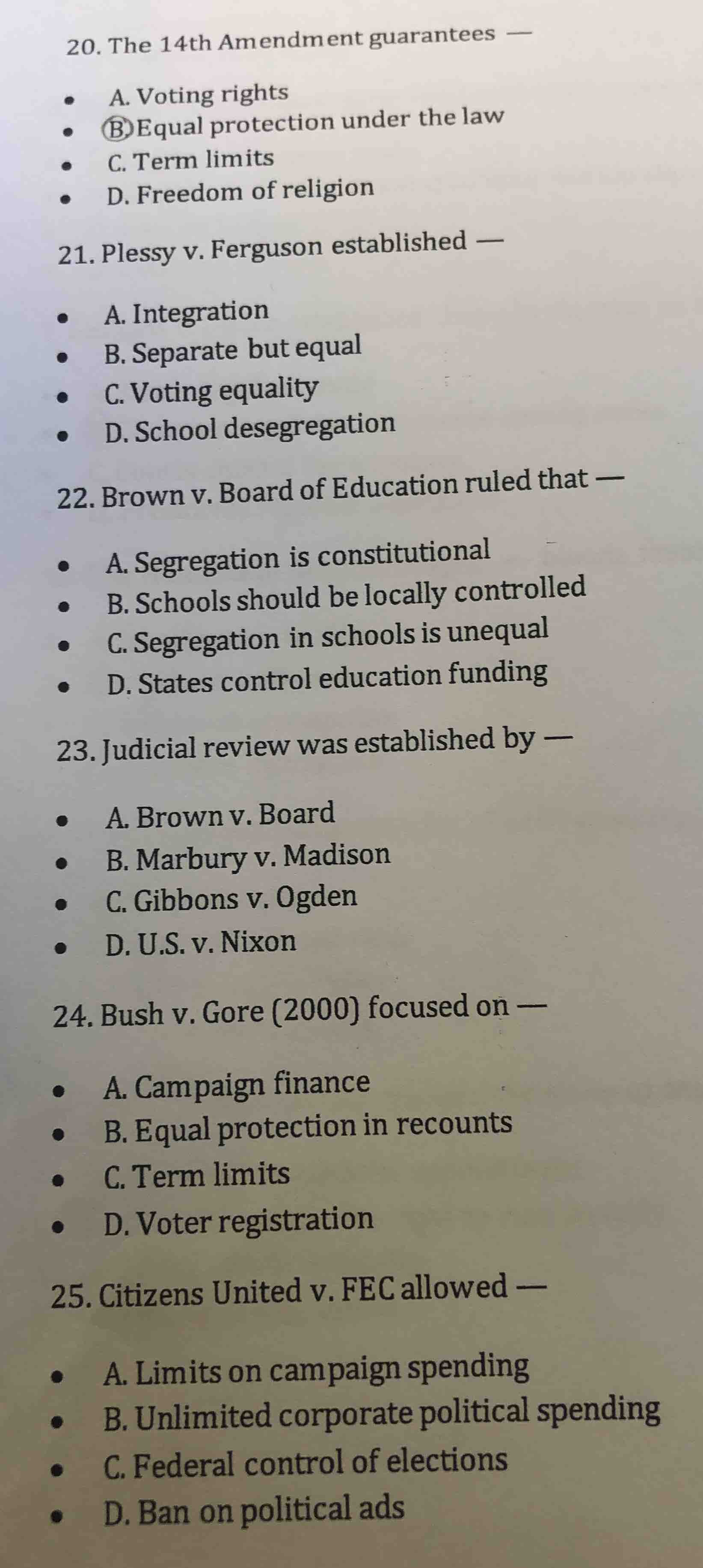
- the 14th amendment guarantees —
a. voting rights
b. equal protection under the law
c. term limits
d. freedom of religion
- plessy v. ferguson established —
a. integration
b. separate but equal
c. voting equality
d. school desegregation
- brown v. board of education ruled that —
a. segregation is constitutional
b. schools should be locally controlled
c. segregation in schools is unequal
d. states control education funding
- judicial review was established by —
a. brown v. board
b. marbury v. madison
c. gibbons v. ogden
d. u.s. v. nixon
- bush v. gore (2000) focused on —
a. campaign finance
b. equal protection in recounts
c. term limits
d. voter registration
- citizens united v. fec allowed —
a. limits on campaign spending
b. unlimited corporate political spending
c. federal control of elections
d. ban on political ads
Brief Explanations
- The 14th Amendment's Equal Protection Clause guarantees equal treatment under law. Voting rights are covered by other amendments, term limits are not in this amendment, and religious freedom is in the 1st Amendment.
- Plessy v. Ferguson (1896) upheld racial segregation under the "separate but equal" doctrine, which was later overturned.
- Brown v. Board of Education (1954) ruled that state-mandated racial segregation in public schools violated the Equal Protection Clause, finding segregated schools inherently unequal.
- Marbury v. Madison (1803) was the landmark Supreme Court case that established the principle of judicial review, giving courts the power to strike down unconstitutional laws.
- Bush v. Gore (2000) centered on the equal protection of voters during the Florida presidential vote recount, with the Court halting the recount.
- Citizens United v. FEC (2010) held that corporate political spending is protected under the 1st Amendment, allowing unlimited independent corporate political spending.

Snap & solve any problem in the app
Get step-by-step solutions on Sovi AI
Photo-based solutions with guided steps
Explore more problems and detailed explanations
- B. Equal protection under the law
- B. Separate but equal
- C. Segregation in schools is unequal
- B. Marbury v. Madison
- B. Equal protection in recounts
- B. Unlimited corporate political spending