QUESTION IMAGE
Question
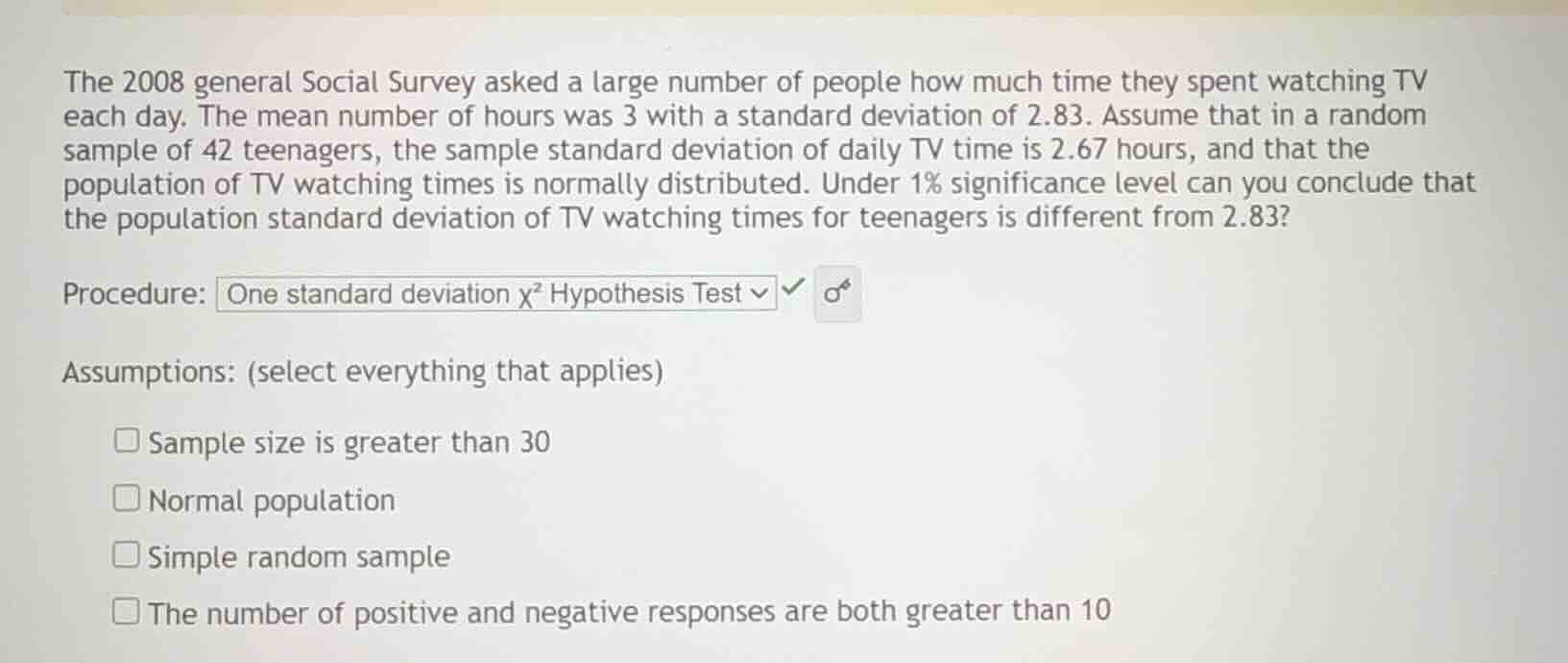
the 2008 general social survey asked a large number of people how much time they spent watching tv each day. the mean number of hours was 3 with a standard deviation of 2.83. assume that in a random sample of 42 teenagers, the sample standard deviation of daily tv time is 2.67 hours, and that the population of tv watching times is normally distributed. under 1% significance level can you conclude that the population standard deviation of tv watching times for teenagers is different from 2.83?
procedure: one standard deviation ( chi^2 ) hypothesis test
assumptions: (select everything that applies)
- sample size is greater than 30
- normal population
- simple random sample
- the number of positive and negative responses are both greater than 10
To determine the assumptions for a one - standard - deviation \(\chi^{2}\) hypothesis test:
- For a \(\chi^{2}\) test about the population standard deviation (or variance), the key assumptions are:
- Normal population: The problem states that "the population of TV watching times is normally distributed", so this assumption holds.
- Simple random sample: The problem mentions "a random sample of 42 teenagers", so this is a simple random sample.
- "Sample size is greater than 30" is not an assumption for the \(\chi^{2}\) test for standard deviation (this is more related to the Central Limit Theorem for means). The \(\chi^{2}\) test for variance/standard deviation requires normality, not a large sample size for the test's validity.
- "The number of positive and negative responses are both greater than 10" is an assumption for tests like the one - proportion \(z\) - test, not for the \(\chi^{2}\) test for standard deviation.
So the applicable assumptions are "Normal population" and "Simple random sample", and also the sample size here (\(n = 42\)) is greater than 30, so "Sample size is greater than 30" also applies in terms of the given sample size (even though it's not a core assumption for the \(\chi^{2}\) test for standard deviation, the sample size here is indeed greater than 30).

Snap & solve any problem in the app
Get step-by-step solutions on Sovi AI
Photo-based solutions with guided steps
Explore more problems and detailed explanations
- Sample size is greater than 30 (checked, as \(n = 42>30\))
- Normal population (checked, as the population is normally distributed)
- Simple random sample (checked, as it is a random sample)