QUESTION IMAGE
Question
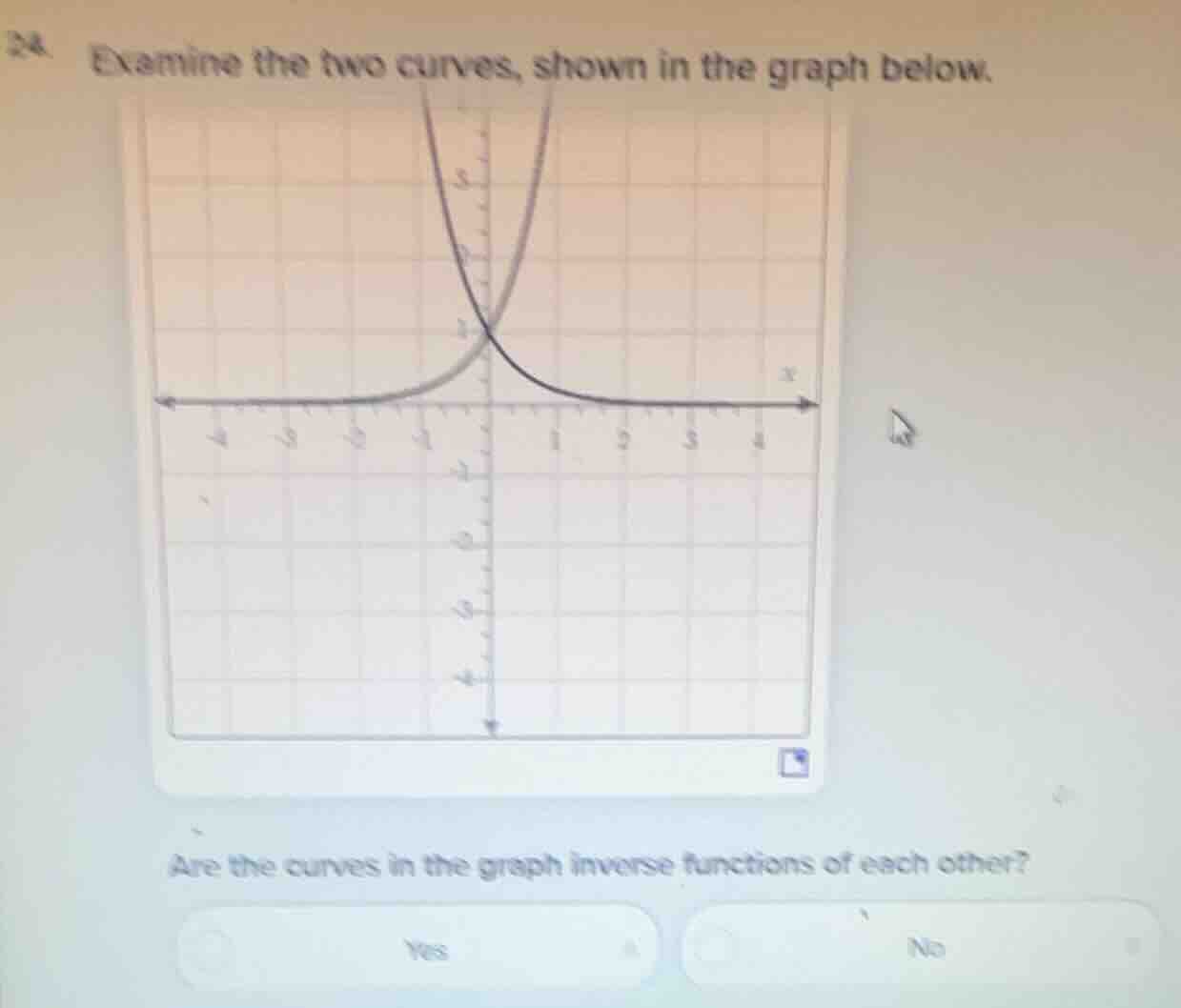
- examine the two curves, shown in the graph below.
are the curves in the graph inverse functions of each other?
yes no
Step1: Recall inverse function graph rule
To determine if two functions are inverses, their graphs should be symmetric about the line \( y = x \). Also, for a function \( y = f(x) \) and its inverse \( y = f^{-1}(x) \), if \( (a, b) \) is on \( f(x) \), then \( (b, a) \) should be on \( f^{-1}(x) \).
Step2: Analyze the given graphs
One graph is a parabola (opening upwards, likely \( y = x^2 + 1 \) or similar) and the other is a curve that looks like an exponential decay (or similar) but symmetric about the y - axis (even function). For inverse functions, if we take a point on the parabola, say \( (1, 2) \) (assuming the parabola is \( y=x^2 + 1 \), when \( x = 1 \), \( y=2 \)), then the inverse function should have the point \( (2, 1) \). But the lower curve (the non - parabola) at \( x = 2 \) has a \( y \) - value close to 0, not 1. Also, the symmetry about \( y=x \): the parabola opens upwards, the other curve is symmetric about the y - axis. If we reflect the parabola over \( y = x \), we would not get the other curve. Another way: a function and its inverse must be one - to - one (pass horizontal line test) if the original function is not one - to - one, its inverse is not a function. The parabola is not one - to - one (fails horizontal line test), but the lower curve is one - to - one? Wait, no, the key is the symmetry. The two curves are both symmetric about the y - axis (even functions), so they are not symmetric about \( y=x \). So they are not inverse functions.

Snap & solve any problem in the app
Get step-by-step solutions on Sovi AI
Photo-based solutions with guided steps
Explore more problems and detailed explanations
No