QUESTION IMAGE
Question
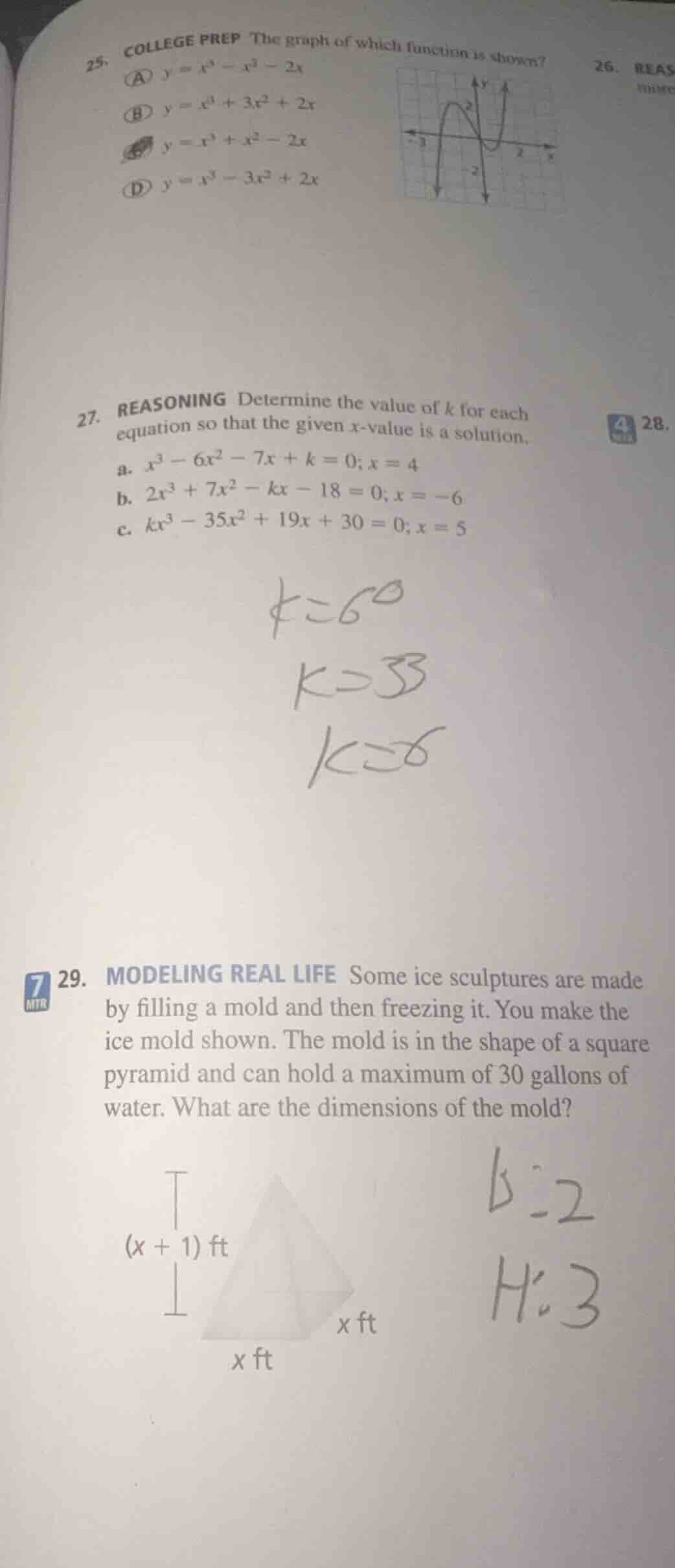
- college prep the graph of which function is shown?
a ( y = x^3 - x^2 - 2x )
b ( y = x^3 + 3x^2 + 2x )
c ( y = x^3 + x^2 - 2x )
d ( y = x^3 - 3x^2 + 2x )
(graph of a cubic function is shown with x - intercepts and a local maximum and minimum)
- reasoning determine the value of ( k ) for each equation so that the given ( x )-value is a solution.
a. ( x^3 - 6x^2 - 7x + k = 0; x = 4 )
b. ( 2x^3 + 7x^2 - kx - 18 = 0; x = -6 )
c. ( kx^3 - 35x^2 + 19x + 30 = 0; x = 5 )
- modeling real life some ice sculptures are made by filling a mold and then freezing it. you make the ice mold shown. the mold is in the shape of a square pyramid and can hold a maximum of 30 gallons of water. what are the dimensions of the mold?
(diagram of a square pyramid with base length ( x ) ft, base width ( x ) ft, and height ( (x + 1) ) ft)
Problem 25
Step1: Identify x-intercepts from graph
The graph crosses the x-axis at $x=-2$, $x=0$, $x=1$.
Step2: Write factored form of function
A cubic function with these roots is $y = x(x+2)(x-1)$
Step3: Expand the factored form
First multiply $(x+2)(x-1) = x^2 -x +2x -2 = x^2 +x -2$
Then multiply by $x$: $y = x(x^2 +x -2) = x^3 +x^2 -2x$
Step4: Match with options
This matches option C.
Part a
Step1: Substitute $x=4$ into equation
$4^3 - 6(4)^2 -7(4) + k = 0$
Step2: Calculate known terms
$64 - 6(16) -28 + k = 0$
$64 - 96 -28 + k = 0$
$-60 + k = 0$
Step3: Solve for $k$
$k = 60$
Part b
Step1: Substitute $x=-6$ into equation
$2(-6)^3 +7(-6)^2 -k(-6) -18 = 0$
Step2: Calculate known terms
$2(-216) +7(36) +6k -18 = 0$
$-432 +252 -18 +6k = 0$
$-198 +6k = 0$
Step3: Solve for $k$
$6k=198 \implies k=33$
Part c
Step1: Substitute $x=5$ into equation
$k(5)^3 -35(5)^2 +19(5) +30 = 0$
Step2: Calculate known terms
$125k -35(25) +95 +30 = 0$
$125k -875 +125 = 0$
$125k -750 = 0$
Step3: Solve for $k$
$125k=750 \implies k=6$
Step1: Convert volume to cubic feet
1 gallon = 0.133681 cubic feet, so $30 \times 0.133681 \approx 4.01043$ cubic feet
Step2: Use pyramid volume formula
Volume of square pyramid: $V = \frac{1}{3} \times \text{base area} \times \text{height}$
Base area = $x^2$, height = $x+1$, so:
$\frac{1}{3}x^2(x+1) = 4.01043$
Step3: Simplify and solve for $x$
Multiply both sides by 3: $x^3 +x^2 = 12.03129$
Test $x=2$: $2^3 +2^2 = 8+4=12$, which is approximately equal to 12.03129
Step4: Find dimensions
Base side length $x=2$ ft, height $x+1=3$ ft

Snap & solve any problem in the app
Get step-by-step solutions on Sovi AI
Photo-based solutions with guided steps
Explore more problems and detailed explanations
C. $y = x^3 + x^2 - 2x$
---