QUESTION IMAGE
Question
abstract. practice problems for lecture
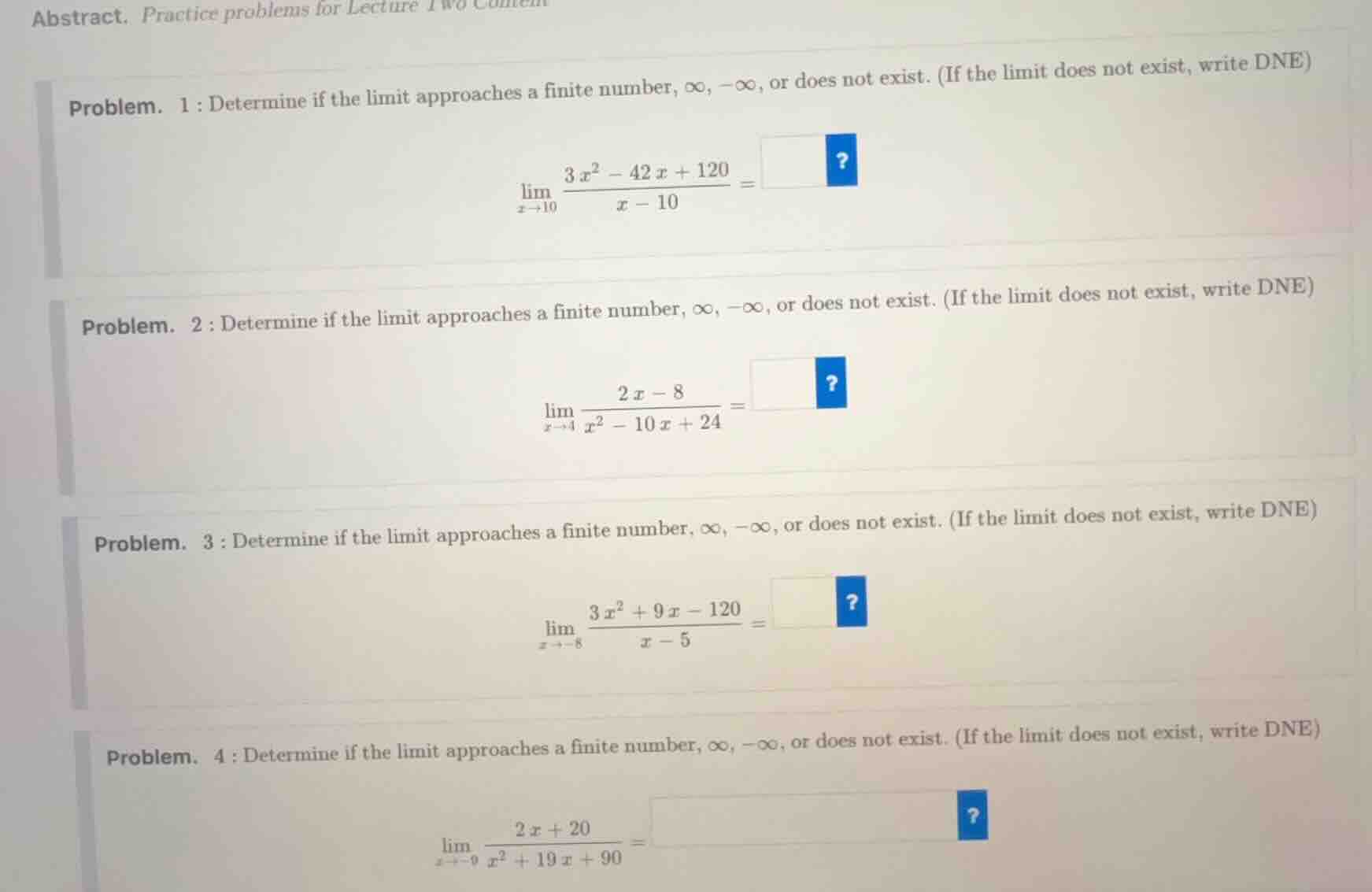
problem. 1 : determine if the limit approaches a finite number, $\infty$, $-\infty$, or does not exist. (if the limit does not exist, write dne)
$\lim \limits_{x \to 10} \frac{3 x^2 - 42 x + 120}{x - 10} = $
problem. 2 : determine if the limit approaches a finite number, $\infty$, $-\infty$, or does not exist. (if the limit does not exist, write dne)
$\lim \limits_{x \to 4} \frac{2 x - 8}{x^2 - 10 x + 24} = $
problem. 3 : determine if the limit approaches a finite number, $\infty$, $-\infty$, or does not exist. (if the limit does not exist, write dne)
$\lim \limits_{x \to -8} \frac{3 x^2 + 9 x - 120}{x - 5} = $
problem. 4 : determine if the limit approaches a finite number, $\infty$, $-\infty$, or does not exist. (if the limit does not exist, write dne)
$\lim \limits_{x \to -9} \frac{2 x + 20}{x^2 + 19 x + 90} = $
Step1: Factor numerator (Problem 1)
$3x^2 - 42x + 120 = 3(x-10)(x-4)$
Step2: Simplify the expression (Problem 1)
$\lim_{x \to 10} \frac{3(x-10)(x-4)}{x-10} = \lim_{x \to 10} 3(x-4)$
Step3: Evaluate the limit (Problem 1)
$3(10-4) = 18$
Step1: Factor numerator/denominator (Problem 2)
$2x-8=2(x-4)$; $x^2-10x+24=(x-4)(x-6)$
Step2: Simplify the expression (Problem 2)
$\lim_{x \to 4} \frac{2(x-4)}{(x-4)(x-6)} = \lim_{x \to 4} \frac{2}{x-6}$
Step3: Evaluate the limit (Problem 2)
$\frac{2}{4-6} = -1$
Step1: Substitute $x=-8$ directly (Problem 3)
Denominator: $-8-5=-13
eq 0$, so no simplification needed
Step2: Compute numerator (Problem 3)
$3(-8)^2 +9(-8)-120=3(64)-72-120=192-192= -33$
Step3: Evaluate the limit (Problem 3)
$\frac{-33}{-13} = \frac{33}{13}$
Step1: Factor numerator/denominator (Problem 4)
$2x+20=2(x+10)$; $x^2+19x+90=(x+9)(x+10)$
Step2: Simplify the expression (Problem 4)
$\lim_{x \to -9} \frac{2(x+10)}{(x+9)(x+10)} = \lim_{x \to -9} \frac{2}{x+9}$
Wait, correction: Re-evaluate substitution:
Wait, $x \to -9$, denominator $(-9)+9=0$, numerator $2(-9+10)=2(1)=2$
Wait no, re-factor denominator correctly: $x^2+19x+90=(x+9)(x+10)$, yes. When $x \to -9$, the simplified limit is $\lim_{x \to -9} \frac{2}{x+9}$. As $x \to -9^+$, $x+9 \to 0^+$, limit is $+\infty$; as $x \to -9^-$, $x+9 \to 0^-$, limit is $-\infty$. Wait no, original problem: $\lim_{x \to -9} \frac{2x+20}{x^2+19x+90}$
Wait re-calculate numerator at $x=-9$: $2(-9)+20=-18+20=2$. Denominator: $(-9)^2+19(-9)+90=81-171+90=0$. Now check left and right limits:
As $x \to -9^+$, $x+9 \to 0^+$, so $\frac{2}{x+9} \to +\infty$
As $x \to -9^-$, $x+9 \to 0^-$, so $\frac{2}{x+9} \to -\infty$
Since left and right limits are not equal, the limit DNE? Wait no, wait I made a mistake in factoring:
Wait $2x+20=2(x+10)$, $x^2+19x+90=(x+9)(x+10)$. So when $x
eq -10$, we can cancel $x+10$. But $x \to -9$, so $x
eq -10$, so simplification is valid. Then $\lim_{x \to -9} \frac{2}{x+9}$. Since left limit is $-\infty$ and right limit is $+\infty$, the two-sided limit does not exist.
Wait correction for Problem 4:
Step1: Factor numerator/denominator (Problem 4)
$2x+20=2(x+10)$; $x^2+19x+90=(x+9)(x+10)$
Step2: Simplify the expression (Problem 4)
$\lim_{x \to -9} \frac{2(x+10)}{(x+9)(x+10)} = \lim_{x \to -9} \frac{2}{x+9}$ (for $x
eq -10$)
Step3: Evaluate left/right limits (Problem 4)
Left limit ($x \to -9^-$): $\frac{2}{0^-} = -\infty$; Right limit ($x \to -9^+$): $\frac{2}{0^+} = +\infty$
Step4: Conclude limit status (Problem 4)
Left $
eq$ right limit, so limit DNE
Final corrected answers:
- $18$
- $-1$
- $\frac{33}{13}$
- DNE
Revised Answer:
- $18$
- $-1$
- $\frac{33}{13}$
- DNE
Revised Explanation:
Problem 1
Step1: Factor numerator
$3x^2 - 42x + 120 = 3(x-10)(x-4)$
Step2: Cancel common factor
$\lim_{x \to 10} \frac{3(x-10)(x-4)}{x-10} = \lim_{x \to 10} 3(x-4)$
Step3: Compute limit
$3(10-4) = 18$
Problem 2
Step1: Factor numerator/denominator
$2x-8=2(x-4)$; $x^2-10x+24=(x-4)(x-6)$
Step2: Cancel common factor
$\lim_{x \to 4} \frac{2(x-4)}{(x-4)(x-6)} = \lim_{x \to 4} \frac{2}{x-6}$
Step3: Compute limit
$\frac{2}{4-6} = -1$
Problem 3
Step1: Substitute $x=-8$ directly
Denominator: $-8-5=-13
eq 0$
Step2: Calculate numerator
$3(-8)^2 +9(-8)-120=192-72-120=-33$
Step3: Compute limit
$\frac{-33}{-13} = \frac{33}{13}$
Problem 4
Step1: Factor numerator/denominator
$2x+20=2(x+10)$; $x^2+19x+90=(x+9)(x+10)$
Step2: Cancel common factor
$\lim_{x \to -9} \frac{2(x+10)}{(x+9)(x+10)} = \lim_{x \t…

Snap & solve any problem in the app
Get step-by-step solutions on Sovi AI
Photo-based solutions with guided steps
Explore more problems and detailed explanations
- $18$
- $-1$
- $\frac{33}{13}$
- $-2$