QUESTION IMAGE
Question
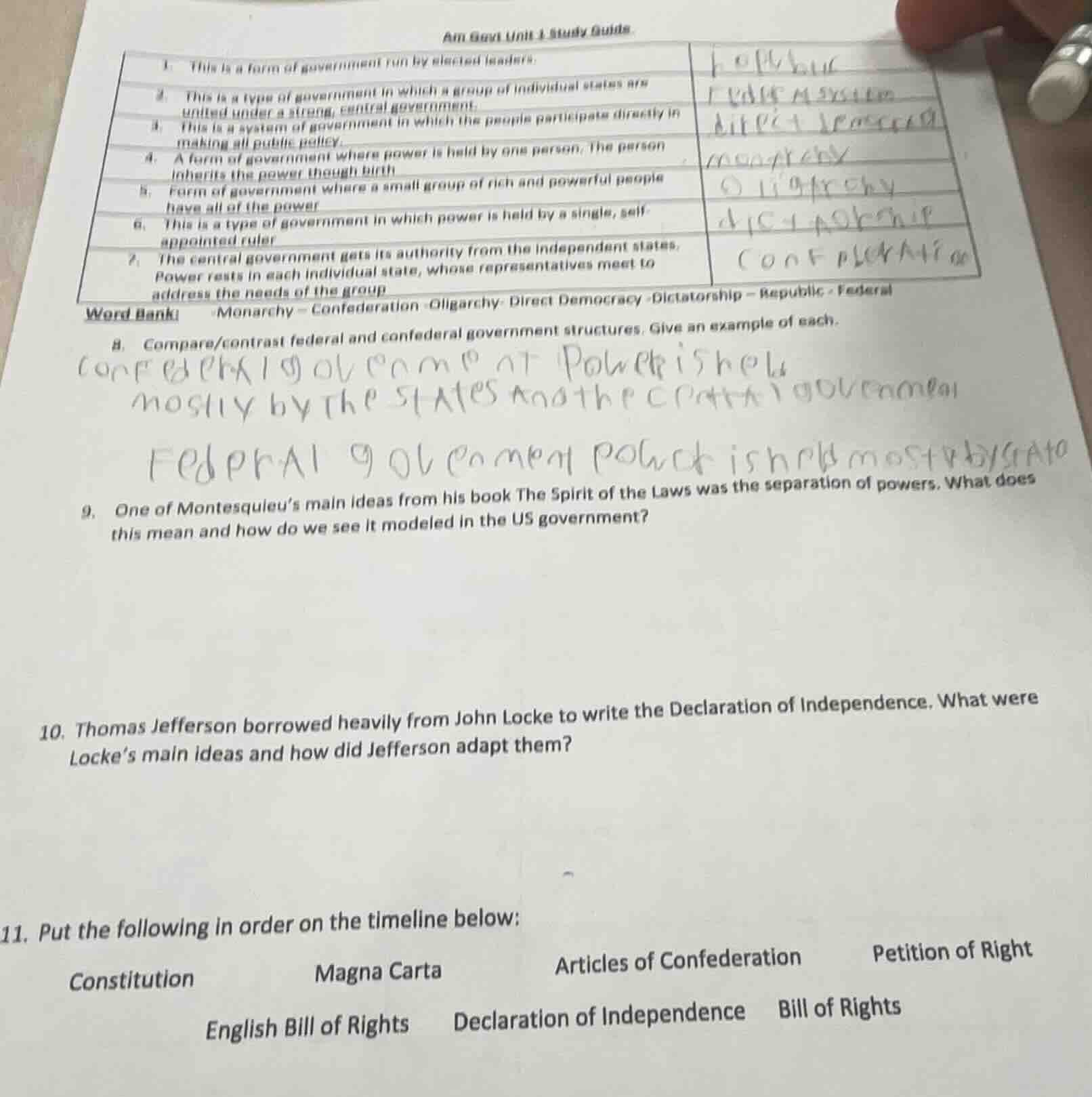
am govt unit 1 study guide
- this is a form of government run by elected leaders.
- this is a type of government in which a group of individual states are united under a strong, central government.
- this is a system of government in which the people participate directly in making all public policy.
- a form of government where power is held by one person. the person inherits the power though birth
- form of government where a small group of rich and powerful people have all of the power
- this is a type of government in which power is held by a single, self - appointed ruler
- the central government gets its authority from the independent states. power rests in each individual state, whose representatives meet to address the needs of the group
word bank: monarchy – confederation – oligarchy - direct democracy - dictatorship – republic - federal
- compare/contrast federal and confederal government structures. give an example of each.
- one of montesquieu’s main ideas from his book the spirit of the laws was the separation of powers. what does this mean and how do we see it modeled in the us government?
- thomas jefferson borrowed heavily from john locke to write the declaration of independence. what were locke’s main ideas and how did jefferson adapt them?
- put the following in order on the timeline below:
constitution magna carta articles of confederation petition of right
english bill of rights declaration of independence bill of rights
Questions 1-7 (Matching):
- Defined as government by elected leaders: matches Republic.
- States united under strong central government: matches Federal.
- People directly make public policy: matches Direct Democracy.
- Power held by inheriting single person: matches Monarchy.
- Power held by rich/powerful small group: matches Oligarchy.
- Power held by self-appointed single ruler: matches Dictatorship.
- Central government authority from independent states: matches Confederation.
Question 8:
- Confederal: Power is held primarily by individual states; the central government has only the powers states grant it. Example: The U.S. under the Articles of Confederation (1781-1789).
- Federal: Power is shared between a strong central government and individual states, with both having defined, independent powers. Example: The modern United States government under the U.S. Constitution.
Question 9:
Separation of powers means dividing government authority into distinct branches with separate responsibilities, to prevent one branch from gaining too much power. In the U.S. government:
- Legislative Branch (Congress): Makes laws
- Executive Branch (President): Enforces laws
- Judicial Branch (Supreme Court/Federal Courts): Interprets laws
This system is paired with checks and balances, where each branch can limit the actions of the others.
Question 10:
John Locke's key ideas:
- Natural rights: All people are born with inherent rights to life, liberty, and property.
- Social contract: Governments are formed by the people to protect these natural rights; if a government fails to do so, the people have the right to overthrow it.
Jefferson adapted these ideas for the Declaration of Independence:
- He rephrased natural rights as "life, liberty, and the pursuit of happiness" to reflect the revolutionary context.
- He argued that the British government had violated the colonists' natural rights, justifying the colonists' decision to break away from Britain (exercising their right to overthrow an unjust government under the social contract).
Question 11 (Timeline Order):
Ordered chronologically by their adoption/creation date:
- Magna Carta (1215)
- Petition of Right (1628)
- English Bill of Rights (1689)
- Declaration of Independence (1776)
- Articles of Confederation (1781)
- Constitution (1788)
- Bill of Rights (1791)

Snap & solve any problem in the app
Get step-by-step solutions on Sovi AI
Photo-based solutions with guided steps
Explore more problems and detailed explanations
- Republic
- Federal
- Direct Democracy
- Monarchy
- Oligarchy
- Dictatorship
- Confederation
- - Confederal: Power rests mostly with states; central government has limited, state-granted authority. Example: U.S. under the Articles of Confederation.
- Federal: Power is shared between central and state governments, with defined independent powers. Example: Modern U.S. government.
- Separation of powers splits government into distinct, specialized branches to prevent tyranny. In the U.S., this is modeled by the Legislative (makes laws), Executive (enforces laws), and Judicial (interprets laws) branches, with checks and balances between them.
- Locke's ideas: Natural rights (life, liberty, property) and the social contract (government exists to protect rights; people can overthrow unjust governments). Jefferson adapted these by rephrasing natural rights as "life, liberty, and the pursuit of happiness" and using the social contract theory to justify the colonists' break from Britain.
- 1. Magna Carta
- Petition of Right
- English Bill of Rights
- Declaration of Independence
- Articles of Confederation
- Constitution
- Bill of Rights