QUESTION IMAGE
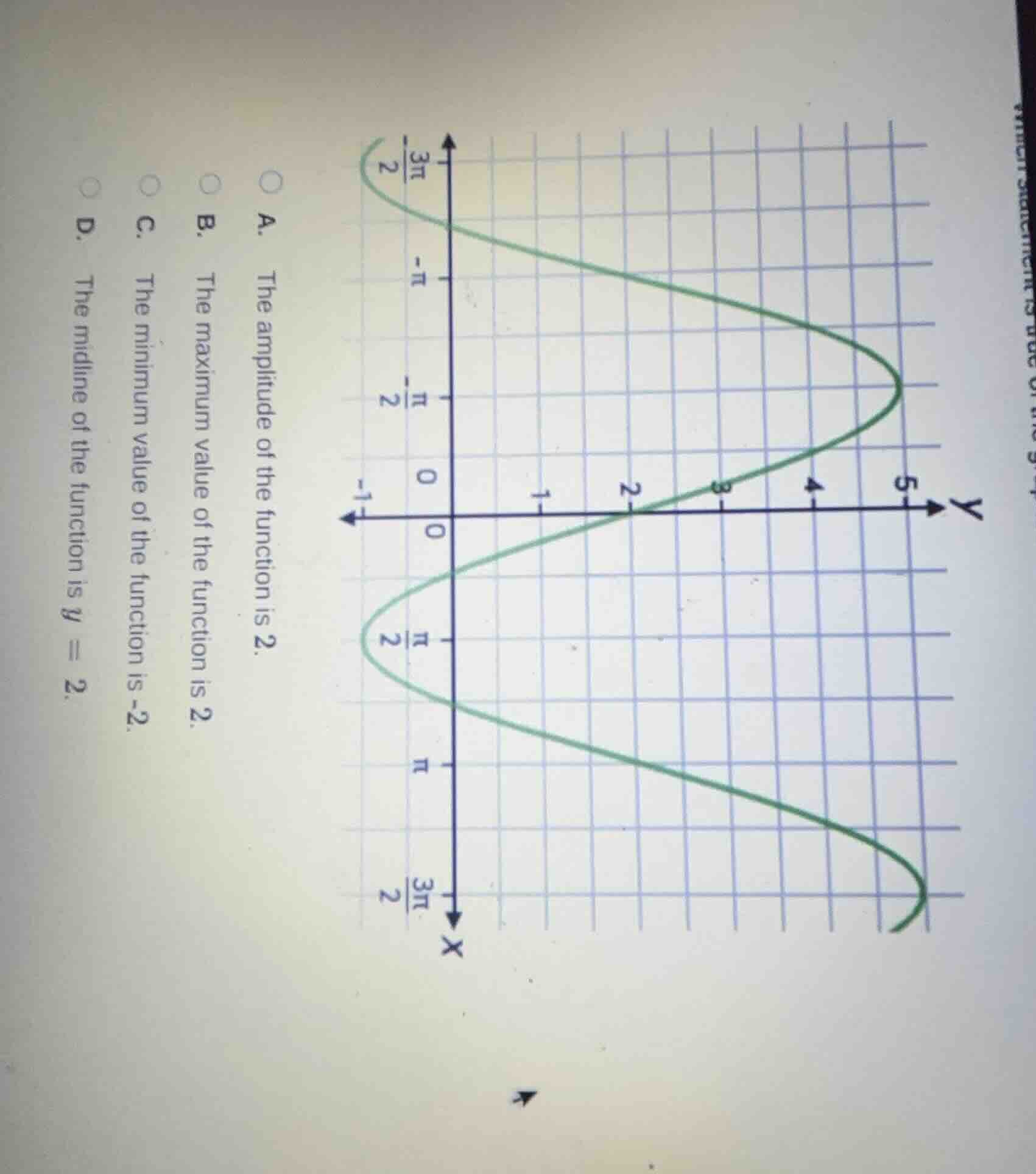
Question
a. the amplitude of the function is 2.
b. the maximum value of the function is 2.
c. the minimum value of the function is -2.
d. the midline of the function is ( y = 2 ).
Brief Explanations
To determine the correct statement, we analyze each option:
- Option A: Amplitude is half the distance between max and min. From the graph, max - min distance seems larger than 4? Wait, no, looking at y - axis, the midline? Wait, no, let's check the midline first. The midline is the horizontal line halfway between max and min. The graph crosses y = 2? Wait, no, the y - axis: the green curve, looking at the y - axis (vertical) and x - axis (horizontal). Wait, the midline: the function oscillates around a midline. Let's check the options:
- Option D: The midline is \( y = 2 \)? Wait, no, looking at the graph, the curve crosses y = 2? Wait, no, the horizontal axis (y - axis? Wait, the axes: x - axis is horizontal (labeled x) with \( -\frac{3\pi}{2},-\pi,-\frac{\pi}{2},0,\frac{\pi}{2},\pi,\frac{3\pi}{2} \), and y - axis is vertical (labeled y) with - 1,0,2,3,4,5. Wait, the green curve: one part is above y = 2, one below? Wait, no, the midline: the midline is the average of max and min y - values. Wait, the options:
- Option D: Midline \( y = 2 \). Let's see: the midline is the horizontal line that the function oscillates around. If we look at the graph, the function seems to have a midline at \( y = 2 \), because the distance from midline to max and midline to min should be equal (amplitude). Let's check other options:
- Option A: Amplitude is 2? If midline is 2, and max is, say, 5 - 2 = 3? No, wait, maybe I misread axes. Wait, the y - axis has labels 0,2,3,4,5 (vertical) and x - axis (horizontal) with \( -\frac{3\pi}{2} \) etc. Wait, the green curve: at x = 0, it crosses y = 2? Wait, the midline is y = 2, so amplitude would be the distance from midline to max (or min). If midline is 2, and max is 5 - 2 = 3? No, maybe the axes are different. Wait, the key is: the midline is the horizontal line that the function is symmetric about. Looking at the graph, the midline is \( y = 2 \), so option D is correct. Wait, let's re - evaluate:
- Option D: "The midline of the function is \( y = 2 \)". This is correct because the midline is the horizontal line halfway between the maximum and minimum values of the function, and from the graph, the function oscillates around \( y = 2 \).
- Option A: Amplitude: if midline is 2, and if max is, say, 5 - 2 = 3, then amplitude would be 3, not 2. So A is wrong.
- Option B: Maximum value: if midline is 2 and amplitude is not 2, maximum would not be 2.
- Option C: Minimum value: if midline is 2 and amplitude is not 2, minimum would not be - 2.
So the correct option is D.

Snap & solve any problem in the app
Get step-by-step solutions on Sovi AI
Photo-based solutions with guided steps
Explore more problems and detailed explanations
D. The midline of the function is \( y = 2 \)