QUESTION IMAGE
Question
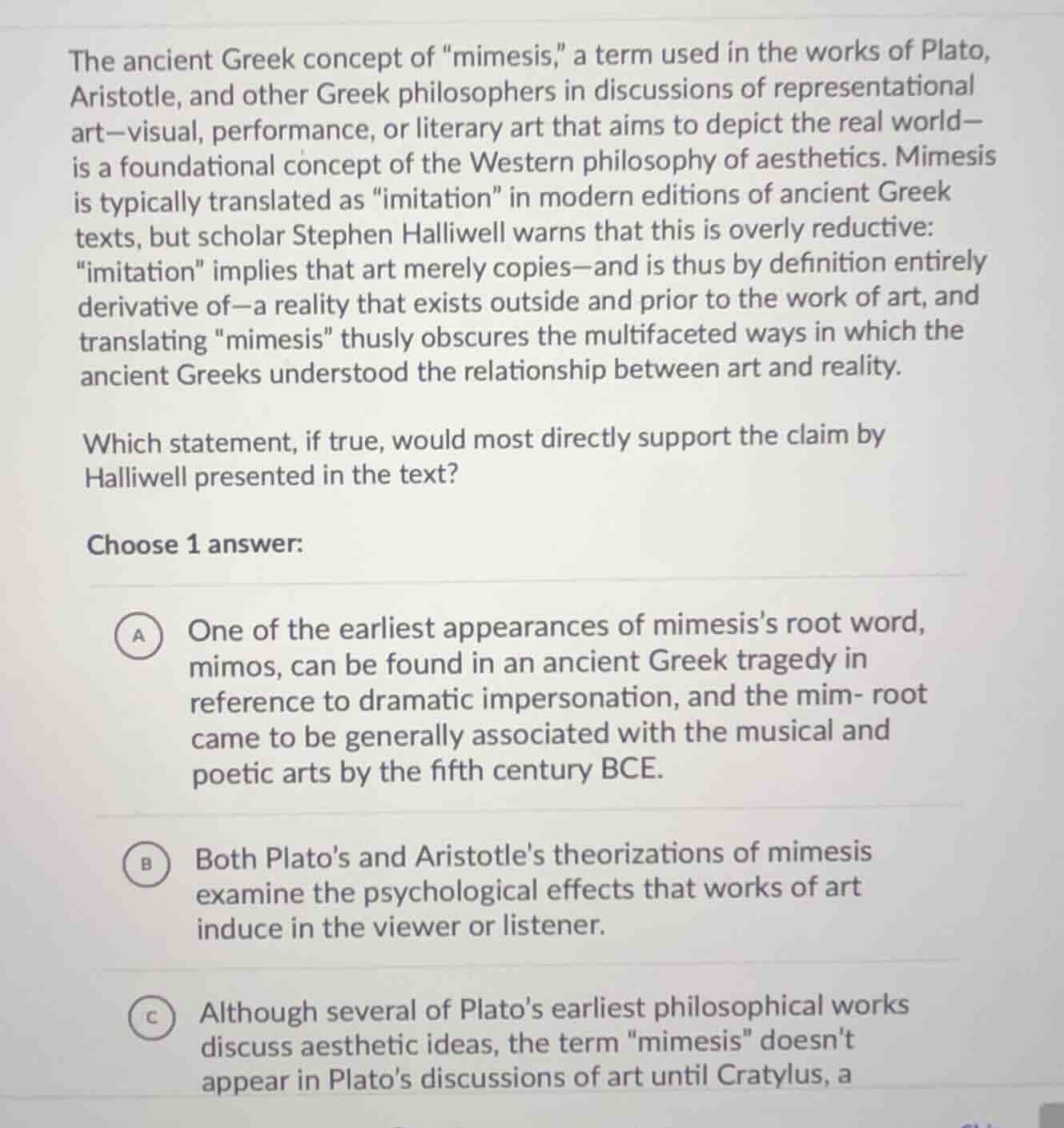
the ancient greek concept of “mimesis,” a term used in the works of plato, aristotle, and other greek philosophers in discussions of representational art—visual, performance, or literary art that aims to depict the real world—is a foundational concept of the western philosophy of aesthetics. mimesis is typically translated as “imitation” in modern editions of ancient greek texts, but scholar stephen halliwell warns that this is overly reductive: “imitation” implies that art merely copies—and is thus by definition entirely derivative of—a reality that exists outside and prior to the work of art, and translating “mimesis” thusly obscures the multifaceted ways in which the ancient greeks understood the relationship between art and reality. which statement, if true, would most directly support the claim by halliwell presented in the text? choose 1 answer: a one of the earliest appearances of mimesis’s root word, mimos, can be found in an ancient greek tragedy in reference to dramatic impersonation, and the mim- root came to be generally associated with the musical and poetic arts by the fifth century bce. b both plato’s and aristotle’s theorizations of mimesis examine the psychological effects that works of art induce in the viewer or listener. c although several of plato’s earliest philosophical works discuss aesthetic ideas, the term “mimesis” doesn’t appear in plato’s discussions of art until cratylus, a
To support Halliwell's claim that translating "mimesis" as "imitation" is reductive (as it obscures the multifaceted art - reality relationship the ancient Greeks had), we need an option that shows the diverse aspects of how "mimesis" was understood.
- Option A: It shows that the root of "mimesis" (mimos) was associated with dramatic impersonation and later with musical and poetic arts. This shows that "mimesis" had connections to different art forms, not just a simple act of copying (imitation). So it supports the idea that the "imitation" translation is too narrow.
- Option B: This focuses on the psychological effects of art in Plato and Aristotle's theories of mimesis. It doesn't relate to the multifaceted nature of the art - reality relationship or the inadequacy of the "imitation" translation.
- Option C: This is about when the term "mimesis" appeared in Plato's works, which has nothing to do with the meaning of "mimesis" or Halliwell's claim.

Snap & solve any problem in the app
Get step-by-step solutions on Sovi AI
Photo-based solutions with guided steps
Explore more problems and detailed explanations
A. One of the earliest appearances of mimesis’s root word, mimos, can be found in an ancient Greek tragedy in reference to dramatic impersonation, and the mim - root came to be generally associated with the musical and poetic arts by the fifth century BCE.