QUESTION IMAGE
Question
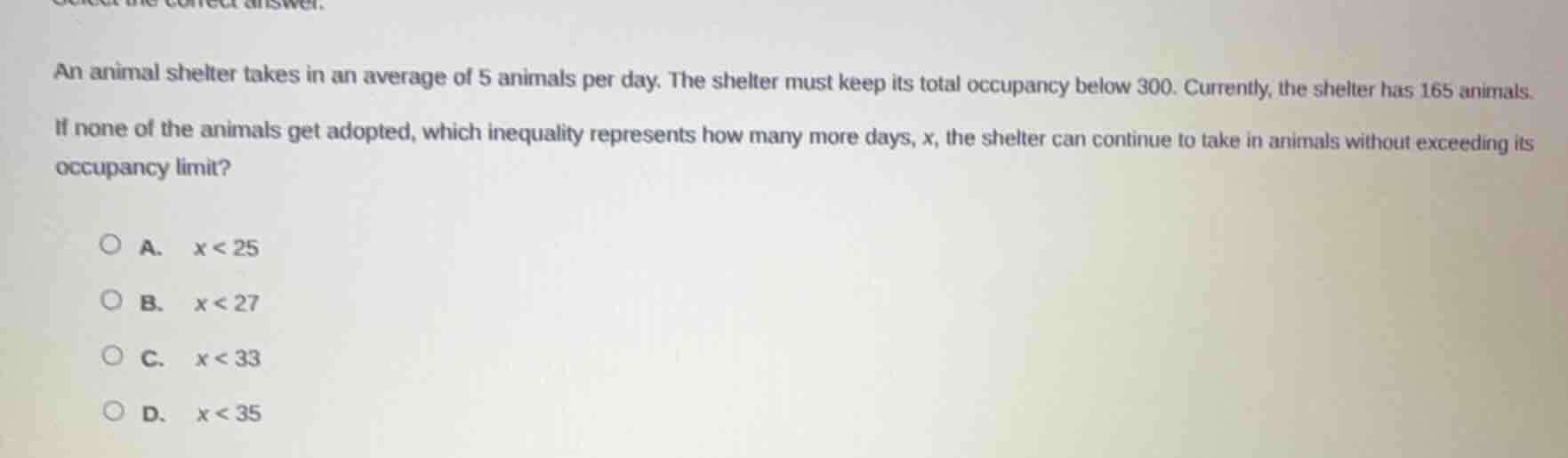
an animal shelter takes in an average of 5 animals per day. the shelter must keep its total occupancy below 300. currently, the shelter has 165 animals. if none of the animals get adopted, which inequality represents how many more days, x, the shelter can continue to take in animals without exceeding its occupancy limit?
a. ( x < 25 )
b. ( x < 27 )
c. ( x < 33 )
d. ( x < 35 )
Step1: Define the total animals
The current number of animals is 165, and the shelter takes in 5 animals per day for \( x \) days. So the total number of animals after \( x \) days is \( 165 + 5x \).
Step2: Set up the inequality
The total occupancy must be below 300, so we have the inequality \( 165 + 5x < 300 \).
Step3: Solve the inequality
Subtract 165 from both sides: \( 5x < 300 - 165 \)
Simplify the right side: \( 5x < 135 \)
Divide both sides by 5: \( x < \frac{135}{5} \)
Simplify: \( x < 27 \)

Snap & solve any problem in the app
Get step-by-step solutions on Sovi AI
Photo-based solutions with guided steps
Explore more problems and detailed explanations
B. \( x < 27 \)