QUESTION IMAGE
Question
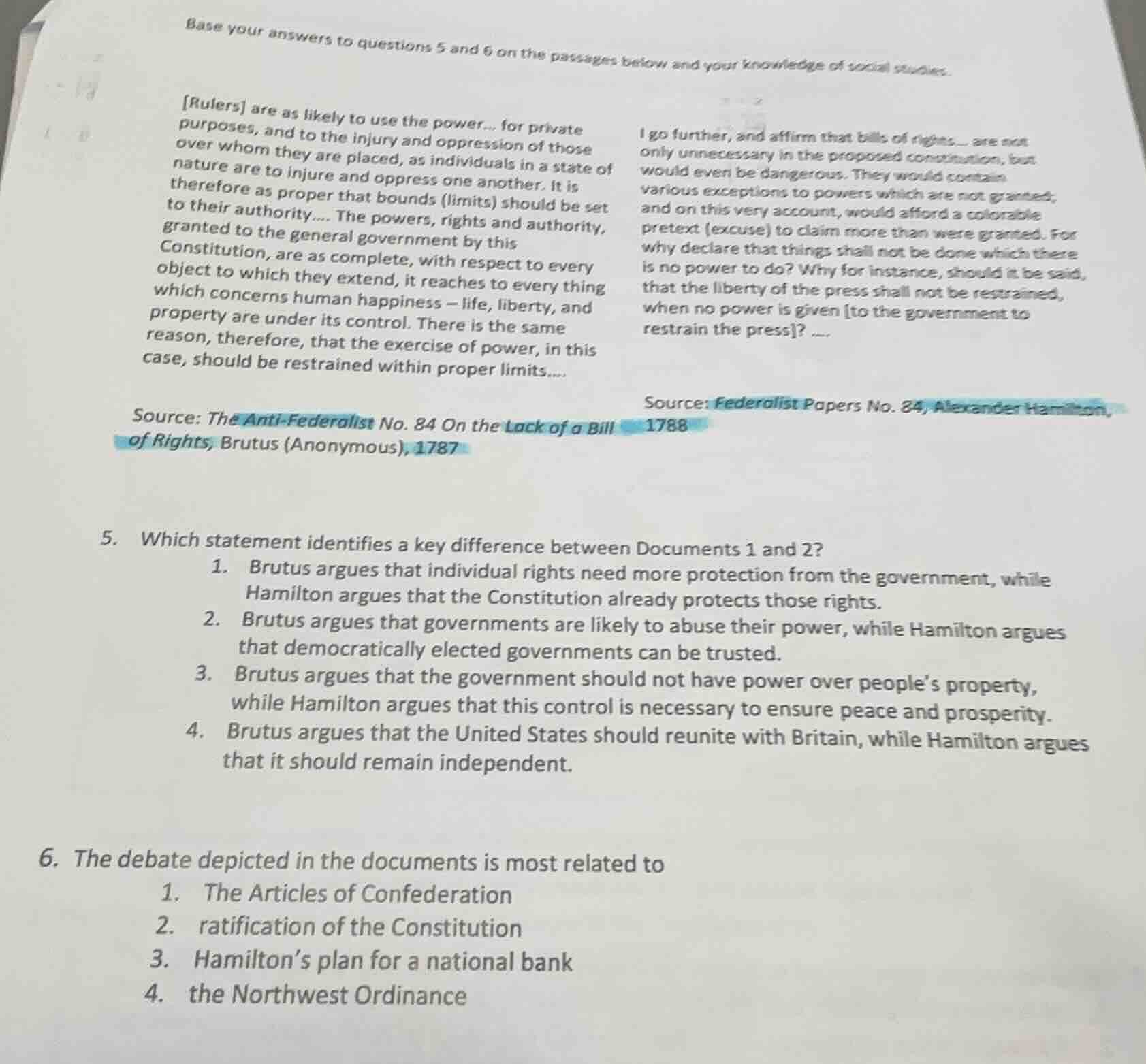
base your answers to questions 5 and 6 on the passages below and your knowledge of social studies.
rulers are as likely to use the power... for private purposes, and to the injury and oppression of those over whom they are placed, as individuals in a state of nature are to injure and oppress one another. it is therefore as proper that bounds (limits) should be set to their authority.... the powers, rights and authority, granted to the general government by this constitution, are as complete, with respect to every object to which they extend, it reaches to every thing which concerns human happiness – life, liberty, and property are under its control. there is the same reason, therefore, that the exercise of power, in this case, should be restrained within proper limits....
source: the anti - federalist no. 84 on the lack of a bill of rights, brutus (anonymous), 1787
i go further, and affirm that bills of rights... are not only unnecessary in the proposed constitution, but would even be dangerous. they would contain various exceptions to powers which are not granted; and on this very account, would afford a colorable pretext (excuse) to claim more than were granted. for why declare that things shall not be done which there is no power to do? why for instance, should it be said, that the liberty of the press shall not be restrained, when no power is given to the government to restrain the press?....
source: federalist papers no. 84, alexander hamilton, 1788
- which statement identifies a key difference between documents 1 and 2?
- brutus argues that individual rights need more protection from the government, while hamilton argues that the constitution already protects those rights.
- brutus argues that governments are likely to abuse their power, while hamilton argues that democratically elected governments can be trusted.
- brutus argues that the government should not have power over people’s property, while hamilton argues that this control is necessary to ensure peace and prosperity.
- brutus argues that the united states should reunite with britain, while hamilton argues that it should remain independent.
- the debate depicted in the documents is most related to
- the articles of confederation
- ratification of the constitution
- hamilton’s plan for a national bank
- the northwest ordinance
For question 5: Brutus (Anti-Federalist) argues government power must be restrained to protect individual rights like life, liberty, property, implying a need for explicit protection. Hamilton (Federalist) argues a bill of rights is unnecessary because the Constitution does not grant the government power to infringe on such rights, meaning he believes the document already safeguards them. Option 2 is incorrect because Hamilton does not focus on trusting elected governments, but on the limits of granted power. Option 3 is incorrect because Brutus does not say the government should have no power over property, just that power needs limits. Option 4 is irrelevant, as neither author discusses reuniting with Britain.
For question 6: The passages are from the Federalist and Anti-Federalist Papers, which were written during the debate over whether to ratify the U.S. Constitution. The core disagreement here is over the need for a bill of rights, a key issue in the ratification debate. The Articles of Confederation was a prior governing document, Hamilton's national bank was a later debate, and the Northwest Ordinance dealt with territorial governance, none of which match the topic here.

Snap & solve any problem in the app
Get step-by-step solutions on Sovi AI
Photo-based solutions with guided steps
Explore more problems and detailed explanations
- 1. Brutus argues that individual rights need more protection from the government, while Hamilton argues that the Constitution already protects those rights.
- 2. ratification of the Constitution