QUESTION IMAGE
Question
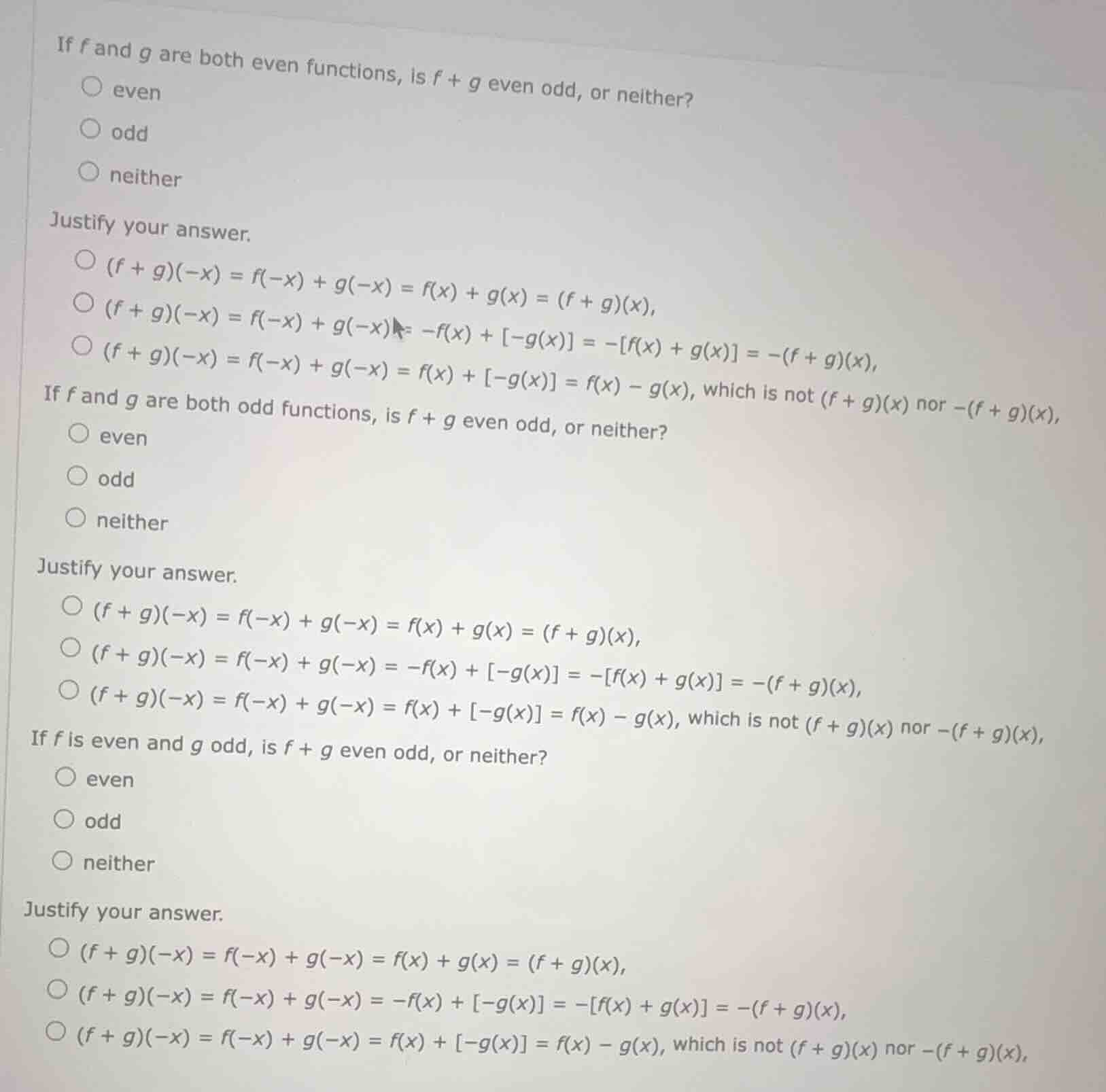
if f and g are both even functions, is f + g even odd, or neither?
even
odd
neither
justify your answer.
$(f + g)(-x) = f(-x) + g(-x) = f(x) + g(x) = (f + g)(x),$
$(f + g)(-x) = f(-x) + g(-x) = -f(x) + -g(x) = -f(x) + g(x) = -(f + g)(x),$
$(f + g)(-x) = f(-x) + g(-x) = f(x) + -g(x) = f(x) - g(x),$ which is not $(f + g)(x)$ nor $-(f + g)(x),$
if f and g are both odd functions, is f + g even odd, or neither?
even
odd
neither
justify your answer.
$(f + g)(-x) = f(-x) + g(-x) = f(x) + g(x) = (f + g)(x),$
$(f + g)(-x) = f(-x) + g(-x) = -f(x) + -g(x) = -f(x) + g(x) = -(f + g)(x),$
$(f + g)(-x) = f(-x) + g(-x) = f(x) + -g(x) = f(x) - g(x),$ which is not $(f + g)(x)$ nor $-(f + g)(x),$
if f is even and g odd, is f + g even odd, or neither?
even
odd
neither
justify your answer.
$(f + g)(-x) = f(-x) + g(-x) = f(x) + g(x) = (f + g)(x),$
$(f + g)(-x) = f(-x) + g(-x) = -f(x) + -g(x) = -f(x) + g(x) = -(f + g)(x),$
$(f + g)(-x) = f(-x) + g(-x) = f(x) + -g(x) = f(x) - g(x),$ which is not $(f + g)(x)$ nor $-(f + g)(x),$
First Question (f and g even)
To determine if \( f + g \) is even, odd, or neither when \( f \) and \( g \) are even, we use the definition of an even function: a function \( h(x) \) is even if \( h(-x)=h(x) \). For \( h(x)=f(x)+g(x) \), we calculate \( h(-x)=(f + g)(-x)=f(-x)+g(-x) \). Since \( f \) and \( g \) are even, \( f(-x)=f(x) \) and \( g(-x)=g(x) \). Thus, \( (f + g)(-x)=f(x)+g(x)=(f + g)(x) \), so \( f + g \) is even. The correct justification is the first option for this part.
For a function \( h(x) \) to be odd, \( h(-x)=-h(x) \). Let \( h(x)=f(x)+g(x) \) where \( f \) and \( g \) are odd. Then \( (f + g)(-x)=f(-x)+g(-x) \). Since \( f \) and \( g \) are odd, \( f(-x)=-f(x) \) and \( g(-x)=-g(x) \). So \( (f + g)(-x)=-f(x)-g(x)=-[f(x)+g(x)]=-(f + g)(x) \), meaning \( f + g \) is odd. The correct justification is the second option for this part.
Let \( h(x)=f(x)+g(x) \) with \( f \) even (\( f(-x)=f(x) \)) and \( g \) odd (\( g(-x)=-g(x) \)). Then \( (f + g)(-x)=f(-x)+g(-x)=f(x)-g(x) \). Now, \( (f + g)(x)=f(x)+g(x) \) and \( -(f + g)(x)=-f(x)-g(x) \). Since \( f(x)-g(x)
eq f(x)+g(x) \) (unless \( g(x)=0 \), which isn't general) and \( f(x)-g(x)
eq -f(x)-g(x) \) (unless \( f(x)=0 \), not general), \( h(-x) \) is neither equal to \( h(x) \) nor \( -h(x) \). The correct justification is the third option for this part.

Snap & solve any problem in the app
Get step-by-step solutions on Sovi AI
Photo-based solutions with guided steps
Explore more problems and detailed explanations
even
\( (f + g)(-x) = f(-x) + g(-x) = f(x) + g(x) = (f + g)(x) \)