QUESTION IMAGE
Question
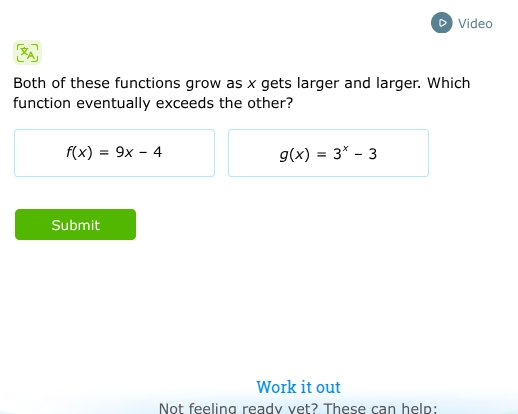
both of these functions grow as x gets larger and larger. which function eventually exceeds the other?
$f(x) = 9x - 4$
$g(x) = 3^x - 3$
Step1: Analyze the types of functions
\( f(x) = 9x - 4 \) is a linear function (degree 1 polynomial), and \( g(x)=3^{x}-3 \) is an exponential function with base \( 3>1 \).
Step2: Recall the growth rates of functions
Linear functions have a constant rate of change (slope), while exponential functions with base \( > 1 \) grow at an increasing rate, meaning their rate of change increases as \( x \) increases. For large enough values of \( x \), exponential functions will eventually outpace linear functions.
Step3: Test with large \( x \) values (optional verification)
Let's pick a large \( x \), say \( x = 10 \):
- For \( f(x) \): \( f(10)=9\times10 - 4=90 - 4 = 86 \)
- For \( g(x) \): \( g(10)=3^{10}-3 = 59049 - 3=59046 \)
Here, \( g(10)>f(10) \). As \( x \) gets even larger, the gap between \( g(x) \) and \( f(x) \) will only increase because the exponential function's growth accelerates.

Snap & solve any problem in the app
Get step-by-step solutions on Sovi AI
Photo-based solutions with guided steps
Explore more problems and detailed explanations
\( g(x)=3^{x}-3 \) (the exponential function) eventually exceeds \( f(x) = 9x - 4 \) (the linear function) as \( x \) gets larger and larger.