QUESTION IMAGE
Question
chapter 8 midterm review questions
chapter 8 - cellular energy
(photosynthesis & cellular respiration)
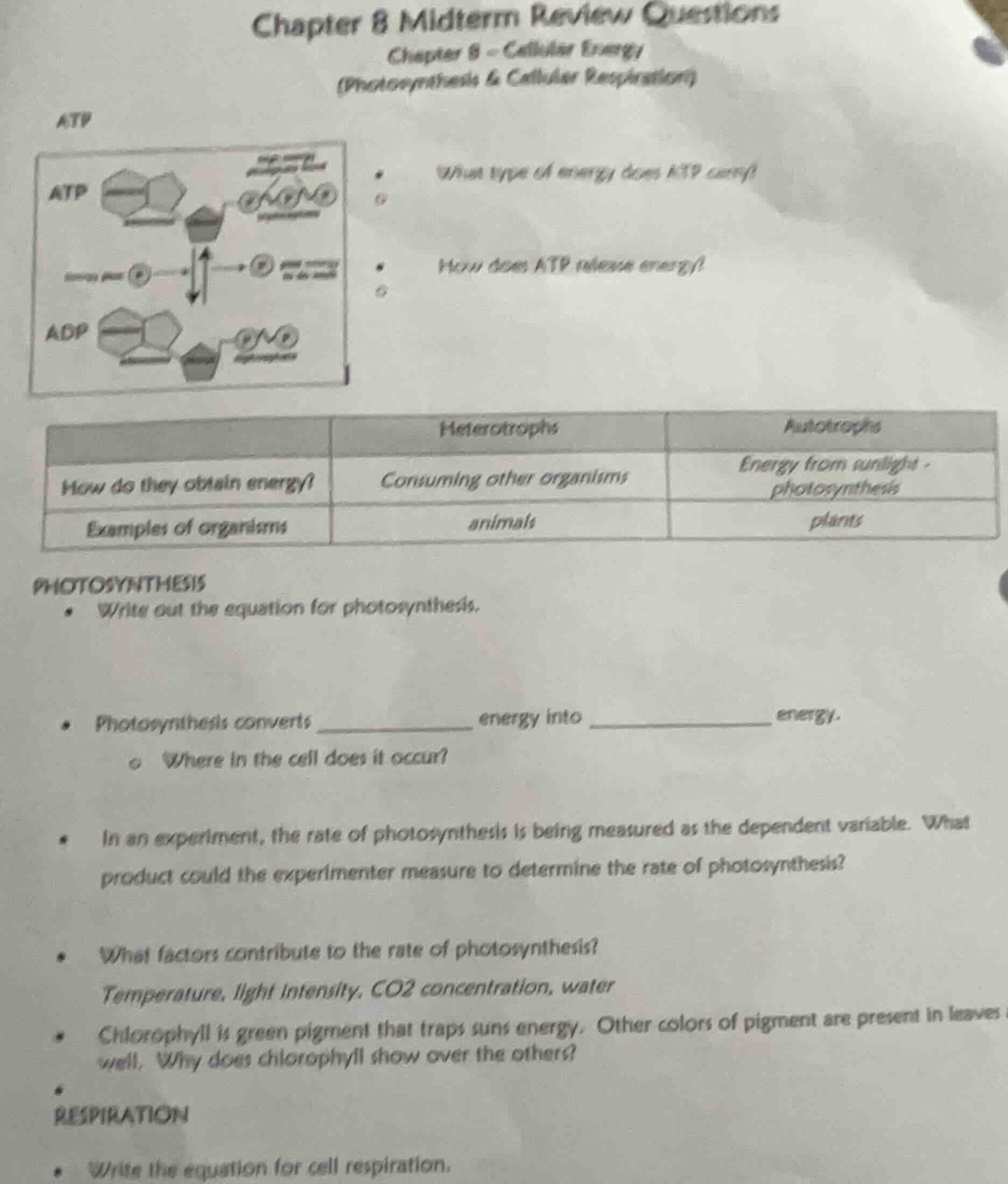
atp
- what type of energy does atp carry?
- how does atp release energy?
| heterotrophs | autotrophs | |
|---|---|---|
| examples of organisms | animals | plants |
photosynthesis
- write out the equation for photosynthesis.
- photosynthesis converts __________ energy into _____________ energy.
- where in the cell does it occur?
- in an experiment, the rate of photosynthesis is being measured as the dependent variable. what product could the experimenter measure to determine the rate of photosynthesis?
- what factors contribute to the rate of photosynthesis?
temperature, light intensity, co2 concentration, water
- chlorophyll is green pigment that traps suns energy. other colors of pigment are present in leaves well. why does chlorophyll show over the others?
respiration
- write the equation for cell respiration.
1. What type of energy does ATP carry?
ATP (adenosine triphosphate) carries chemical energy. The high - energy phosphate bonds in ATP store energy, and when these bonds are broken, the energy is released for cellular processes.
ATP releases energy when the bond between the second and third phosphate groups is broken. This reaction converts ATP into ADP (adenosine diphosphate) and an inorganic phosphate group (\(P_i\)), and the energy stored in that bond is released for use in the cell.
The general equation for photosynthesis is \(6CO_2 + 6H_2O\xrightarrow[Chlorophyll]{Light}C_6H_{12}O_6+6O_2\). Carbon dioxide and water, in the presence of light energy and chlorophyll, are converted into glucose and oxygen.

Snap & solve any problem in the app
Get step-by-step solutions on Sovi AI
Photo-based solutions with guided steps
Explore more problems and detailed explanations
Chemical energy