QUESTION IMAGE
Question
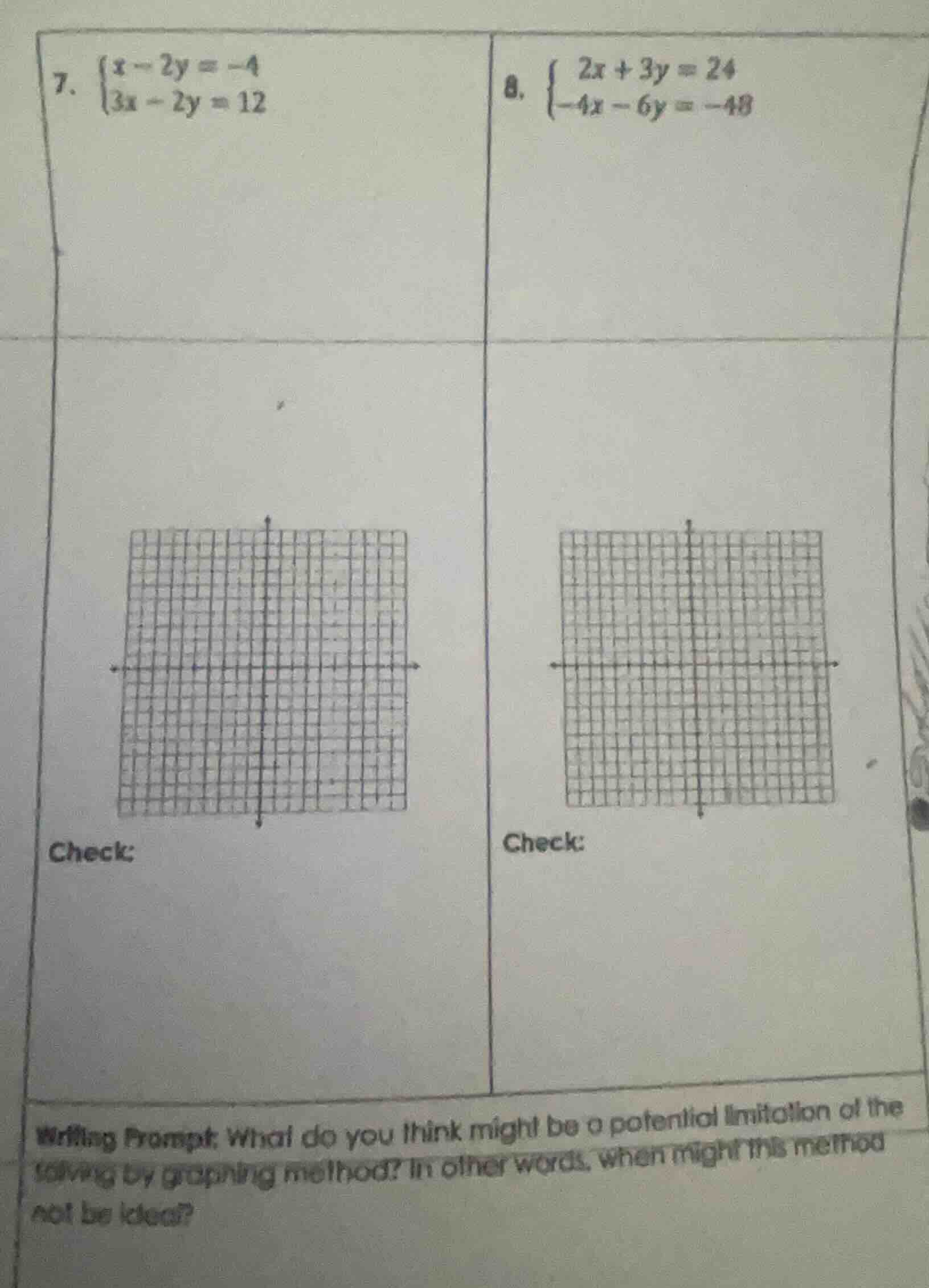
- \\(\
\\)
check:
- \\(\
\\)
check:
writing prompt: what do you think might be a potential limitation of the solving by graphing method? in other words, when might this method not be ideal?
Problem 7: Solve the system \(
\)
Step 1: Subtract the first equation from the second equation
Subtract \((x - 2y=-4)\) from \((3x - 2y = 12)\) to eliminate \(y\).
\((3x - 2y)-(x - 2y)=12-(-4)\)
Simplify the left - hand side: \(3x - 2y - x + 2y=2x\)
Simplify the right - hand side: \(12 + 4 = 16\)
So we have the equation \(2x=16\)
Step 2: Solve for \(x\)
Divide both sides of the equation \(2x = 16\) by 2:
\(x=\frac{16}{2}=8\)
Step 3: Substitute \(x = 8\) into the first equation to solve for \(y\)
Substitute \(x = 8\) into \(x-2y=-4\):
\(8-2y=-4\)
Subtract 8 from both sides: \(-2y=-4 - 8=-12\)
Divide both sides by \(-2\): \(y=\frac{-12}{-2}=6\)
Check:
Substitute \(x = 8\) and \(y = 6\) into the first equation:
Left - hand side: \(x-2y=8-2\times6=8 - 12=-4\) (which is equal to the right - hand side of the first equation)
Substitute into the second equation:
Left - hand side: \(3x-2y=3\times8-2\times6=24 - 12 = 12\) (which is equal to the right - hand side of the second equation)
Step 1: Simplify the second equation
Notice that the second equation \(-4x-6y=-48\) can be divided by \(-2\) throughout.
\(\frac{-4x}{-2}+\frac{-6y}{-2}=\frac{-48}{-2}\)
We get \(2x + 3y=24\), which is the same as the first equation.
This means that the two equations in the system are dependent (they represent the same line). So there are infinitely many solutions. The solutions are all the points \((x,y)\) that satisfy the equation \(2x + 3y=24\) (or \(y=\frac{24 - 2x}{3}=8-\frac{2}{3}x\))
Check:
Take a value of \(x\), say \(x = 0\). Then from \(2x+3y=24\), we have \(3y=24\), \(y = 8\). Substitute \(x = 0,y = 8\) into the second equation: \(-4\times0-6\times8=-48\), \(-48=-48\)
Take \(x = 3\), then from \(2x + 3y=24\), \(6 + 3y=24\), \(3y=18\), \(y = 6\). Substitute \(x = 3,y = 6\) into the second equation: \(-4\times3-6\times6=-12-36=-48\), \(-48=-48\)
One potential limitation of the graphing method is that it can be inaccurate when the solution does not have integer coordinates. For example, if the solution of a system of linear equations is \((\frac{1}{2},\frac{3}{4})\), it is difficult to plot the lines precisely enough on a graph (especially a graph with a grid of whole - number units) to identify the exact intersection point. Also, if the two lines are almost parallel (with very similar slopes), it can be hard to see if they are parallel (no solution) or if they intersect at a point that is far from the origin or in a region where the grid is not fine enough to distinguish. Another limitation is that for systems with more than two variables (e.g., a system of three linear equations in three variables), the graphing method becomes impractical as we can't easily visualize graphs in more than two dimensions.

Snap & solve any problem in the app
Get step-by-step solutions on Sovi AI
Photo-based solutions with guided steps
Explore more problems and detailed explanations
\(x = 8,y = 6\) or the solution is \((8,6)\)
Problem 8: Solve the system \(
\)