QUESTION IMAGE
Question
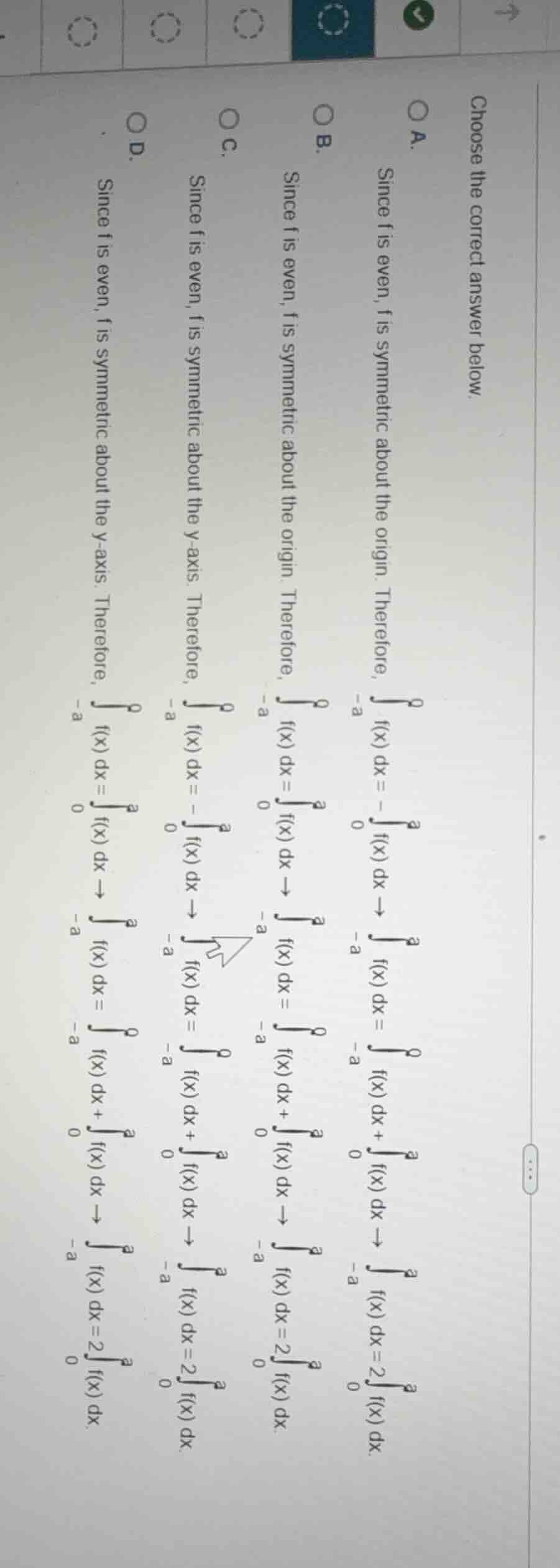
choose the correct answer below.
a. since f is even, f is symmetric about the origin. therefore, (int_{-a}^{0} f(x) dx = -int_{0}^{a} f(x) dx \to int_{-a}^{a} f(x) dx = int_{-a}^{0} f(x) dx + int_{0}^{a} f(x) dx \to int_{-a}^{a} f(x) dx = 2int_{0}^{a} f(x) dx).
b. since f is even, f is symmetric about the origin. therefore, (int_{-a}^{0} f(x) dx = int_{0}^{a} f(x) dx \to int_{-a}^{a} f(x) dx = int_{-a}^{0} f(x) dx + int_{0}^{a} f(x) dx \to int_{-a}^{a} f(x) dx = 2int_{0}^{a} f(x) dx).
c. since f is even, f is symmetric about the y - axis. therefore, (int_{-a}^{0} f(x) dx = -int_{0}^{a} f(x) dx \to int_{-a}^{a} f(x) dx = int_{-a}^{0} f(x) dx + int_{0}^{a} f(x) dx \to int_{-a}^{a} f(x) dx = 2int_{0}^{a} f(x) dx).
d. since f is even, f is symmetric about the y - axis. therefore, (int_{-a}^{0} f(x) dx = int_{0}^{a} f(x) dx \to int_{-a}^{a} f(x) dx = int_{-a}^{0} f(x) dx + int_{0}^{a} f(x) dx \to int_{-a}^{a} f(x) dx = 2int_{0}^{a} f(x) dx).
Step1: Recall even function properties
An even function satisfies $f(-x)=f(x)$, and is symmetric about the y-axis (not the origin, which is for odd functions).
Step2: Split the definite integral
For $\int_{-a}^{a} f(x) dx$, split it into two parts:
$$\int_{-a}^{a} f(x) dx = \int_{-a}^{0} f(x) dx + \int_{0}^{a} f(x) dx$$
Step3: Substitute variable for left integral
Let $u=-x$, so $du=-dx$. When $x=-a$, $u=a$; when $x=0$, $u=0$. Then:
$$\int_{-a}^{0} f(x) dx = \int_{a}^{0} f(-u) (-du) = \int_{0}^{a} f(u) du = \int_{0}^{a} f(x) dx$$
(using $f(-u)=f(u)$ for even $f$)
Step4: Combine the integrals
Substitute back into the split integral:
$$\int_{-a}^{a} f(x) dx = \int_{0}^{a} f(x) dx + \int_{0}^{a} f(x) dx = 2\int_{0}^{a} f(x) dx$$

Snap & solve any problem in the app
Get step-by-step solutions on Sovi AI
Photo-based solutions with guided steps
Explore more problems and detailed explanations
D. Since f is even, f is symmetric about the y-axis. Therefore, $\int_{-a}^{0} f(x) dx = \int_{0}^{a} f(x) dx
ightarrow \int_{-a}^{a} f(x) dx = \int_{-a}^{0} f(x) dx + \int_{0}^{a} f(x) dx
ightarrow \int_{-a}^{a} f(x) dx = 2\int_{0}^{a} f(x) dx$