QUESTION IMAGE
Question
compare the graph to the absolute value parent function ($y = |x|$). select all the transformations that apply.
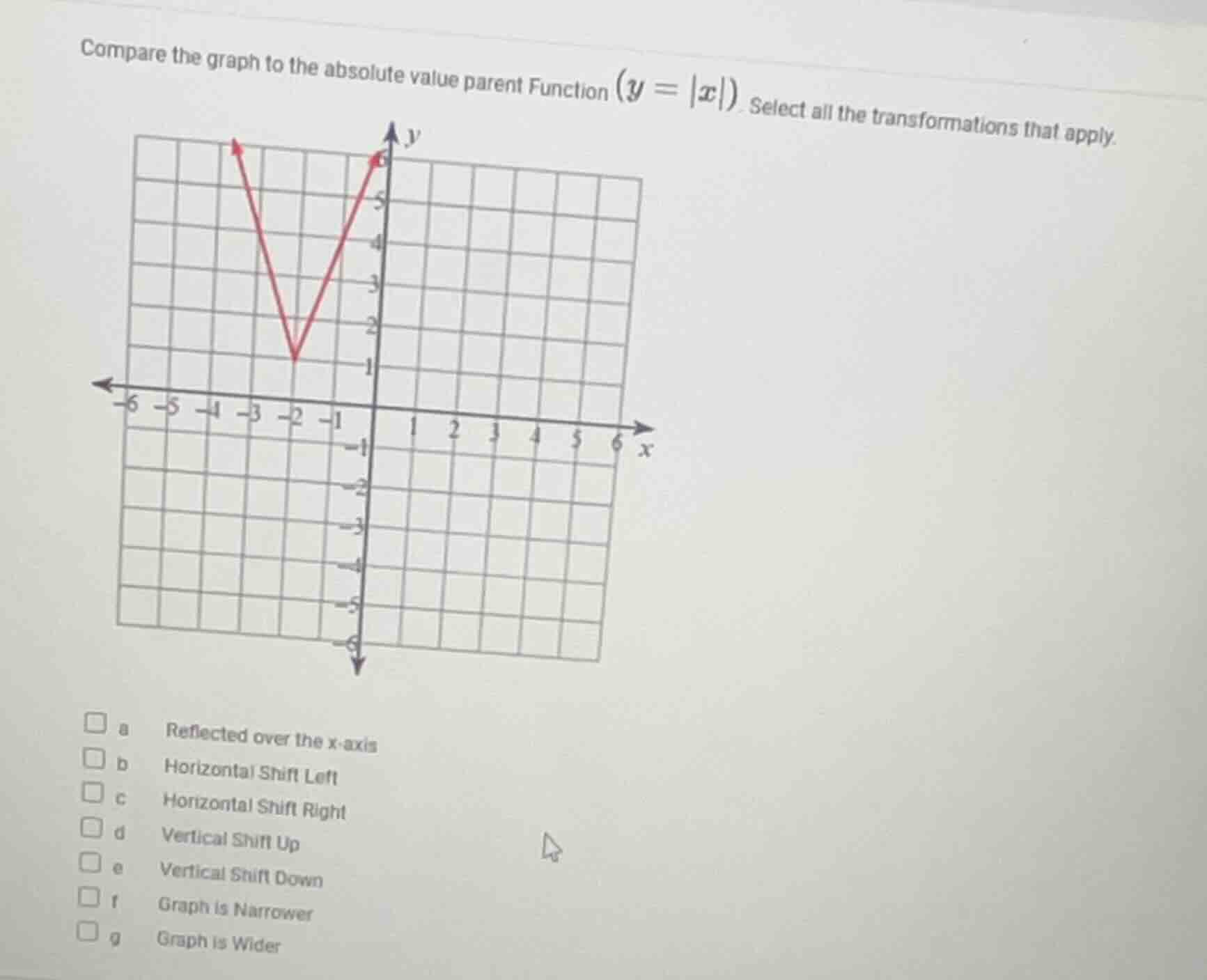
graph of a v - shaped function with vertex at (-2,1), passing through (-3,3) and (-1,3), and y - intercept at (0,6)
□ a reflected over the x - axis
□ b horizontal shift left
□ c horizontal shift right
□ d vertical shift up
□ e vertical shift down
□ f graph is narrower
□ g graph is wider
Step1: Analyze Reflection
The parent function \( y = |x| \) opens upwards. The given graph also opens upwards, so no reflection over the x - axis (option a is out).
Step2: Analyze Horizontal Shift
The vertex of \( y = |x| \) is at \( (0,0) \). The vertex of the given graph is at \( (- 2,1) \). To get from \( x = 0 \) to \( x=-2 \), we shift left by 2 units (so option b: Horizontal Shift Left applies).
Step3: Analyze Vertical Shift
The y - coordinate of the vertex of \( y = |x| \) is 0, and for the given graph, it is 1. So we shift up by 1 unit (option d: Vertical Shift Up applies).
Step4: Analyze Width (Stretch/Compression)
The slope of \( y = |x| \) is \( \pm1 \). Let's find the slope of the given graph. Take two points, say from the left side: when \( x=-3 \), \( y = 6 \) (wait, no, the vertex is at \( (-2,1) \), when \( x=-3 \), let's see the graph. Wait, the left side: from \( (-2,1) \) to \( (-3,6) \)? No, looking at the graph, when \( x=-2 \), \( y = 1 \); when \( x=-3 \), \( y = 6 \)? Wait, no, the grid: each square is 1 unit. Wait, the vertex is at \( (-2,1) \), and when \( x=-1 \), \( y = 6 \)? Wait, no, the red line: at \( x = 0 \), \( y=6 \)? Wait, maybe I misread. Wait, the parent function \( y = |x| \): for \( x = 1 \), \( y = 1 \); \( x = 2 \), \( y = 2 \). For the given graph, at \( x=-1 \), let's see the y - value. Wait, the vertex is at \( (-2,1) \), and when \( x=-1 \), the y - value is, from the graph, it seems to be 6? Wait, no, the grid: the y - axis has marks at 1,2,3,4,5,6. Wait, the left side: from \( (-2,1) \) to \( (-3,6) \)? No, maybe the slope. Let's take two points on the right side of the vertex: vertex at \( (-2,1) \), when \( x=-1 \), \( y = 6 \)? Wait, no, the graph at \( x = 0 \) has \( y=6 \)? Wait, maybe the function is \( y=|x + 2|+1 \)? Wait, no, let's check the slope. For \( y = |x| \), the rate of change is 1. For the given graph, from \( x=-2 \) (vertex) to \( x=-1 \), the change in x is 1, change in y: let's see the graph, at \( x=-1 \), y is 6? Wait, no, the vertex is at \( (-2,1) \), and when \( x=-1 \), the y - value is 6? Wait, that would mean the slope is \( \frac{6 - 1}{-1-(-2)}=\frac{5}{1}=5 \), which is steeper than the parent function (slope \( \pm1 \)). So the graph is narrower (since the absolute value of the slope is greater than 1, which means a vertical stretch, making the graph narrower). So option f: Graph is Narrower applies. Option g (wider) is out.

Snap & solve any problem in the app
Get step-by-step solutions on Sovi AI
Photo-based solutions with guided steps
Explore more problems and detailed explanations
b. Horizontal Shift Left, d. Vertical Shift Up, f. Graph is Narrower