QUESTION IMAGE
Question
1
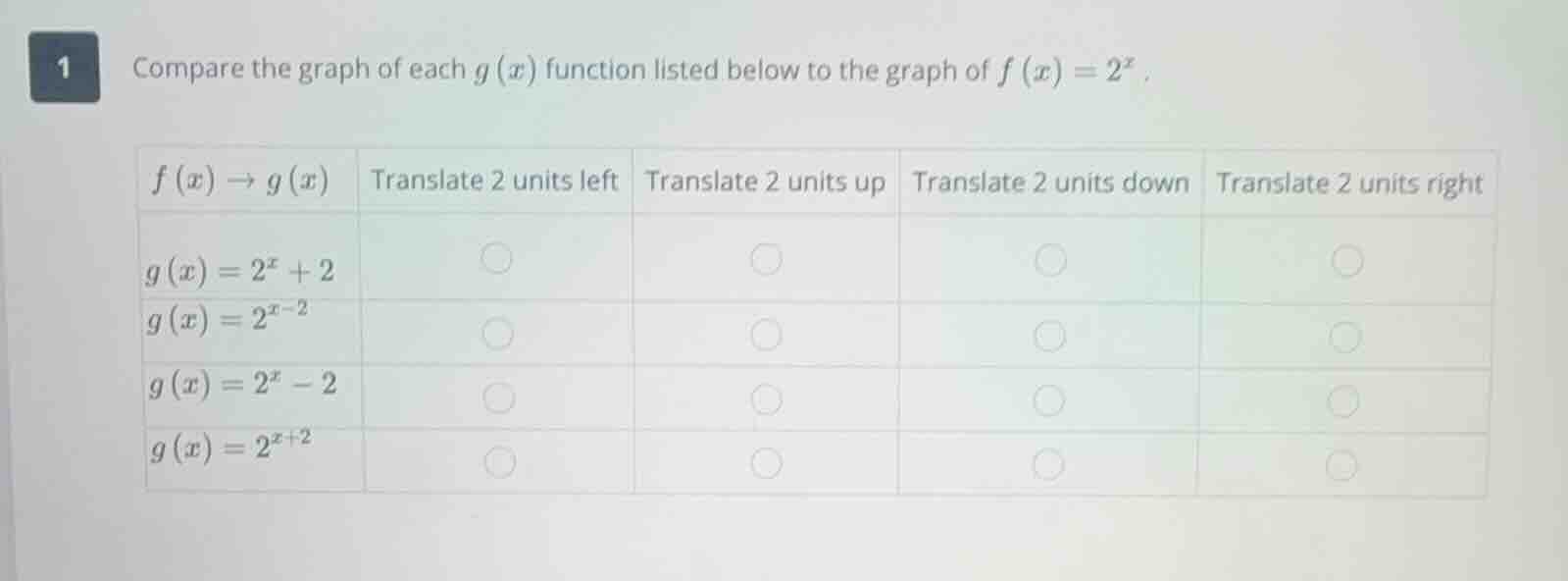
compare the graph of each ( g(x) ) function listed below to the graph of ( f(x) = 2^x ).
| ( f(x) \to g(x) ) | translate 2 units left | translate 2 units up | translate 2 units down | translate 2 units right |
|---|---|---|---|---|
| ( g(x) = 2^{x - 2} ) | ( circ ) | ( circ ) | ( circ ) | ( circ ) |
| ( g(x) = 2^x - 2 ) | ( circ ) | ( circ ) | ( circ ) | ( circ ) |
| ( g(x) = 2^{x + 2} ) | ( circ ) | ( circ ) | ( circ ) | ( circ ) |
To solve this, we use the rules of function transformations:
- For vertical shifts: \( g(x) = f(x) + k \) shifts \( f(x) \) up by \( k \) (if \( k>0 \)) or down by \( |k| \) (if \( k<0 \)).
- For horizontal shifts: \( g(x) = f(x - h) \) shifts \( f(x) \) right by \( h \) (if \( h>0 \)) or left by \( |h| \) (if \( h<0 \)).
For \( g(x) = 2^x + 2 \):
This is \( f(x) + 2 \) (where \( f(x) = 2^x \)). By vertical shift rule, adding 2 shifts the graph 2 units up.
For \( g(x) = 2^{x - 2} \):
This is \( f(x - 2) \) (where \( f(x) = 2^x \)). By horizontal shift rule, \( h = 2>0 \), so it shifts the graph 2 units right.
For \( g(x) = 2^x - 2 \):
This is \( f(x) - 2 \) (where \( f(x) = 2^x \)). By vertical shift rule, subtracting 2 shifts the graph 2 units down.
For \( g(x) = 2^{x + 2} \):
Rewrite as \( 2^{(x - (-2))} \), so this is \( f(x - (-2)) \) (where \( f(x) = 2^x \)). By horizontal shift rule, \( h = -2 \), so it shifts the graph 2 units left (since \( h<0 \)).
Final Table (with selections):
| \( f(x) \to g(x) \) | Translate 2 units left | Translate 2 units up | Translate 2 units down | Translate 2 units right |
|---|---|---|---|---|
| \( g(x) = 2^{x - 2} \) | \(\boldsymbol{\circ}\) | |||
| \( g(x) = 2^x - 2 \) | \(\boldsymbol{\circ}\) | |||
| \( g(x) = 2^{x + 2} \) | \(\boldsymbol{\circ}\) |
(Note: In the table, mark the correct column with \(\boldsymbol{\circ}\) for each \( g(x) \).)

Snap & solve any problem in the app
Get step-by-step solutions on Sovi AI
Photo-based solutions with guided steps
Explore more problems and detailed explanations
To solve this, we use the rules of function transformations:
- For vertical shifts: \( g(x) = f(x) + k \) shifts \( f(x) \) up by \( k \) (if \( k>0 \)) or down by \( |k| \) (if \( k<0 \)).
- For horizontal shifts: \( g(x) = f(x - h) \) shifts \( f(x) \) right by \( h \) (if \( h>0 \)) or left by \( |h| \) (if \( h<0 \)).
For \( g(x) = 2^x + 2 \):
This is \( f(x) + 2 \) (where \( f(x) = 2^x \)). By vertical shift rule, adding 2 shifts the graph 2 units up.
For \( g(x) = 2^{x - 2} \):
This is \( f(x - 2) \) (where \( f(x) = 2^x \)). By horizontal shift rule, \( h = 2>0 \), so it shifts the graph 2 units right.
For \( g(x) = 2^x - 2 \):
This is \( f(x) - 2 \) (where \( f(x) = 2^x \)). By vertical shift rule, subtracting 2 shifts the graph 2 units down.
For \( g(x) = 2^{x + 2} \):
Rewrite as \( 2^{(x - (-2))} \), so this is \( f(x - (-2)) \) (where \( f(x) = 2^x \)). By horizontal shift rule, \( h = -2 \), so it shifts the graph 2 units left (since \( h<0 \)).
Final Table (with selections):
| \( f(x) \to g(x) \) | Translate 2 units left | Translate 2 units up | Translate 2 units down | Translate 2 units right |
|---|---|---|---|---|
| \( g(x) = 2^{x - 2} \) | \(\boldsymbol{\circ}\) | |||
| \( g(x) = 2^x - 2 \) | \(\boldsymbol{\circ}\) | |||
| \( g(x) = 2^{x + 2} \) | \(\boldsymbol{\circ}\) |
(Note: In the table, mark the correct column with \(\boldsymbol{\circ}\) for each \( g(x) \).)