QUESTION IMAGE
Question
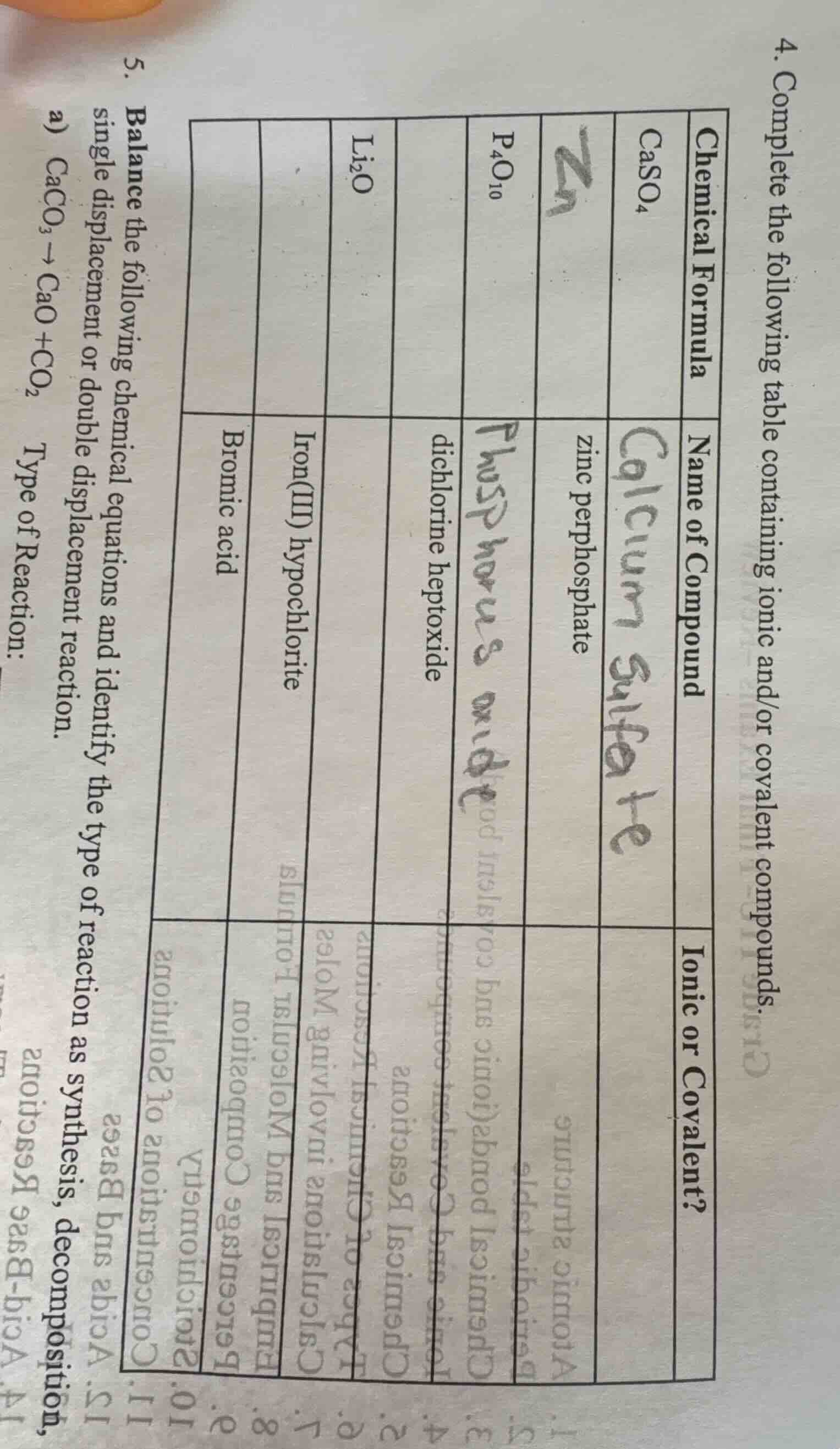
- complete the following table containing ionic and/or covalent compounds.
| chemical formula | name of compound | ionic or covalent? |
|---|---|---|
| zinc perphosphate | ||
| p₄o₁₀ | phosphorus pentoxide | |
| dichlorine heptoxide | ||
| li₂o | ||
| iron(iii) hypochlorite | ||
| bromic acid |
- balance the following chemical equations and identify the type of reaction as synthesis, decomposition, single displacement or double displacement reaction.
a) caco₃ → cao + co₂
type of reaction:
Problem 4: Completing the Table (Chemical Compounds)
Let's tackle each row of the table:
1. Chemical Formula: $\boldsymbol{CaSO_4}$
- Name of Compound: Calcium Sulfate (Calcium is $Ca^{2+}$, Sulfate is $SO_4^{2-}$; charge balance: $2+ + 2- = 0$)
- Ionic or Covalent?: Ionic (formed from metal cation $Ca^{2+}$ and polyatomic anion $SO_4^{2-}$)
2. Chemical Formula: (Assuming "Zn" was a typo, likely $\boldsymbol{Zn_3(PO_3)_4}$ for Zinc Perphosphate)
- Name of Compound: Zinc Perphosphate (Zinc is $Zn^{2+}$, Perphosphate is $PO_3^{1-}$; to balance: $3 \times 2+ + 4 \times 3 \times 1- = 0$ → $Zn_3(PO_3)_4$)
- Ionic or Covalent?: Ionic (metal cation $Zn^{2+}$ and polyatomic anion $PO_3^{-}$)
3. Chemical Formula: $\boldsymbol{P_4O_{10}}$
- Name of Compound: Tetraphosphorus Decoxide (Covalent compound; prefixes: tetra- (4 P), deca- (10 O))
- Ionic or Covalent?: Covalent (formed from nonmetals P and O, sharing electrons)
4. Chemical Formula: (Assuming "dichlorine heptoxide" → $\boldsymbol{Cl_2O_7}$)
- Name of Compound: Dichlorine Heptoxide (Covalent; di- (2 Cl), hepta- (7 O))
- Ionic or Covalent?: Covalent (nonmetals Cl and O)
5. Chemical Formula: $\boldsymbol{Li_2O}$
- Name of Compound: Lithium Oxide (Lithium is $Li^+$, Oxide is $O^{2-}$; balance: $2 \times 1+ + 2- = 0$ → $Li_2O$)
- Ionic or Covalent?: Ionic (metal Li and nonmetal O)
6. Chemical Formula: (Iron(III) Hypochlorite → $\boldsymbol{Fe(ClO)_3}$)
- Name of Compound: Iron(III) Hypochlorite (Iron(III) is $Fe^{3+}$, Hypochlorite is $ClO^-$; balance: $3+ + 3 \times 1- = 0$ → $Fe(ClO)_3$)
- Ionic or Covalent?: Ionic (metal cation $Fe^{3+}$ and polyatomic anion $ClO^-$)
7. Chemical Formula: (Bromic Acid → $\boldsymbol{HBrO_3}$)
- Name of Compound: Bromic Acid (Acid with bromine; $H^+$ and $BrO_3^-$)
- Ionic or Covalent?: Ionic (dissociates into $H^+$ and $BrO_3^-$ in water)
Problem 5a: Balancing and Identifying Reaction Type
Reaction: $\boldsymbol{CaCO_3
ightarrow CaO + CO_2}$
Step 1: Check Atoms
- Ca: 1 on left, 1 on right.
- C: 1 on left, 1 on right.
- O: 3 on left ($CaCO_3$: 3 O), 3 on right ($CaO$: 1 O; $CO_2$: 2 O → 1+2=3 O).
The equation is already balanced: $CaCO_3
ightarrow CaO + CO_2$
Step 2: Identify Reaction Type
A decomposition reaction breaks a compound into simpler substances. Here, $CaCO_3$ (one compound) decomposes into $CaO$ and $CO_2$ (two simpler substances).
Final Answers (Table Completion for Key Rows):
| Chemical Formula | Name of Compound | Ionic or Covalent? |
|---|---|---|
| $Zn_3(PO_3)_4$ | Zinc Perphosphate | Ionic |
| $P_4O_{10}$ | Tetraphosphorus Decoxide | Covalent |
| $Cl_2O_7$ | Dichlorine Heptoxide | Covalent |
| $Li_2O$ | Lithium Oxide | Ionic |
| $Fe(ClO)_3$ | Iron(III) Hypochlorite | Ionic |
| $HBrO_3$ | Bromic Acid | Ionic |
Reaction 5a:
- Balanced Equation: $CaCO_3
ightarrow CaO + CO_2$
- Type of Reaction: Decomposition

Snap & solve any problem in the app
Get step-by-step solutions on Sovi AI
Photo-based solutions with guided steps
Explore more problems and detailed explanations
Problem 4: Completing the Table (Chemical Compounds)
Let's tackle each row of the table:
1. Chemical Formula: $\boldsymbol{CaSO_4}$
- Name of Compound: Calcium Sulfate (Calcium is $Ca^{2+}$, Sulfate is $SO_4^{2-}$; charge balance: $2+ + 2- = 0$)
- Ionic or Covalent?: Ionic (formed from metal cation $Ca^{2+}$ and polyatomic anion $SO_4^{2-}$)
2. Chemical Formula: (Assuming "Zn" was a typo, likely $\boldsymbol{Zn_3(PO_3)_4}$ for Zinc Perphosphate)
- Name of Compound: Zinc Perphosphate (Zinc is $Zn^{2+}$, Perphosphate is $PO_3^{1-}$; to balance: $3 \times 2+ + 4 \times 3 \times 1- = 0$ → $Zn_3(PO_3)_4$)
- Ionic or Covalent?: Ionic (metal cation $Zn^{2+}$ and polyatomic anion $PO_3^{-}$)
3. Chemical Formula: $\boldsymbol{P_4O_{10}}$
- Name of Compound: Tetraphosphorus Decoxide (Covalent compound; prefixes: tetra- (4 P), deca- (10 O))
- Ionic or Covalent?: Covalent (formed from nonmetals P and O, sharing electrons)
4. Chemical Formula: (Assuming "dichlorine heptoxide" → $\boldsymbol{Cl_2O_7}$)
- Name of Compound: Dichlorine Heptoxide (Covalent; di- (2 Cl), hepta- (7 O))
- Ionic or Covalent?: Covalent (nonmetals Cl and O)
5. Chemical Formula: $\boldsymbol{Li_2O}$
- Name of Compound: Lithium Oxide (Lithium is $Li^+$, Oxide is $O^{2-}$; balance: $2 \times 1+ + 2- = 0$ → $Li_2O$)
- Ionic or Covalent?: Ionic (metal Li and nonmetal O)
6. Chemical Formula: (Iron(III) Hypochlorite → $\boldsymbol{Fe(ClO)_3}$)
- Name of Compound: Iron(III) Hypochlorite (Iron(III) is $Fe^{3+}$, Hypochlorite is $ClO^-$; balance: $3+ + 3 \times 1- = 0$ → $Fe(ClO)_3$)
- Ionic or Covalent?: Ionic (metal cation $Fe^{3+}$ and polyatomic anion $ClO^-$)
7. Chemical Formula: (Bromic Acid → $\boldsymbol{HBrO_3}$)
- Name of Compound: Bromic Acid (Acid with bromine; $H^+$ and $BrO_3^-$)
- Ionic or Covalent?: Ionic (dissociates into $H^+$ and $BrO_3^-$ in water)
Problem 5a: Balancing and Identifying Reaction Type
Reaction: $\boldsymbol{CaCO_3
ightarrow CaO + CO_2}$
Step 1: Check Atoms
- Ca: 1 on left, 1 on right.
- C: 1 on left, 1 on right.
- O: 3 on left ($CaCO_3$: 3 O), 3 on right ($CaO$: 1 O; $CO_2$: 2 O → 1+2=3 O).
The equation is already balanced: $CaCO_3
ightarrow CaO + CO_2$
Step 2: Identify Reaction Type
A decomposition reaction breaks a compound into simpler substances. Here, $CaCO_3$ (one compound) decomposes into $CaO$ and $CO_2$ (two simpler substances).
Final Answers (Table Completion for Key Rows):
| Chemical Formula | Name of Compound | Ionic or Covalent? |
|---|---|---|
| $Zn_3(PO_3)_4$ | Zinc Perphosphate | Ionic |
| $P_4O_{10}$ | Tetraphosphorus Decoxide | Covalent |
| $Cl_2O_7$ | Dichlorine Heptoxide | Covalent |
| $Li_2O$ | Lithium Oxide | Ionic |
| $Fe(ClO)_3$ | Iron(III) Hypochlorite | Ionic |
| $HBrO_3$ | Bromic Acid | Ionic |
Reaction 5a:
- Balanced Equation: $CaCO_3
ightarrow CaO + CO_2$
- Type of Reaction: Decomposition