QUESTION IMAGE
Question
- the complete graphs of ( y = f(x) ) and ( y = g(x) ) are shown.
a. find ( g(f(1)) ).
b. find ( g^{-1}(3) ).
Part (a): Find \( g(f(1)) \)
Step 1: Find \( f(1) \)
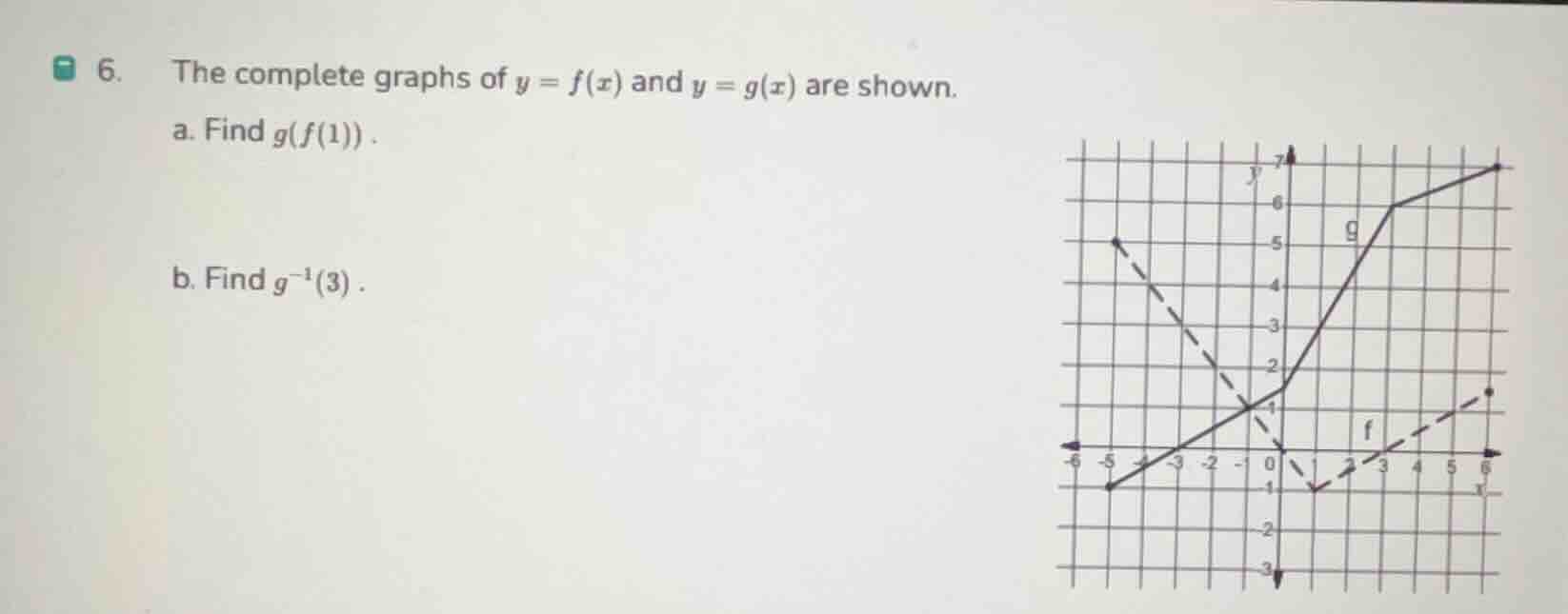
To find \( f(1) \), we look at the graph of \( y = f(x) \). The graph of \( f(x) \) is the dashed line. When \( x = 1 \), we find the corresponding \( y \)-value on the graph of \( f \). From the graph, when \( x = 1 \), \( f(1) = -1 \) (since the dashed line passes through \( (1, -1) \)).
Step 2: Find \( g(f(1)) = g(-1) \)
Now we need to find \( g(-1) \) using the graph of \( y = g(x) \) (the solid line). We look for the \( y \)-value on \( g(x) \) when \( x = -1 \). From the graph, when \( x = -1 \), the \( y \)-value of \( g(x) \) is \( 1 \) (since the solid line passes through \( (-1, 1) \)).
Part (b): Find \( g^{-1}(3) \)
Step 1: Recall the definition of an inverse function
The inverse function \( g^{-1}(y) \) gives the \( x \)-value such that \( g(x) = y \). So, to find \( g^{-1}(3) \), we need to find the \( x \)-value where \( g(x) = 3 \).
Step 2: Find \( x \) such that \( g(x) = 3 \)
Looking at the graph of \( y = g(x) \) (the solid line), we find the point where \( y = 3 \) and determine the corresponding \( x \)-value. From the graph, when \( y = 3 \), the \( x \)-value is \( 0 \) (since the solid line passes through \( (0, 3) \)). Therefore, \( g(0) = 3 \), which means \( g^{-1}(3) = 0 \).
Final Answers
Part (a)
\( g(f(1)) = \boxed{1} \)
Part (b)
\( g^{-1}(3) = \boxed{0} \)

Snap & solve any problem in the app
Get step-by-step solutions on Sovi AI
Photo-based solutions with guided steps
Explore more problems and detailed explanations
Part (a): Find \( g(f(1)) \)
Step 1: Find \( f(1) \)
To find \( f(1) \), we look at the graph of \( y = f(x) \). The graph of \( f(x) \) is the dashed line. When \( x = 1 \), we find the corresponding \( y \)-value on the graph of \( f \). From the graph, when \( x = 1 \), \( f(1) = -1 \) (since the dashed line passes through \( (1, -1) \)).
Step 2: Find \( g(f(1)) = g(-1) \)
Now we need to find \( g(-1) \) using the graph of \( y = g(x) \) (the solid line). We look for the \( y \)-value on \( g(x) \) when \( x = -1 \). From the graph, when \( x = -1 \), the \( y \)-value of \( g(x) \) is \( 1 \) (since the solid line passes through \( (-1, 1) \)).
Part (b): Find \( g^{-1}(3) \)
Step 1: Recall the definition of an inverse function
The inverse function \( g^{-1}(y) \) gives the \( x \)-value such that \( g(x) = y \). So, to find \( g^{-1}(3) \), we need to find the \( x \)-value where \( g(x) = 3 \).
Step 2: Find \( x \) such that \( g(x) = 3 \)
Looking at the graph of \( y = g(x) \) (the solid line), we find the point where \( y = 3 \) and determine the corresponding \( x \)-value. From the graph, when \( y = 3 \), the \( x \)-value is \( 0 \) (since the solid line passes through \( (0, 3) \)). Therefore, \( g(0) = 3 \), which means \( g^{-1}(3) = 0 \).
Final Answers
Part (a)
\( g(f(1)) = \boxed{1} \)
Part (b)
\( g^{-1}(3) = \boxed{0} \)