QUESTION IMAGE
Question
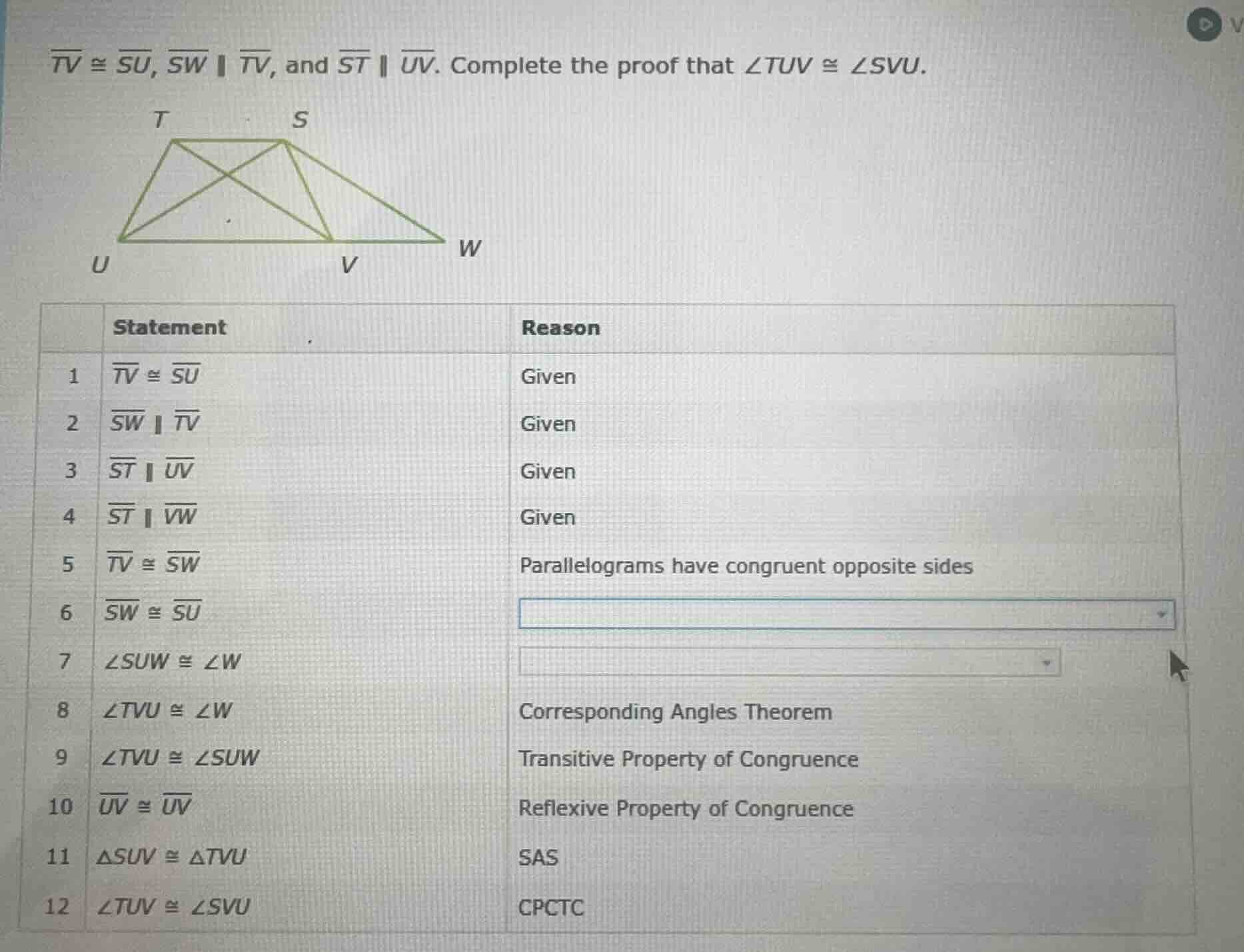
$\overline{tv} \cong \overline{su}$, $\overline{sw} \parallel \overline{tv}$, and $\overline{st} \parallel \overline{uv}$. complete the proof that $\angle tuv \cong \angle svu$.
| statement | reason | |
|---|---|---|
| 2 | $\overline{sw} \parallel \overline{tv}$ | given |
| 3 | $\overline{st} \parallel \overline{uv}$ | given |
| 4 | $\overline{st} \parallel \overline{vw}$ | given |
| 5 | $\overline{tv} \cong \overline{sw}$ | parallelograms have congruent opposite sides |
| 6 | $\overline{sw} \cong \overline{su}$ | |
| 7 | $\angle suw \cong \angle w$ | |
| 8 | $\angle tvu \cong \angle w$ | corresponding angles theorem |
| 9 | $\angle tvu \cong \angle suw$ | transitive property of congruence |
| 10 | $\overline{uv} \cong \overline{uv}$ | reflexive property of congruence |
| 11 | $\triangle suv \cong \triangle tvu$ | sas |
| 12 | $\angle tuv \cong \angle svu$ | cpctc |
For Statement 6:
Step1: Identify known congruences
We know from Statement 1 that $\overline{TV} \cong \overline{SU}$ and from Statement 5 that $\overline{TV} \cong \overline{SW}$.
Step2: Apply Transitive Property
The Transitive Property of Congruence states that if $a \cong b$ and $b \cong c$, then $a \cong c$. Here, let $a = \overline{SW}$, $b = \overline{TV}$, and $c = \overline{SU}$. Since $\overline{TV} \cong \overline{SU}$ (Statement 1) and $\overline{TV} \cong \overline{SW}$ (Statement 5), by the Transitive Property of Congruence, we can conclude that $\overline{SW} \cong \overline{SU}$.
For Statement 7:
Step1: Identify triangle type
Since $\overline{SW} \cong \overline{SU}$ (from Statement 6), triangle $SUW$ is isosceles with $\overline{SW} = \overline{SU}$.
Step2: Apply Isosceles Triangle Theorem
The Isosceles Triangle Theorem states that if two sides of a triangle are congruent, then the angles opposite those sides are congruent. In $\triangle SUW$, the sides $\overline{SW}$ and $\overline{SU}$ are congruent, so the angles opposite them, $\angle SUW$ and $\angle W$, are congruent. So the reason is "Isosceles Triangle Theorem" (or "Base Angles of an Isosceles Triangle are Congruent").
Final Answers for the Blanks:
- Statement 6 Reason: Transitive Property of Congruence
- Statement 7 Reason: Isosceles Triangle Theorem (or Base Angles of an Isosceles Triangle are Congruent)
(If we assume we need to fill one at a time, for Statement 6: Transitive Property of Congruence; for Statement 7: Isosceles Triangle Theorem)

Snap & solve any problem in the app
Get step-by-step solutions on Sovi AI
Photo-based solutions with guided steps
Explore more problems and detailed explanations
Step1: Identify triangle type
Since $\overline{SW} \cong \overline{SU}$ (from Statement 6), triangle $SUW$ is isosceles with $\overline{SW} = \overline{SU}$.
Step2: Apply Isosceles Triangle Theorem
The Isosceles Triangle Theorem states that if two sides of a triangle are congruent, then the angles opposite those sides are congruent. In $\triangle SUW$, the sides $\overline{SW}$ and $\overline{SU}$ are congruent, so the angles opposite them, $\angle SUW$ and $\angle W$, are congruent. So the reason is "Isosceles Triangle Theorem" (or "Base Angles of an Isosceles Triangle are Congruent").
Final Answers for the Blanks:
- Statement 6 Reason: Transitive Property of Congruence
- Statement 7 Reason: Isosceles Triangle Theorem (or Base Angles of an Isosceles Triangle are Congruent)
(If we assume we need to fill one at a time, for Statement 6: Transitive Property of Congruence; for Statement 7: Isosceles Triangle Theorem)