QUESTION IMAGE
Question
complete the statements.
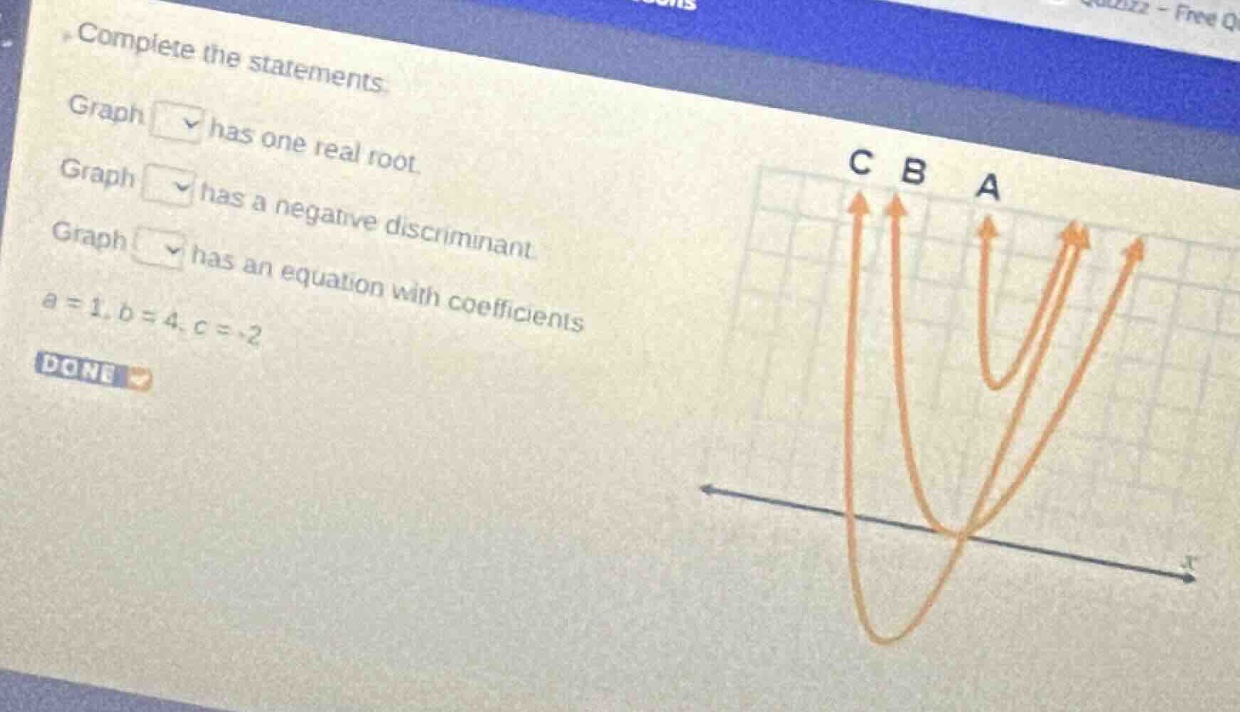
graph □ has one real root.
graph □ has a negative discriminant.
graph □ has an equation with coefficients a = 1, b = 4, c = -2
done
To solve this, we analyze each statement using properties of quadratic graphs (parabolas) and discriminant:
1. Graph with one real root
A quadratic has one real root when its graph touches the x - axis at exactly one point (vertex on the x - axis). From the graphs, Graph C (the left - most narrow parabola) touches the x - axis at one point. So Graph C has one real root.
2. Graph with negative discriminant
The discriminant of a quadratic \( ax^{2}+bx + c \) is \( D=b^{2}-4ac \). If \( D\lt0 \), the quadratic has no real roots (graph does not intersect the x - axis). Graph A (the right - most wider parabola) does not intersect the x - axis, so its discriminant is negative.
3. Graph with \( a = 1,b = 4,c=-2 \)
First, find the vertex of \( y=x^{2}+4x - 2 \). The x - coordinate of the vertex is \( x=-\frac{b}{2a}=-\frac{4}{2(1)}=-2 \). Substitute \( x = - 2 \) into the equation: \( y=(-2)^{2}+4(-2)-2=4 - 8 - 2=-6 \). The vertex is \( (-2,-6) \). Also, the discriminant \( D = 4^{2}-4(1)(-2)=16 + 8 = 24\gt0 \), so the graph intersects the x - axis at two points. Looking at the graphs, Graph B matches this (vertex position and two x - intercepts).
Final Answers
- Graph with one real root: \(\boldsymbol{C}\)
- Graph with negative discriminant: \(\boldsymbol{A}\)
- Graph with \( a = 1,b = 4,c=-2 \): \(\boldsymbol{B}\)

Snap & solve any problem in the app
Get step-by-step solutions on Sovi AI
Photo-based solutions with guided steps
Explore more problems and detailed explanations
To solve this, we analyze each statement using properties of quadratic graphs (parabolas) and discriminant:
1. Graph with one real root
A quadratic has one real root when its graph touches the x - axis at exactly one point (vertex on the x - axis). From the graphs, Graph C (the left - most narrow parabola) touches the x - axis at one point. So Graph C has one real root.
2. Graph with negative discriminant
The discriminant of a quadratic \( ax^{2}+bx + c \) is \( D=b^{2}-4ac \). If \( D\lt0 \), the quadratic has no real roots (graph does not intersect the x - axis). Graph A (the right - most wider parabola) does not intersect the x - axis, so its discriminant is negative.
3. Graph with \( a = 1,b = 4,c=-2 \)
First, find the vertex of \( y=x^{2}+4x - 2 \). The x - coordinate of the vertex is \( x=-\frac{b}{2a}=-\frac{4}{2(1)}=-2 \). Substitute \( x = - 2 \) into the equation: \( y=(-2)^{2}+4(-2)-2=4 - 8 - 2=-6 \). The vertex is \( (-2,-6) \). Also, the discriminant \( D = 4^{2}-4(1)(-2)=16 + 8 = 24\gt0 \), so the graph intersects the x - axis at two points. Looking at the graphs, Graph B matches this (vertex position and two x - intercepts).
Final Answers
- Graph with one real root: \(\boldsymbol{C}\)
- Graph with negative discriminant: \(\boldsymbol{A}\)
- Graph with \( a = 1,b = 4,c=-2 \): \(\boldsymbol{B}\)