QUESTION IMAGE
Question
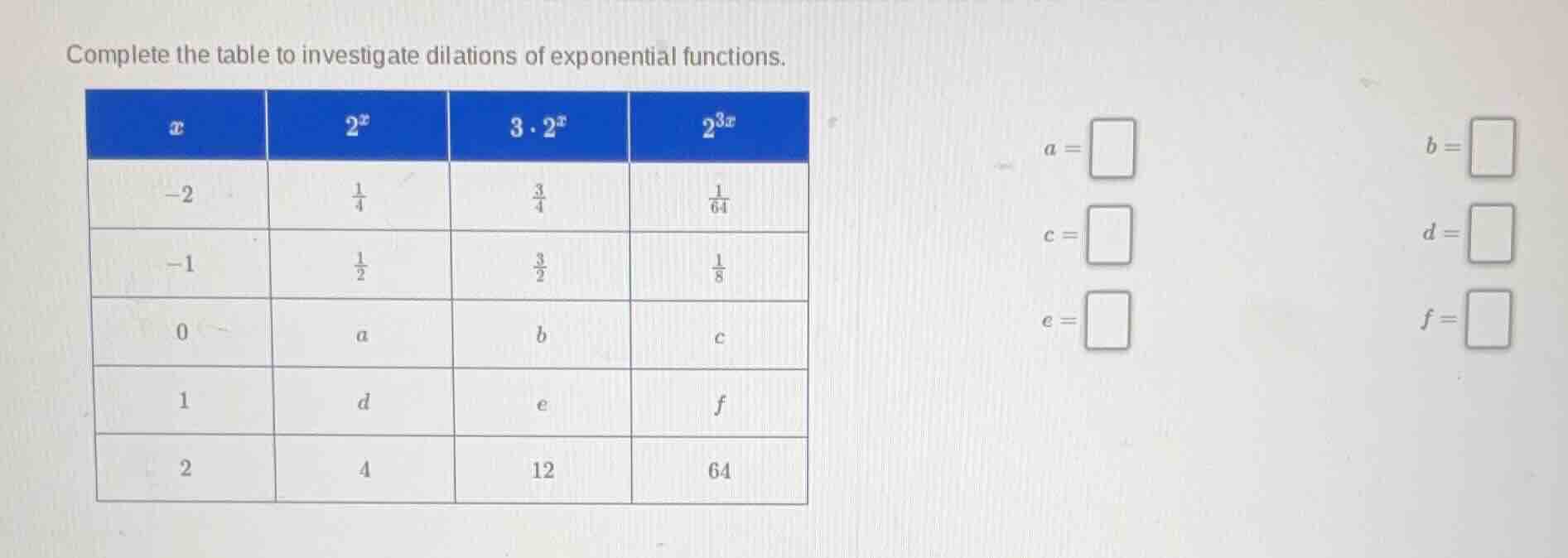
complete the table to investigate dilations of exponential functions.
| $x$ | $2^x$ | $3\cdot 2^x$ | $2^{3x}$ |
|---|---|---|---|
| $-1$ | $\frac{1}{2}$ | $\frac{3}{2}$ | $\frac{1}{8}$ |
| $0$ | $a$ | $b$ | $c$ |
| $1$ | $d$ | $e$ | $f$ |
| $2$ | $4$ | $12$ | $64$ |
$a=\square$ $b=\square$
$c=\square$ $d=\square$
$e=\square$ $f=\square$
Step1: Find \(a\) (when \(x = 0\) for \(2^x\))
For the function \(y = 2^x\), substitute \(x = 0\). Using the property of exponents \(a^0=1\) (where \(a
eq0\)), we have \(2^0 = 1\). So \(a = 1\).
Step2: Find \(b\) (when \(x = 0\) for \(3\cdot2^x\))
For the function \(y = 3\cdot2^x\), substitute \(x = 0\). We know \(2^0 = 1\), so \(3\cdot2^0=3\times1 = 3\). Thus \(b = 3\).
Step3: Find \(c\) (when \(x = 0\) for \(2^{3x}\))
For the function \(y = 2^{3x}\), substitute \(x = 0\). Then \(2^{3\times0}=2^0 = 1\). So \(c = 1\).
Step4: Find \(d\) (when \(x = 1\) for \(2^x\))
For the function \(y = 2^x\), substitute \(x = 1\). We get \(2^1 = 2\). So \(d = 2\).
Step5: Find \(e\) (when \(x = 1\) for \(3\cdot2^x\))
For the function \(y = 3\cdot2^x\), substitute \(x = 1\). We know \(2^1 = 2\), so \(3\cdot2^1=3\times2 = 6\). Thus \(e = 6\).
Step6: Find \(f\) (when \(x = 1\) for \(2^{3x}\))
For the function \(y = 2^{3x}\), substitute \(x = 1\). Then \(2^{3\times1}=2^3 = 8\). So \(f = 8\).

Snap & solve any problem in the app
Get step-by-step solutions on Sovi AI
Photo-based solutions with guided steps
Explore more problems and detailed explanations
\(a = 1\), \(b = 3\), \(c = 1\), \(d = 2\), \(e = 6\), \(f = 8\)