QUESTION IMAGE
Question
composition of functions and modeling
analyzing composition of functions
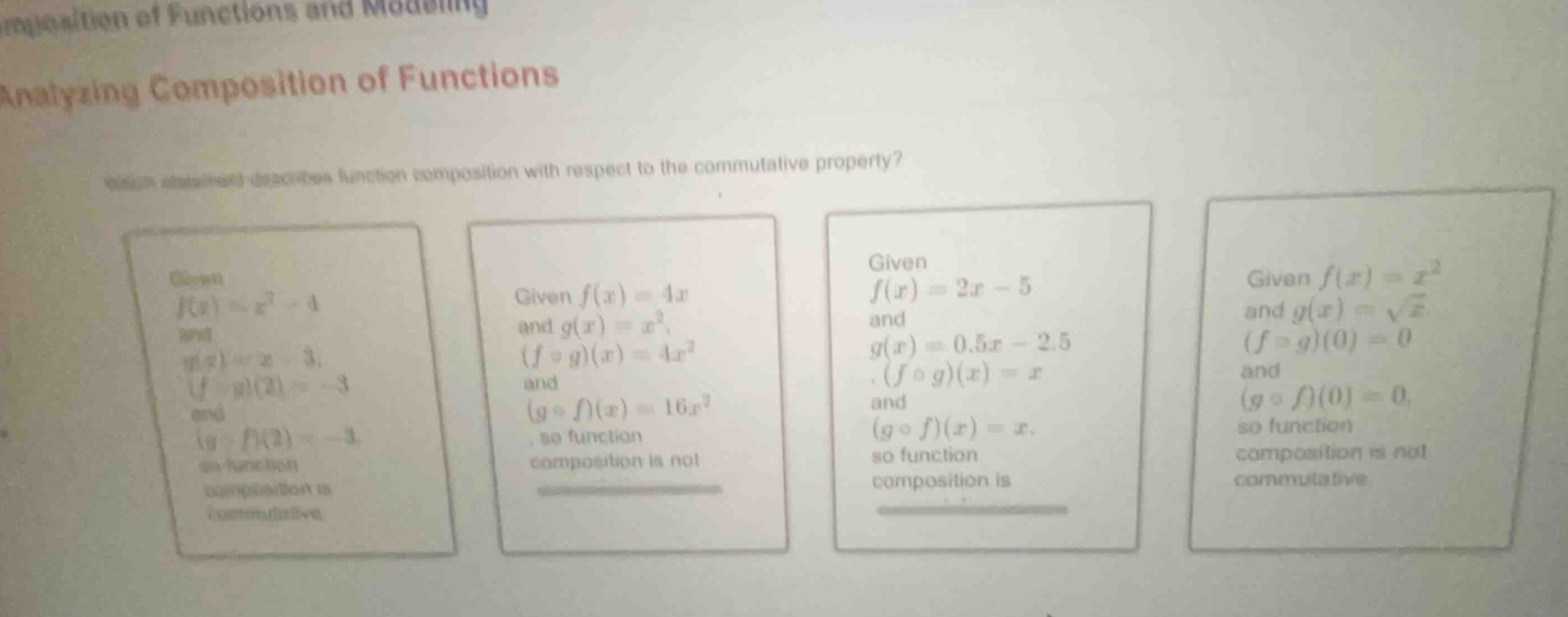
which statement describes function composition with respect to the commutative property?
first box: given ( f(x) = x^2 - 4 ) and ( g(x) = x - 3 ), ( (f circ g)(2) = -3 ) and ( (g circ f)(2) = -3 ), so function composition is commutative.
second box: given ( f(x) = 4x ) and ( g(x) = x^3 ), ( (f circ g)(x) = 4x^3 ) and ( (g circ f)(x) = 16x^3 ), so function composition is not commutative.
third box: given ( f(x) = 2x - 5 ) and ( g(x) = 0.5x - 2.5 ), ( (f circ g)(x) = x ) and ( (g circ f)(x) = x ), so function composition is commutative.
fourth box: given ( f(x) = x^2 ) and ( g(x) = sqrt{x} ), ( (f circ g)(0) = 0 ) and ( (g circ f)(0) = 0 ), so function composition is not commutative.
Step1: Define commutative function composition
A function composition is commutative if $(f \circ g)(x) = (g \circ f)(x)$ for all valid $x$, or $(f \circ g)(a) = (g \circ f)(a)$ for a tested value $a$ (with consistency across the domain).
Step2: Analyze first box
Given $f(x)=x^2-4$, $g(x)=x-3$:
$(f \circ g)(2)=f(g(2))=f(-1)=(-1)^2-4=-3$
$(g \circ f)(2)=g(f(2))=g(0)=0-3=-3$
This single case matches, but it does not prove commutativity for all $x$.
Step3: Analyze second box
Given $f(x)=4x$, $g(x)=x^2$:
$(f \circ g)(x)=f(g(x))=4x^2$
$(g \circ f)(x)=g(f(x))=(4x)^2=16x^2$
Since $4x^2
eq 16x^2$ for most $x$, composition is not commutative.
Step4: Analyze third box
Given $f(x)=2x-5$, $g(x)=0.5x-2.5$:
$(f \circ g)(x)=f(g(x))=2(0.5x-2.5)-5=x-5-5=x$
$(g \circ f)(x)=g(f(x))=0.5(2x-5)-2.5=x-2.5-2.5=x$
Since $(f \circ g)(x)=(g \circ f)(x)$ for all $x$, composition is commutative.
Step5: Analyze fourth box
Given $f(x)=x^2$, $g(x)=\sqrt{x}$:
$(f \circ g)(0)=f(g(0))=f(0)=0^2=0$
$(g \circ f)(0)=g(f(0))=g(0)=\sqrt{0}=0$
This single case matches, but it does not prove commutativity for all $x$ (e.g., $(f \circ g)(4)=4$, $(g \circ f)(4)=g(16)=4$ holds here, but the domain of $g \circ f$ is all real numbers, while domain of $f \circ g$ is non-negative reals, so they are not equivalent functions overall).

Snap & solve any problem in the app
Get step-by-step solutions on Sovi AI
Photo-based solutions with guided steps
Explore more problems and detailed explanations
The correct statements are:
- For $f(x)=4x$, $g(x)=x^2$: so function composition is not commutative
- For $f(x)=2x-5$, $g(x)=0.5x-2.5$: so function composition is commutative
- For $f(x)=x^2$, $g(x)=\sqrt{x}$: so function composition is not commutative
The first box's conclusion is incorrect, as a single matching value does not prove commutativity.