QUESTION IMAGE
Question
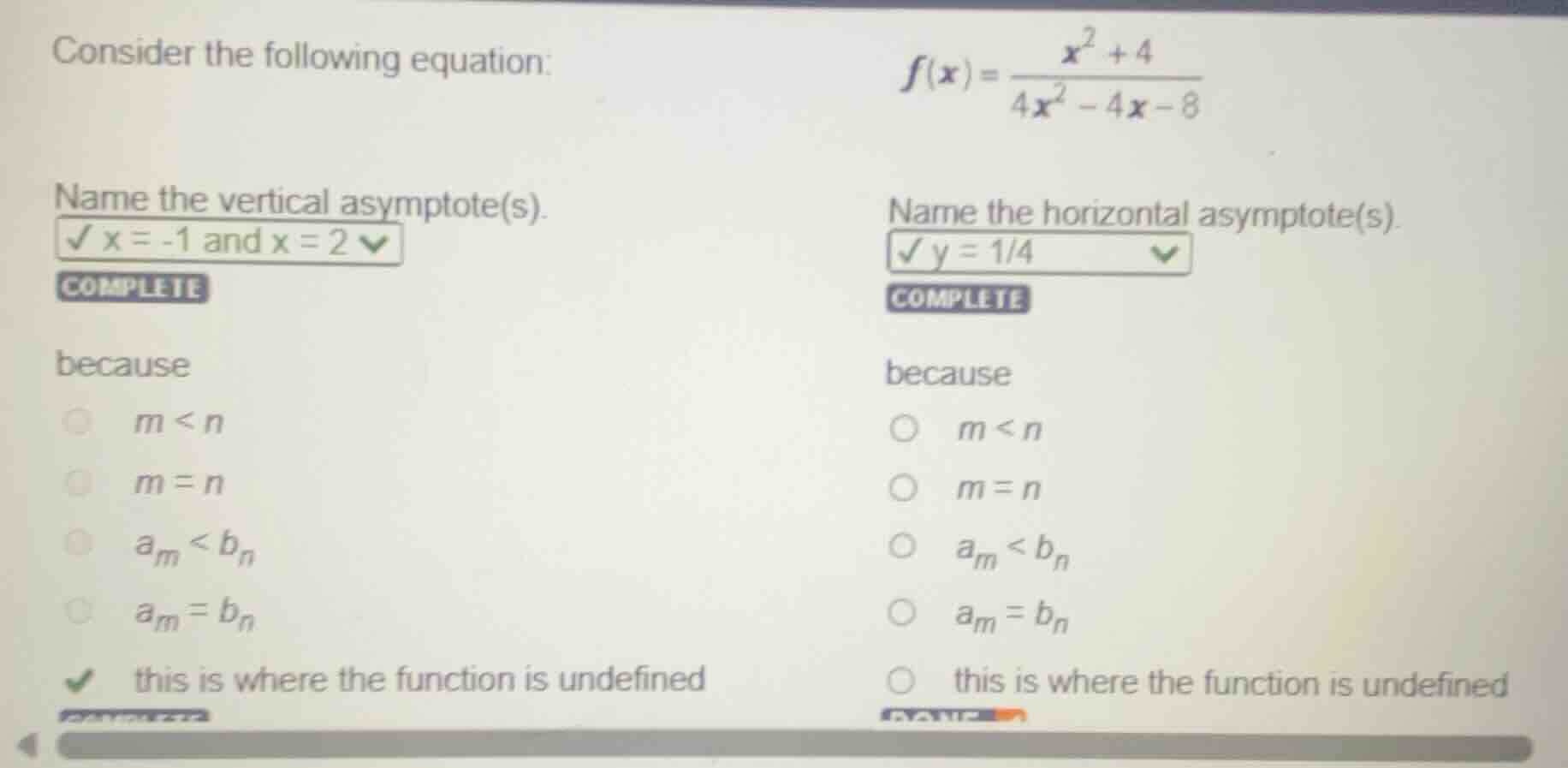
consider the following equation:
$f(x)=\frac{x^2 + 4}{4x^2 - 4x - 8}$
name the vertical asymptote(s).
✓ x = -1 and x = 2 ✔️
complete
because
○ $m < n$
○ $m = n$
○ $a_m < b_n$
○ $a_m = b_n$
✓ this is where the function is undefined
name the horizontal asymptote(s).
✓ y = 1/4 ✔️
complete
because
○ $m < n$
○ $m = n$
○ $a_m < b_n$
○ $a_m = b_n$
○ this is where the function is undefined
Step1: Analyze vertical asymptote reason
Vertical asymptotes occur where the rational function is undefined, which happens when the denominator equals 0 (and the numerator does not equal 0 at those points). For $f(x)=\frac{x^2 + 4}{4x^2 - 4x - 8}$, solving $4x^2 - 4x - 8=0$ gives $x=-1$ and $x=2$, and the numerator $x^2+4$ is non-zero at these values. So the correct reason is that this is where the function is undefined.
Step2: Analyze horizontal asymptote reason
For a rational function $f(x)=\frac{a_mx^m+...}{b_nx^n+...}$, when the degree of the numerator equals the degree of the denominator ($m=n$), the horizontal asymptote is $y=\frac{a_m}{b_n}$. Here, $m=n=2$, $a_m=1$, $b_n=4$, so $y=\frac{1}{4}$. The correct reason is $m=n$.

Snap & solve any problem in the app
Get step-by-step solutions on Sovi AI
Photo-based solutions with guided steps
Explore more problems and detailed explanations
For vertical asymptote reason: this is where the function is undefined
For horizontal asymptote reason: $m = n$