QUESTION IMAGE
Question
consider the following.
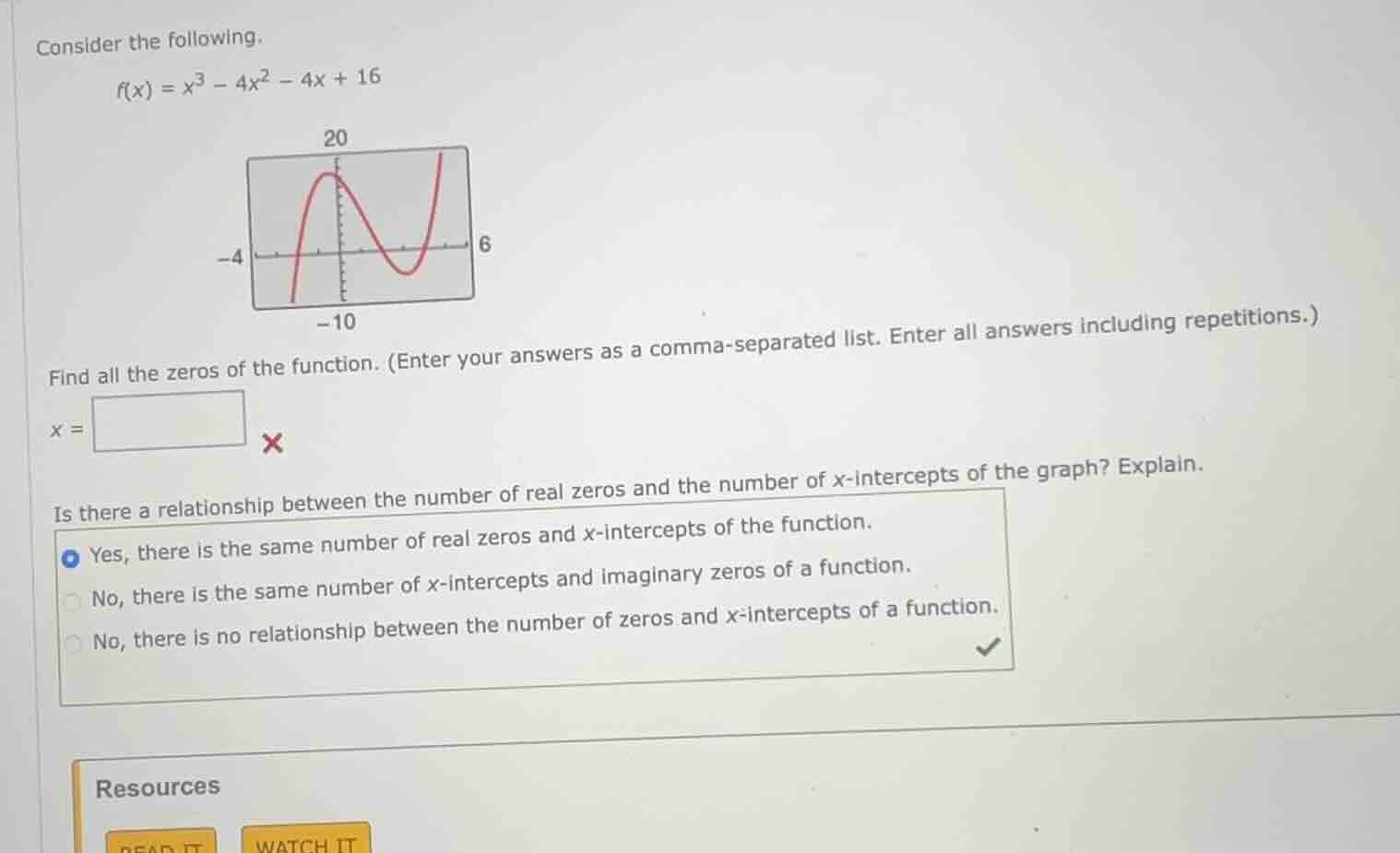
$f(x) = x^3 - 4x^2 - 4x + 16$
find all the zeros of the function. (enter your answers as a comma - separated list. enter all answers including repetitions.)
$x = $
is there a relationship between the number of real zeros and the number of x - intercepts of the graph? explain.
- yes, there is the same number of real zeros and x - intercepts of the function.
- no, there is the same number of x - intercepts and imaginary zeros of a function.
- no, there is no relationship between the number of zeros and x - intercepts of a function.
Step1: Factor by grouping
Group terms to factor:
$f(x) = (x^3 - 4x^2) + (-4x + 16)$
$= x^2(x - 4) - 4(x - 4)$
$= (x^2 - 4)(x - 4)$
Step2: Factor difference of squares
Factor $x^2 - 4$ as a difference of squares:
$x^2 - 4 = (x - 2)(x + 2)$
So $f(x) = (x - 2)(x + 2)(x - 4)$
Step3: Solve for zeros
Set each factor equal to 0:
$x - 2 = 0 \implies x = 2$
$x + 2 = 0 \implies x = -2$
$x - 4 = 0 \implies x = 4$
For a real-valued function, the real zeros of the function are exactly the x-values where the graph crosses or touches the x-axis (x-intercepts). Each real zero corresponds to one x-intercept, so their counts are equal.

Snap & solve any problem in the app
Get step-by-step solutions on Sovi AI
Photo-based solutions with guided steps
Explore more problems and detailed explanations
$x = -2, 2, 4$
---