QUESTION IMAGE
Question
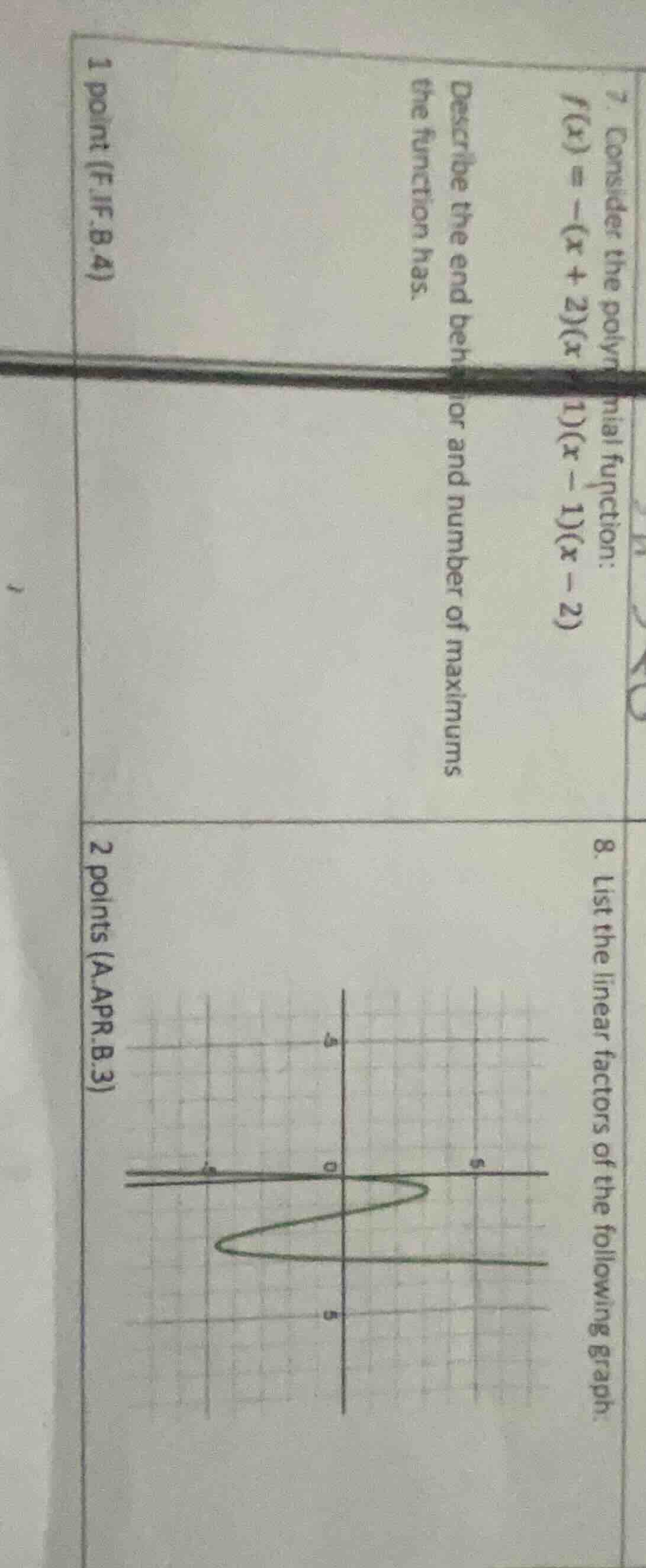
- consider the polynomial function: ( f(x) = -(x + 2)(x - 1)(x - 2) ) describe the end behavior and number of maximums the function has. 1 point (f.if.b.4) 8. list the linear factors of the following graph. 2 points (a.apr.b.3)
Question 7
Step 1: Determine the degree and leading coefficient
First, expand the polynomial \( f(x) = -(x + 2)(x - 1)(x - 2) \). First, multiply \( (x + 2)(x - 1)(x - 2) \). Notice that \( (x - 1)(x - 2)=x^{2}-3x + 2 \), then multiply by \( (x + 2) \): \( (x + 2)(x^{2}-3x + 2)=x^{3}-3x^{2}+2x + 2x^{2}-6x + 4=x^{3}-x^{2}-4x + 4 \). Then multiply by -1: \( f(x)=-x^{3}+x^{2}+4x - 4 \). The degree of the polynomial is 3 (odd), and the leading coefficient is -1 (negative).
Step 2: Analyze end - behavior
For a polynomial \( f(x)=a_{n}x^{n}+a_{n - 1}x^{n - 1}+\cdots+a_{1}x + a_{0} \), when \( n \) is odd:
- If \( a_{n}>0 \), as \( x
ightarrow+\infty \), \( f(x)
ightarrow+\infty \) and as \( x
ightarrow-\infty \), \( f(x)
ightarrow-\infty \).
- If \( a_{n}<0 \), as \( x
ightarrow+\infty \), \( f(x)
ightarrow-\infty \) and as \( x
ightarrow-\infty \), \( f(x)
ightarrow+\infty \).
Since our polynomial has degree 3 (odd) and leading coefficient - 1 (negative), as \( x
ightarrow+\infty \), \( f(x)
ightarrow-\infty \); as \( x
ightarrow-\infty \), \( f(x)
ightarrow+\infty \).
Step 3: Analyze the number of local maxima
The number of local maxima of a polynomial function of degree \( n \) is at most \( n - 1 \). For a cubic polynomial (\( n = 3 \)), the number of local maxima is at most \( 3-1 = 2 \)? Wait, no. Wait, the derivative of \( f(x)=-x^{3}+x^{2}+4x - 4 \) is \( f^\prime(x)=-3x^{2}+2x + 4 \). The discriminant of the quadratic \( -3x^{2}+2x + 4 \) is \( \Delta=b^{2}-4ac=(2)^{2}-4\times(-3)\times4=4 + 48 = 52>0 \), so the derivative has two real roots. A cubic function with a derivative that has two real roots will have one local maximum and one local minimum. Wait, let's correct: for a cubic function \( y = ax^{3}+bx^{2}+cx + d \), the derivative \( y^\prime=3ax^{2}+2bx + c \). The number of critical points (where \( y^\prime = 0 \)) is determined by the discriminant of the quadratic derivative. If the discriminant is positive, there are two critical points, which means the function has one local maximum and one local minimum. So the number of local maxima is 1.
To find the linear factors of a polynomial from its graph, we need to find the x - intercepts of the graph. The x - intercepts are the points where the graph crosses or touches the x - axis. If the graph crosses the x - axis at \( x = a \), then \( (x - a) \) is a linear factor. If it touches the x - axis at \( x = a \) (a repeated root), then \( (x - a) \) is a factor with multiplicity at least 2.
From the given graph (assuming the x - intercepts are at \( x=-3 \), \( x = 0 \), and \( x = 2 \) (we need to estimate from the graph, but since the graph is a cubic - like graph with x - intercepts, let's assume the x - intercepts are \( x=-3 \), \( x = 0 \), \( x = 2 \)). Wait, looking at the graph (the grid - like graph), let's assume the x - intercepts are at \( x=-3 \), \( x = 0 \), and \( x = 2 \). So the linear factors are \( (x + 3) \), \( x \), and \( (x - 2) \). Wait, maybe the x - intercepts are at \( x=-2 \), \( x = 0 \), \( x = 1 \)? Wait, no, let's re - examine. If the graph crosses the x - axis at \( x=-3 \), \( x = 0 \), and \( x = 2 \), then the linear factors are \( (x + 3) \), \( x \), \( (x - 2) \). But maybe the correct x - intercepts are \( x=-3 \), \( x = 0 \), \( x = 2 \), so the linear factors are \( (x + 3) \), \( x \), \( (x - 2) \).

Snap & solve any problem in the app
Get step-by-step solutions on Sovi AI
Photo-based solutions with guided steps
Explore more problems and detailed explanations
End - behavior: As \( x
ightarrow+\infty \), \( f(x)
ightarrow-\infty \); as \( x
ightarrow-\infty \), \( f(x)
ightarrow+\infty \). Number of local maxima: 1.