QUESTION IMAGE
Question
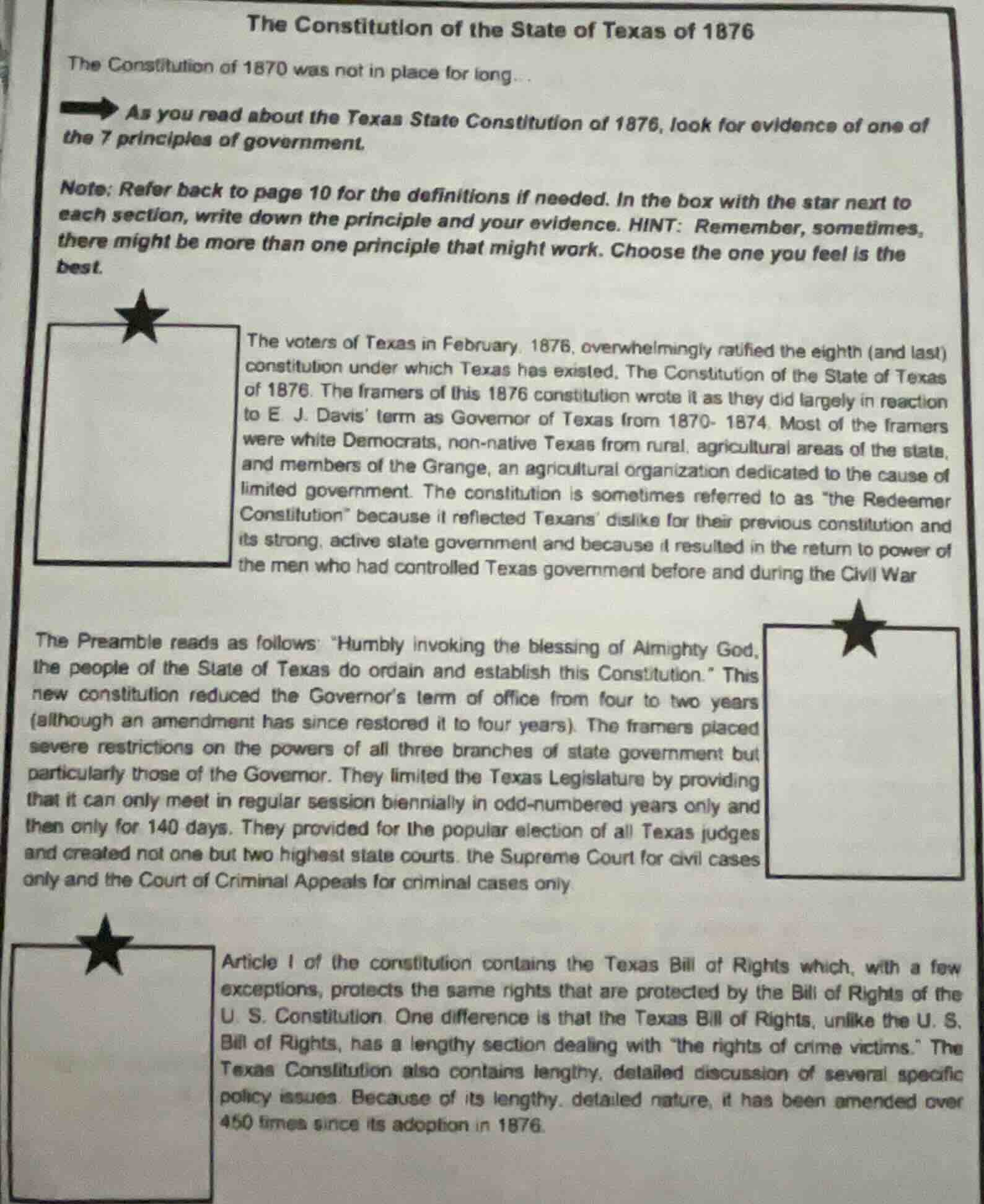
the constitution of the state of texas of 1876
the constitution of 1870 was not in place for long...
as you read about the texas state constitution of 1876, look for evidence of one of
the 7 principles of government.
note: refer back to page 10 for the definitions if needed. in the box with the star next to
each section, write down the principle and your evidence. hint: remember, sometimes,
there might be more than one principle that might work. choose the one you feel is the
best.
starred box 1
the voters of texas in february, 1876, overwhelmingly ratified the eighth (and last)
constitution under which texas has existed. the constitution of the state of texas
of 1876. the framers of this 1876 constitution wrote it as they did largely in reaction
to e. j. davis term as governor of texas from 1870 - 1874. most of the framers
were white democrats, non - native texas from rural, agricultural areas of the state,
and members of the grange, an agricultural organization dedicated to the cause of
limited government. the constitution is sometimes referred to as \the redeemer
constitution\ because it reflected texans dislike for their previous constitution and
its strong, active state government and because it resulted in the return to power of
the men who had controlled texas government before and during the civil war
the preamble reads as follows: \humbly invoking the blessing of almighty god,
the people of the state of texas do ordain and establish this constitution.\ this
new constitution reduced the governors term of office from four to two years
(although an amendment has since restored it to four years). the framers placed
severe restrictions on the powers of all three branches of state government but
particularly those of the governor. they limited the texas legislature by providing
that it can only meet in regular session biennially in odd - numbered years only and
then only for 140 days. they provided for the popular election of all texas judges
and created not one but two highest state courts, the supreme court for civil cases
only and the court of criminal appeals for criminal cases only
starred box 2
article i of the constitution contains the texas bill of rights which, with a few
exceptions, protects the same rights that are protected by the bill of rights of the
u. s. constitution. one difference is that the texas bill of rights, unlike the u. s.
bill of rights, has a lengthy section dealing with \the rights of crime victims.\ the
texas constitution also contains lengthy, detailed discussion of several specific
policy issues. because of its lengthy, detailed nature, it has been amended over
450 times since its adoption in 1876.
starred box 3
To solve this, we analyze each section for a principle of government (e.g., limited government, popular sovereignty, separation of powers, checks and balances, republicanism, federalism, individual rights).
Section 1 (Voter Ratification, Framers’ Goals)
- Principle: Limited Government
- Evidence: The framers were “dedicated to the cause of limited government,” and the constitution reacted against a “strong, active state government” (from E.J. Davis’ term). It aimed to restrict government power.
Section 2 (Preamble, Government Structure)
- Principle: Separation of Powers or Limited Government
- Evidence for Separation of Powers: The constitution restricts all three branches (executive: reduced Governor’s term/powers; legislative: limited session length; judicial: created two highest courts for civil/criminal cases, separating judicial duties).
- Evidence for Limited Government: Severe restrictions on all branches (e.g., Governor’s term, legislative session limits) show a desire to limit government authority.
Section 3 (Article I: Bill of Rights)
- Principle: Individual Rights
- Evidence: Article I contains the Texas Bill of Rights, protecting rights (similar to U.S. Bill of Rights) and adding “rights of crime victims,” emphasizing protection of individual liberties.
Choose one principle (e.g., Limited Government for Section 1, Separation of Powers for Section 2, or Individual Rights for Section 3) and document the principle + evidence in the star boxes.
For example, for the first star box (Section 1):
- Principle: Limited Government
- Evidence: The framers were part of the Grange (dedicated to limited government), and the constitution reacted against a “strong, active state government” (from E.J. Davis’ term) to reduce government power.
Final Answer (Example for Section 1)
Principle: Limited Government
Evidence: The framers were members of the Grange (dedicated to limited government), and the constitution was a reaction against the previous “strong, active state government” (from E.J. Davis’ term) to restrict government authority.
(Adjust based on the section/box you analyze!)

Snap & solve any problem in the app
Get step-by-step solutions on Sovi AI
Photo-based solutions with guided steps
Explore more problems and detailed explanations
To solve this, we analyze each section for a principle of government (e.g., limited government, popular sovereignty, separation of powers, checks and balances, republicanism, federalism, individual rights).
Section 1 (Voter Ratification, Framers’ Goals)
- Principle: Limited Government
- Evidence: The framers were “dedicated to the cause of limited government,” and the constitution reacted against a “strong, active state government” (from E.J. Davis’ term). It aimed to restrict government power.
Section 2 (Preamble, Government Structure)
- Principle: Separation of Powers or Limited Government
- Evidence for Separation of Powers: The constitution restricts all three branches (executive: reduced Governor’s term/powers; legislative: limited session length; judicial: created two highest courts for civil/criminal cases, separating judicial duties).
- Evidence for Limited Government: Severe restrictions on all branches (e.g., Governor’s term, legislative session limits) show a desire to limit government authority.
Section 3 (Article I: Bill of Rights)
- Principle: Individual Rights
- Evidence: Article I contains the Texas Bill of Rights, protecting rights (similar to U.S. Bill of Rights) and adding “rights of crime victims,” emphasizing protection of individual liberties.
Choose one principle (e.g., Limited Government for Section 1, Separation of Powers for Section 2, or Individual Rights for Section 3) and document the principle + evidence in the star boxes.
For example, for the first star box (Section 1):
- Principle: Limited Government
- Evidence: The framers were part of the Grange (dedicated to limited government), and the constitution reacted against a “strong, active state government” (from E.J. Davis’ term) to reduce government power.
Final Answer (Example for Section 1)
Principle: Limited Government
Evidence: The framers were members of the Grange (dedicated to limited government), and the constitution was a reaction against the previous “strong, active state government” (from E.J. Davis’ term) to restrict government authority.
(Adjust based on the section/box you analyze!)