QUESTION IMAGE
Question
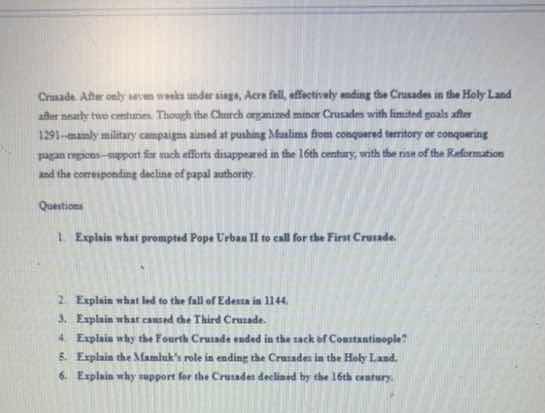
crusade. after only seven weeks under siege, acre fell, effectively ending the crusades in the holy land after nearly two centuries. though the church organized minor crusades with limited goals after 1291—namely military campaigns aimed at pushing muslims from conquered territory or conquering pagan regions—support for such efforts disappeared in the 16th century, with the rise of the reformation and the corresponding decline of papal authority.
questions
- explain what prompted pope urban ii to call for the first crusade.
- explain what led to the fall of edessa in 1144.
- explain what caused the third crusade.
- explain why the fourth crusade ended in the sack of constantinople?
- explain the mamluks’s role in ending the crusades in the holy land.
- explain why support for the crusades declined by the 16th century.
Brief Explanations
- For Question 1: In 1095, Byzantine Emperor Alexios I requested military aid from Pope Urban II to defend against Muslim Seljuk Turks who had seized Byzantine lands in Anatolia. Urban II also sought to unify Western Christendom, assert papal authority, and reclaim the Holy Land (Jerusalem) from Muslim control, which led him to call for the First Crusade at the Council of Clermont.
- For Question 2: In 1144, the County of Edessa fell to a coalition of Muslim forces led by Imad al-Din Zengi, the atabeg of Mosul. The Crusader state of Edessa was isolated from other Crusader territories, lacked sufficient military support, and was overwhelmed by Zengi's well-organized attack, which caught the defenders off guard.
- For Question 3: The Third Crusade was triggered by the 1187 capture of Jerusalem by the Muslim leader Saladin, who defeated the Crusader army at the Battle of Hattin. This loss of the symbolic Holy Land prompted European rulers (including Richard I of England, Philip II of France, and Frederick I of the Holy Roman Empire) to launch a military campaign to recapture it.
- For Question 4: The Fourth Crusade was diverted from its original goal of attacking Muslim-controlled Jerusalem due to financial debts owed to the Venetians. The Venetians convinced the Crusaders to attack the Christian city of Zara first, and later, political rivalries and claims to the Byzantine throne led the Crusaders to sack Constantinople in 1204, as they sought plunder and to install a friendly ruler.
- For Question 5: The Mamluks, a Muslim military dynasty based in Egypt, defeated the remaining Crusader strongholds in the Holy Land. Key victories, such as the Battle of Ain Jalut (1260) against the Mongols (which removed a potential threat to their power) and the capture of Acre (1291), eliminated the last major Crusader outposts, making it impossible for Crusaders to maintain a foothold in the region.
- For Question 6: By the 16th century, support for the Crusades declined for multiple reasons: the Protestant Reformation weakened the authority of the Catholic Church, which had organized the Crusades; European powers shifted focus to territorial expansion and conflicts within Europe; the cost of long-distance military campaigns became unsustainable; and the rise of strong Muslim states made recapturing the Holy Land militarily unfeasible.

Snap & solve any problem in the app
Get step-by-step solutions on Sovi AI
Photo-based solutions with guided steps
Explore more problems and detailed explanations
- Pope Urban II called the First Crusade in 1095 to respond to Byzantine requests for aid against Seljuk Turks, unify Western Christendom, assert papal authority, and reclaim Jerusalem from Muslim control.
- Edessa fell in 1144 due to isolation from other Crusader states, insufficient military support, and a surprise attack by Muslim forces led by Imad al-Din Zengi.
- The Third Crusade was caused by the 1187 capture of Jerusalem by Saladin, who defeated Crusaders at the Battle of Hattin, prompting European rulers to launch a campaign to recapture the city.
- The Fourth Crusade sacked Constantinople because Crusaders owed large debts to Venice, which diverted them to attack Zara first; political rivalries over the Byzantine throne then led to the 1204 sack of the city for plunder and political control.
- The Mamluks ended the Crusades in the Holy Land by defeating the last major Crusader outposts, including the capture of Acre in 1291, and securing control of the region after their victory over the Mongols at Ain Jalut (1260).
- Support for the Crusades declined by the 16th century due to the Protestant Reformation weakening papal authority, European powers focusing on internal conflicts and expansion, the high cost of campaigns, and the strength of Muslim states making recapturing the Holy Land unfeasible.