QUESTION IMAGE
Question
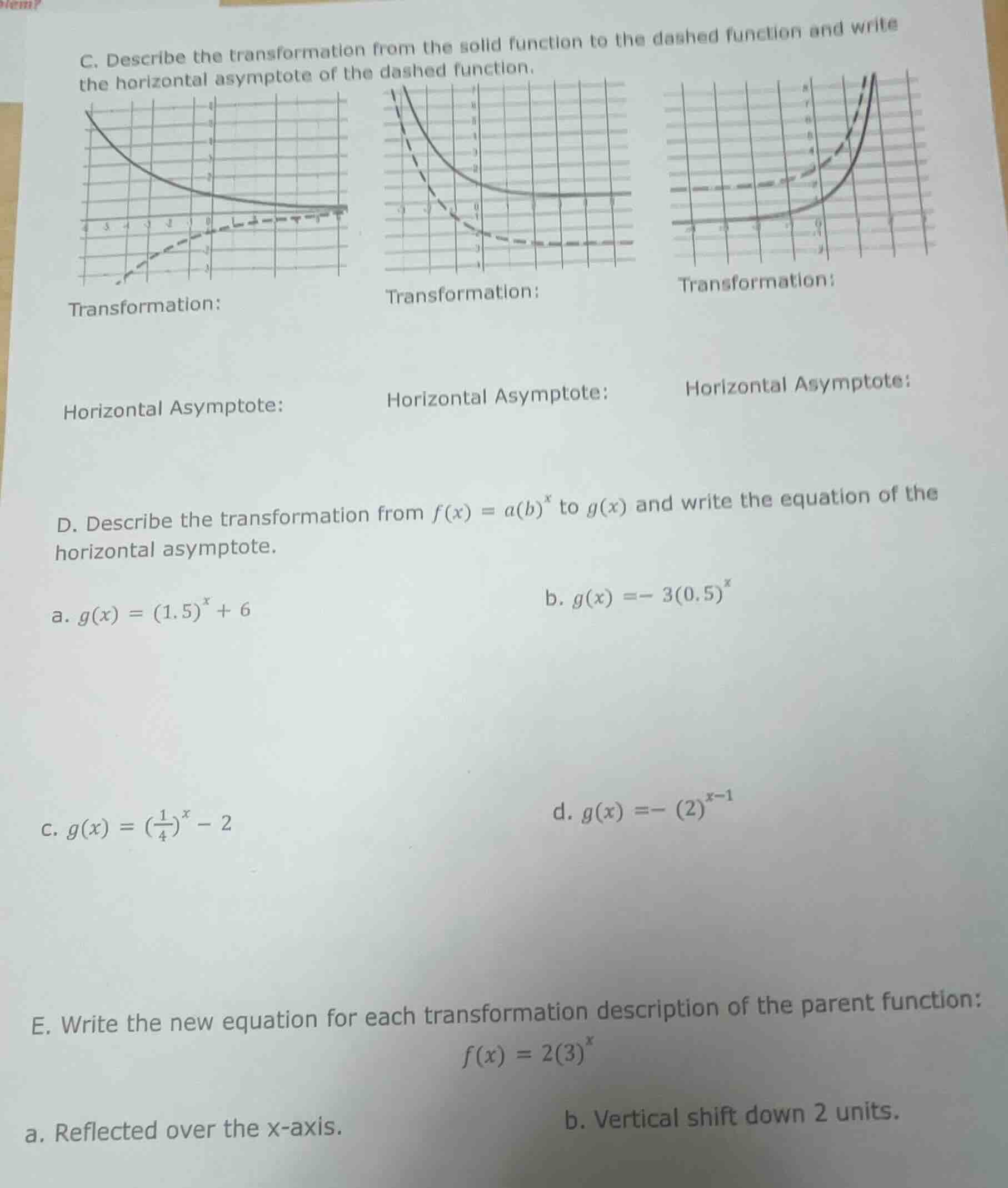
c. describe the transformation from the solid function to the dashed function and write the horizontal asymptote of the dashed function.
transformation:
horizontal asymptote:
transformation:
horizontal asymptote:
transformation:
horizontal asymptote:
d. describe the transformation from ( f(x) = a(b)^x ) to ( g(x) ) and write the equation of the horizontal asymptote.
a. ( g(x) = (1.5)^x + 6 )
b. ( g(x) = -3(0.5)^x )
c. ( g(x) = left( \frac{1}{4}
ight)^x - 2 )
d. ( g(x) = - (2)^{x - 1} )
e. write the new equation for each transformation description of the parent function: ( f(x) = 2(3)^x )
a. reflected over the x - axis.
b. vertical shift down 2 units.
Part D (a)
Step1: Identify Transformation
The parent function is \( f(x)=a(b)^x \), here \( a = 1 \), \( b=1.5 \). The new function is \( g(x)=(1.5)^x + 6 \). So it's a vertical shift up by 6 units.
Step2: Find Horizontal Asymptote
For exponential functions of the form \( y = a(b)^x + k \), the horizontal asymptote is \( y = k \). Here \( k = 6 \), so horizontal asymptote is \( y = 6 \).
Step1: Identify Transformation
Parent function \( f(x)=a(b)^x \), new function \( g(x)=-3(0.5)^x \). The negative sign indicates a reflection over the x - axis, and the coefficient 3 is a vertical stretch by a factor of 3.
Step2: Find Horizontal Asymptote
For \( y = a(b)^x \) (after reflection and stretch), the horizontal asymptote of an exponential function \( y=a(b)^x \) is \( y = 0 \) (since as \( x
ightarrow\pm\infty \), \( a(b)^x
ightarrow0 \) for \( |b|
eq1 \), and reflection/stretch don't change the horizontal asymptote's y - value of 0).
Step1: Identify Transformation
Parent function \( f(x)=a(b)^x \), new function \( g(x)=(\frac{1}{4})^x-2 \). This is a vertical shift down by 2 units.
Step2: Find Horizontal Asymptote
For \( y = a(b)^x + k \) (here \( a = 1 \), \( k=-2 \)), the horizontal asymptote is \( y=k=-2 \).

Snap & solve any problem in the app
Get step-by-step solutions on Sovi AI
Photo-based solutions with guided steps
Explore more problems and detailed explanations
Transformation: Vertical shift up 6 units.
Horizontal Asymptote: \( y = 6 \)