QUESTION IMAGE
Question
describing a combined function
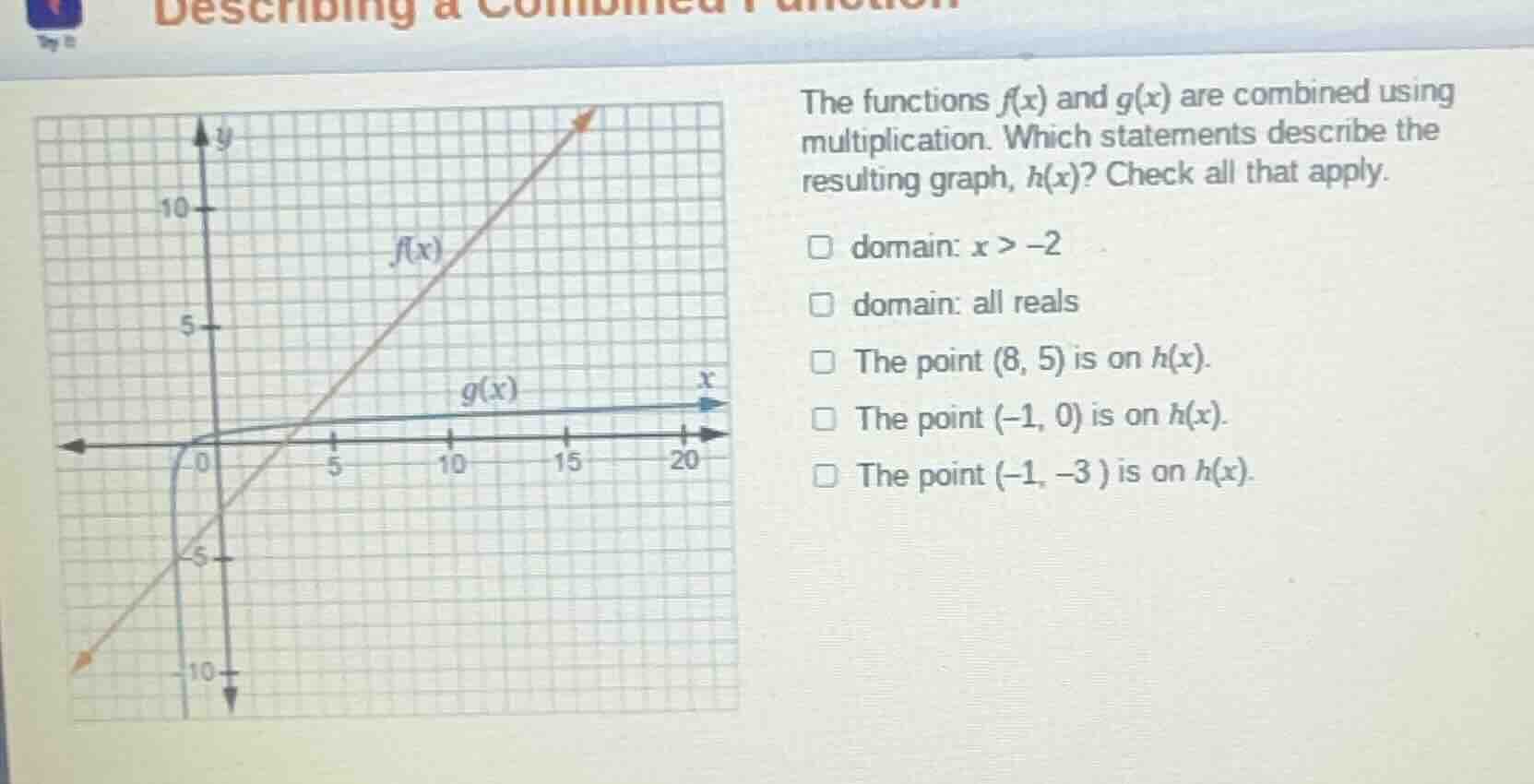
the functions $f(x)$ and $g(x)$ are combined using multiplication. which statements describe the resulting graph, $h(x)$? check all that apply.
$square$ domain: $x > -2$
$square$ domain: all reals
$square$ the point $(8, 5)$ is on $h(x)$.
$square$ the point $(-1, 0)$ is on $h(x)$.
$square$ the point $(-1, -3 )$ is on $h(x)$.
Step1: Identify domain of each function
- For $f(x)$ (linear line): domain is all real numbers, $(-\infty, \infty)$
- For $g(x)$ (curved graph): domain is $x > -2$ (since it does not exist at $x \leq -2$)
Step2: Find domain of $h(x)=f(x)g(x)$
The domain of a product function is the intersection of the domains of the two functions. So domain is $x > -2$.
Step3: Verify point $(8,5)$
First, find $f(8)$: $f(x)$ has slope $\frac{3}{4}$ (from points $(0,-3)$ and $(4,0)$), so $f(x)=\frac{3}{4}x - 3$. $f(8)=\frac{3}{4}(8)-3=6-3=3$.
Find $g(8)$: from graph, $g(8) \approx \frac{5}{3}$. Then $h(8)=3 \times \frac{5}{3}=5$. So $(8,5)$ is on $h(x)$.
Step4: Verify point $(-1,0)$
$f(-1)=\frac{3}{4}(-1)-3=-\frac{3}{4}-3=-\frac{15}{4}$. $g(-1)$: from graph, $g(-1)=0$. Then $h(-1)=-\frac{15}{4} \times 0=0$. So $(-1,0)$ is on $h(x)$.
Step5: Verify point $(-1,-3)$
$h(-1)=0
eq -3$, so this point is not on $h(x)$.

Snap & solve any problem in the app
Get step-by-step solutions on Sovi AI
Photo-based solutions with guided steps
Explore more problems and detailed explanations
- domain: $x > -2$
- The point $(8, 5)$ is on $h(x)$.
- The point $(-1, 0)$ is on $h(x)$.