QUESTION IMAGE
Question
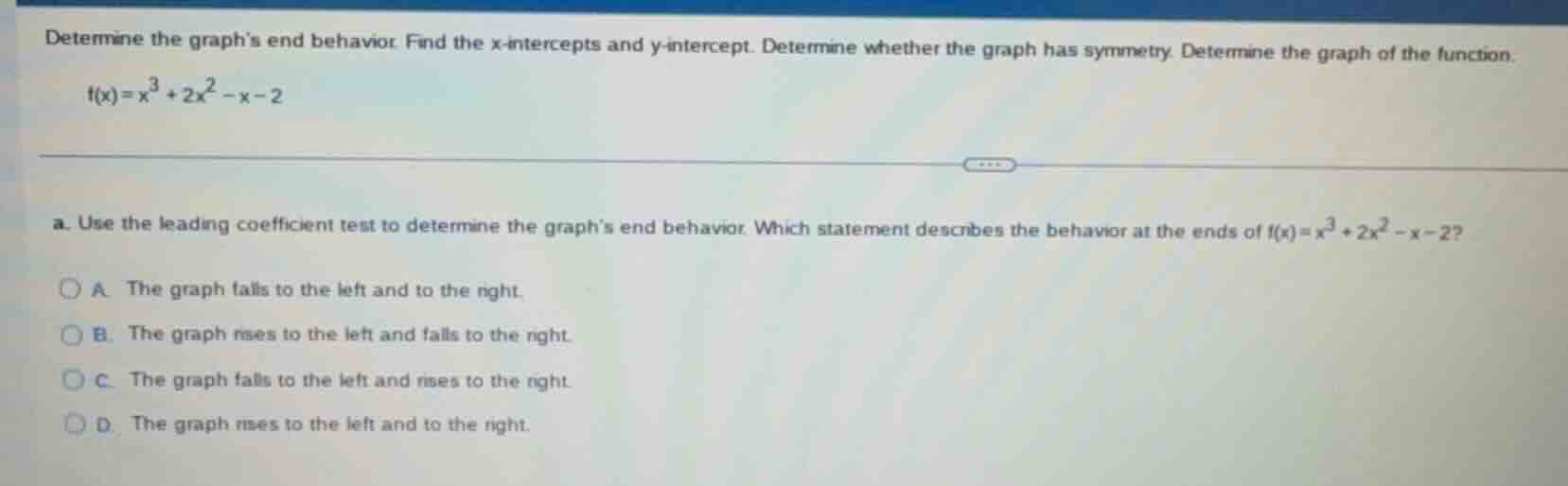
determine the graph’s end behavior. find the x-intercepts and y-intercept. determine whether the graph has symmetry. determine the graph of the function.\\( f(x)=x^3 + 2x^2 - x - 2 \\)\\( \\ \\)a. use the leading coefficient test to determine the graph’s end behavior. which statement describes the behavior at the ends of \\( f(x)=x^3 + 2x^2 - x - 2 \\)?\\( \\ \\)\\( \bigcirc \\) a. the graph falls to the left and to the right.\\( \\ \\)\\( \bigcirc \\) b. the graph rises to the left and falls to the right.\\( \\ \\)\\( \bigcirc \\) c. the graph falls to the left and rises to the right.\\( \\ \\)\\( \bigcirc \\) d. the graph rises to the left and to the right.
Step1: Identify the degree and leading coefficient
The function is \( f(x) = x^3 + 2x^2 - x - 2 \). The degree of the polynomial (highest power of \( x \)) is 3 (odd), and the leading coefficient (coefficient of the highest power term) is 1 (positive).
Step2: Apply the leading coefficient test
For a polynomial with an odd degree:
- If the leading coefficient is positive, as \( x \to +\infty \) (right end), \( f(x) \to +\infty \) (rises), and as \( x \to -\infty \) (left end), \( f(x) \to -\infty \) (falls).
- If the leading coefficient is negative, the opposite happens.
Since our degree is odd (3) and leading coefficient is positive (1), the graph falls to the left (\( x \to -\infty \)) and rises to the right (\( x \to +\infty \)).

Snap & solve any problem in the app
Get step-by-step solutions on Sovi AI
Photo-based solutions with guided steps
Explore more problems and detailed explanations
C. The graph falls to the left and rises to the right.