QUESTION IMAGE
Question
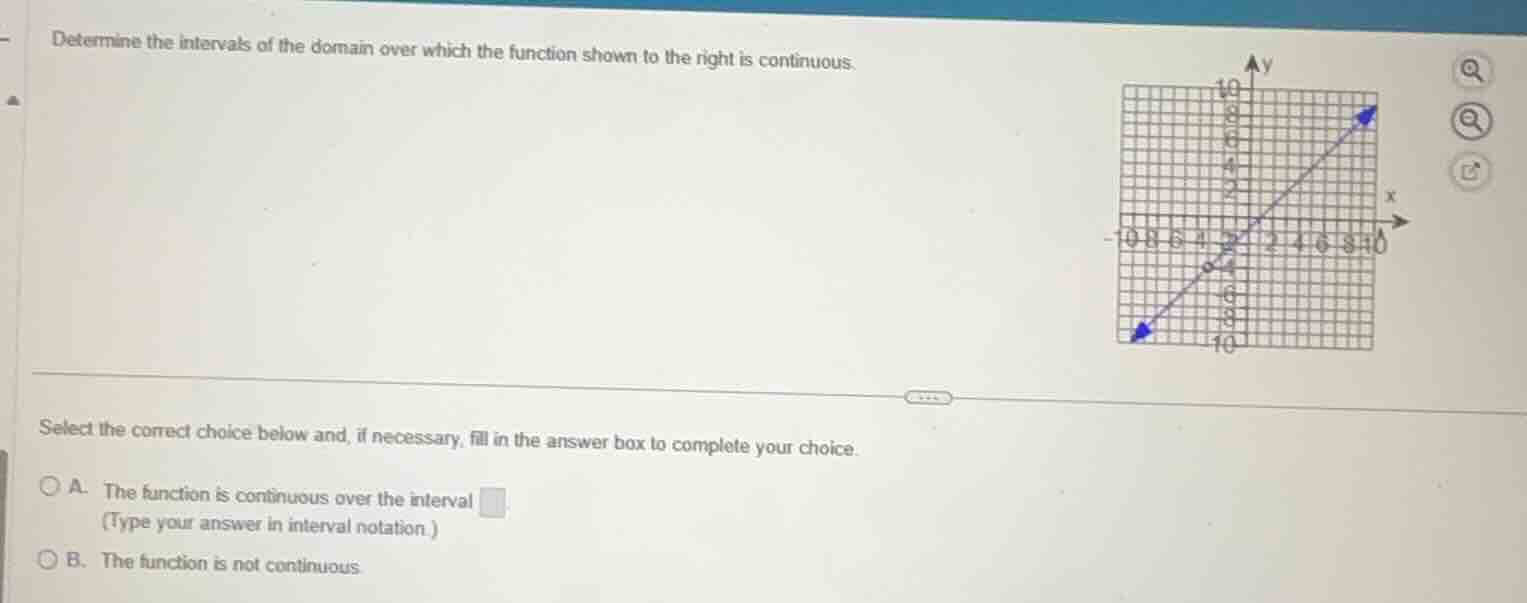
determine the intervals of the domain over which the function shown to the right is continuous.
select the correct choice below and, if necessary, fill in the answer box to complete your choice.
a. the function is continuous over the interval
(type your answer in interval notation.)
b. the function is not continuous
Step1: Analyze the Graph
The graph shows a line with a hole (open circle) at \( x = -3 \). So we need to check the intervals where the function is connected without breaks, except at the hole.
Step2: Determine Continuity Intervals
To the left of \( x = -3 \), the line is continuous. To the right of \( x = -3 \), the line is also continuous, but there's a discontinuity at \( x = -3 \). Wait, no—wait, actually, looking at the graph, the two parts of the line (left of -3 and right of -3) are connected except at \( x = -3 \)? Wait, no, the open circle is at \( x=-3 \), so the domain is all real numbers except \( x = -3 \)? Wait, no, the graph: the left part goes from \( -\infty \) to \( x=-3 \) (but with an open circle at \( x=-3 \)), and the right part goes from \( x=-3 \) (open circle) to \( +\infty \). Wait, but actually, the function is a line with a removable discontinuity at \( x=-3 \). Wait, no, the graph: the two segments are connected except at \( x=-3 \). Wait, no, the open circle is at \( x=-3 \), so the function is continuous on \( (-\infty, -3) \cup (-3, \infty) \)? Wait, no, wait the graph: let's check the coordinates. The left line: when \( x=-10 \), \( y=-10 \) (since it's a line with slope 1, maybe? Wait, the right line: when \( x=0 \), \( y=0 \)? Wait, no, the right line passes through (0,0)? Wait, the open circle is at \( x=-3 \), \( y=-4 \)? Wait, maybe I misread. Wait, the graph: the left part is a line going from \( (-\infty, -\infty) \) to \( (-3, -4) \) (open circle), and the right part is a line from \( (-3, -4) \) (open circle) to \( (+\infty, +\infty) \)? No, that can't be. Wait, no, the two lines: the left line and the right line—are they the same line? Wait, if the slope is 1, then the equation would be \( y = x \). But at \( x=-3 \), the open circle is at \( y=-4 \)? Wait, no, maybe the open circle is at \( x=-3 \), \( y=-3 \)? Wait, maybe I made a mistake. Wait, the problem: the graph is a line with an open circle at \( x=-3 \). So the function is continuous everywhere except at \( x=-3 \). So the intervals of continuity are \( (-\infty, -3) \) and \( (-3, \infty) \)? But wait, the options: option A says "the function is continuous over the interval"—wait, maybe the graph is actually a single line with a hole at \( x=-3 \), but the two parts are connected? No, no, an open circle means the point is not included. Wait, maybe the graph is a line that is continuous except at \( x=-3 \), but the two segments (left of -3 and right of -3) are each continuous. Wait, but the options: option A is "the function is continuous over the interval"—wait, maybe I misread the graph. Wait, maybe the open circle is not a discontinuity that splits the domain, but maybe the graph is actually continuous everywhere? No, the open circle means the function is not defined (or has a different value) at that point. Wait, maybe the graph is a line with a hole at \( x=-3 \), so the function is continuous on \( (-\infty, -3) \cup (-3, \infty) \), but the option A is "the function is continuous over the interval"—wait, maybe the graph is actually continuous everywhere except at \( x=-3 \), but the two intervals are combined? No, interval notation for all real numbers except -3 is \( (-\infty, -3) \cup (-3, \infty) \). But let's check the options. Wait, maybe the graph is a line with a hole at \( x=-3 \), but the function is continuous on \( (-\infty, \infty) \) except at \( x=-3 \), but the option A is "the function is continuous over the interval"—wait, maybe I made a mistake. Wait, the problem: the graph—let's see, the left part an…

Snap & solve any problem in the app
Get step-by-step solutions on Sovi AI
Photo-based solutions with guided steps
Explore more problems and detailed explanations
A. The function is continuous over the interval \((-\infty, -3) \cup (-3, \infty)\)