QUESTION IMAGE
Question
determining the equation of a translated function
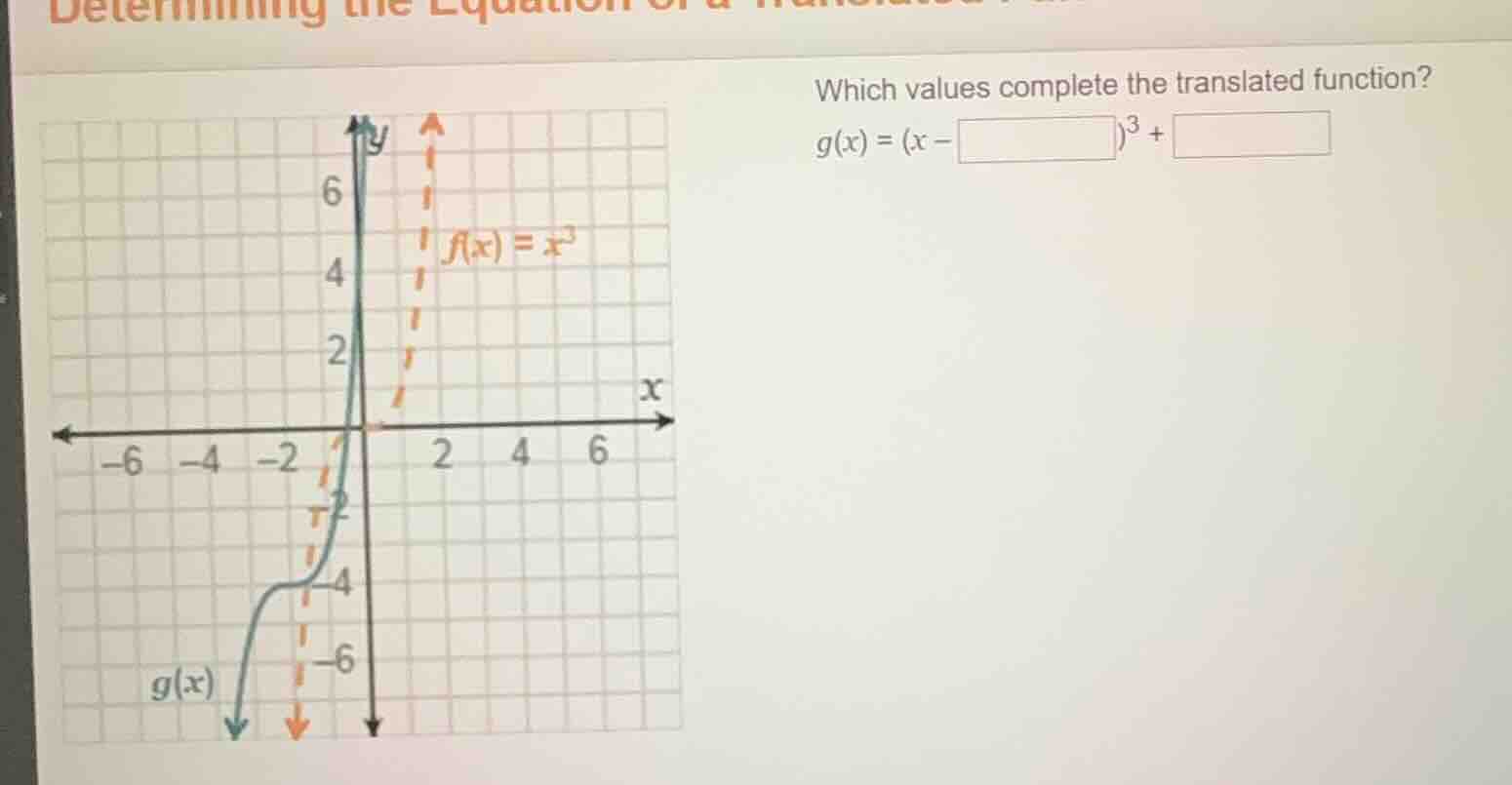
which values complete the translated function?
g(x) = (x − \square)^3 + \square
(graph shows f(x) = x³ (dashed) and g(x) (solid) with grid, axes, and coordinates)
Step1: Analyze horizontal translation
The parent function is \( f(x) = x^3 \), which has its inflection point at \((0,0)\). The graph of \( g(x) \) is shifted horizontally. For a cubic function \( y=(x - h)^3 + k \), a horizontal shift of \( h \) units (right if \( h>0 \), left if \( h<0 \)) occurs. Looking at the dashed line (original inflection point line) and the new graph, the inflection point of \( g(x) \) is at \( x=-1 \)? Wait, no, wait. Wait, the dashed line is at \( x = -1 \)? Wait, no, the grid: let's check the x - coordinate of the inflection point of \( g(x) \). Wait, the parent function \( f(x)=x^3 \) has inflection at (0,0). The graph of \( g(x) \) is shifted left or right? Wait, the dashed vertical line is at \( x=-1 \)? Wait, no, looking at the graph, the original \( f(x)=x^3 \) (dashed) has its inflection at (0,0), and the \( g(x) \) (solid) has its inflection shifted left? Wait, no, the formula is \( g(x)=(x - h)^3 + k \). If the inflection point of \( g(x) \) is at \( (h,k) \). Let's find the inflection point of \( g(x) \). From the graph, the inflection point (where the curve changes concavity) of \( g(x) \) is at \( (-1, -4) \)? Wait, no, let's look at the coordinates. Wait, the solid graph \( g(x) \): when x = -1, what's the behavior? Wait, maybe I made a mistake. Wait, the parent function \( f(x)=x^3 \) is the dashed curve, which passes through (0,0), (1,1), (-1,-1). The solid curve \( g(x) \) is shifted. Let's find the horizontal shift: the inflection point of \( g(x) \) is at \( x = -1 \)? Wait, no, the formula is \( (x - h) \), so if the inflection point is at \( x = h \), \( y = k \). So for \( g(x)=(x - h)^3 + k \), the inflection point is (h,k). Let's find h and k. From the graph, the inflection point of \( g(x) \) is at (-1, -4)? Wait, no, let's check the graph again. Wait, the solid curve: when x = -1, what's y? Wait, maybe the inflection point is at (-1, -4)? Wait, no, let's see the horizontal shift: the parent function \( f(x)=x^3 \) has inflection at (0,0). The \( g(x) \) is shifted left by 1 unit? Wait, no, if we shift left by 1, the function would be \( (x + 1)^3=(x - (-1))^3 \), so h = -1? Wait, no, the formula is \( (x - h) \), so if we shift left by 1, h = -1. Then the vertical shift: the inflection point of \( g(x) \) is at y = -4? Wait, from the graph, the inflection point (the center of the cubic) of \( g(x) \) is at (-1, -4). So h = -1, k = -4? Wait, no, that can't be. Wait, maybe I messed up. Wait, let's take a point. Let's find a point on \( g(x) \). Let's see, when x = 0, what's g(0)? From the graph, g(0) is 0? No, the solid graph passes through (0,0)? Wait, no, the solid graph passes through (0,0)? Wait, the solid graph crosses the y - axis at (0,0)? Wait, the dashed graph \( f(x)=x^3 \) also passes through (0,0). Wait, maybe the vertical shift is different. Wait, no, maybe the horizontal shift is -1 (left 1) and vertical shift is -4? Wait, no, let's re - express. The general form of a cubic function after horizontal shift h and vertical shift k is \( g(x)=(x - h)^3 + k \), where (h,k) is the inflection point. Let's find (h,k) for \( g(x) \). From the graph, the inflection point (the point where the curve changes from concave down to concave up) of \( g(x) \) is at (-1, -4). So h = -1, k = -4? Wait, no, that would make \( g(x)=(x - (-1))^3 + (-4)=(x + 1)^3 - 4 \). Let's check if this matches the graph. Let's plug x = -1: \( (-1 + 1)^3 - 4=0 - 4=-4 \), which matches the inflection point. Plug x = 0: \( (0 + 1)^3 - 4=1 - 4=-3 \)? Wait, but the graph at x = 0: the solid line passes throu…

Snap & solve any problem in the app
Get step-by-step solutions on Sovi AI
Photo-based solutions with guided steps
Explore more problems and detailed explanations
First blank: \(-1\), Second blank: \(-4\)