QUESTION IMAGE
Question
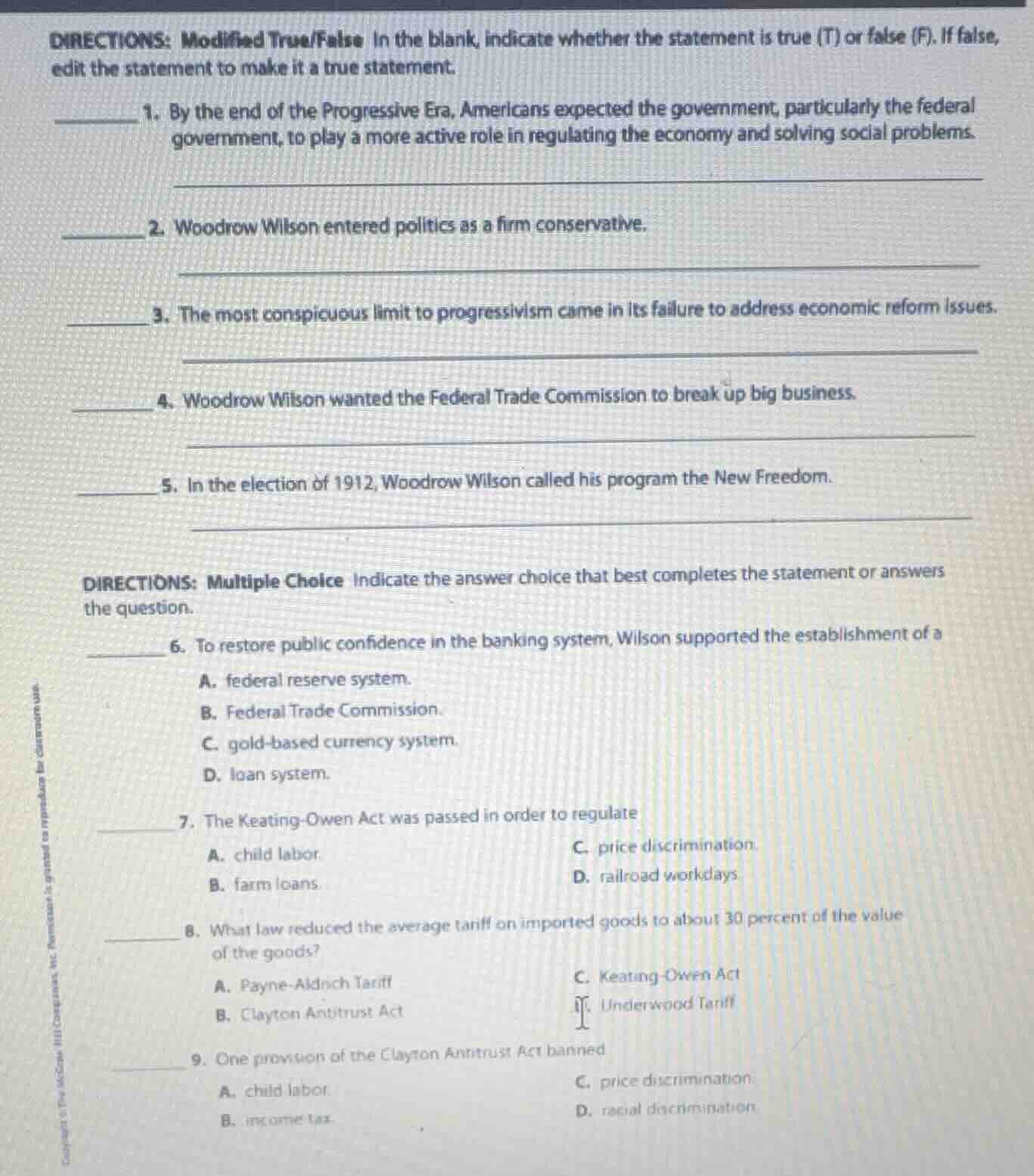
directions: modified true/false in the blank, indicate whether the statement is true (t) or false (f). if false, edit the statement to make it a true statement.
- by the end of the progressive era, americans expected the government, particularly the federal government, to play a more active role in regulating the economy and solving social problems.
- woodrow wilson entered politics as a firm conservative.
- the most conspicuous limit to progressivism came in its failure to address economic reform issues.
- woodrow wilson wanted the federal trade commission to break up big business.
- in the election of 1912, woodrow wilson called his program the new freedom.
directions: multiple choice indicate the answer choice that best completes the statement or answers the question.
- to restore public confidence in the banking system, wilson supported the establishment of a
a. federal reserve system.
b. federal trade commission.
c. gold - based currency system.
d. loan system.
- the keating - owen act was passed in order to regulate
a. child labor
c. price discrimination.
b. farm loans.
d. railroad workdays.
- what law reduced the average tariff on imported goods to about 30 percent of the value of the goods?
a. payne - aldrich tariff
c. keating - owen act
b. clayton antitrust act
d. underwood tariff
- one provision of the clayton antitrust act banned
a. child labor.
c. price discrimination
b. income tax.
d. racial discrimination
- The Progressive Era expanded federal government's regulatory and social role, so the statement is true.
- Woodrow Wilson entered politics as a progressive, not a conservative.
- Progressivism's major limit was failing to address racial injustice, not economic reform.
- Wilson designed the FTC to regulate, not break up, big business.
- Wilson's 1912 campaign platform was explicitly called the New Freedom.
- The Federal Reserve System was created under Wilson to stabilize banking.
- The Keating-Owen Act targeted child labor practices.
- The Underwood Tariff reduced average import tariffs to ~30%.
- The Clayton Antitrust Act included a ban on price discrimination.

Snap & solve any problem in the app
Get step-by-step solutions on Sovi AI
Photo-based solutions with guided steps
Explore more problems and detailed explanations
- T
- F; Woodrow Wilson entered politics as a firm progressive.
- F; The most conspicuous limit to progressivism came in its failure to address racial injustice.
- F; Woodrow Wilson wanted the Federal Trade Commission to regulate big business.
- T
- A. federal reserve system.
- A. child labor.
- D. Underwood Tariff
- C. price discrimination.